
Which Broiler Chicken Farming Equipment Manufacturer Fits Your Farm Scale?
TIME
Click count
The manufacturer that fits a broiler operation is not necessarily the one offering the highest automation level or the lowest equipment quote. The right fit is the supplier whose house design, production capacity, component quality, control system, installation capability, and service reach match the farm’s present operating model and its credible expansion path.
A small independent farm can lose money by purchasing a complex system it cannot maintain locally. A multi-house operation can lose far more by selecting low-cost equipment that creates uneven feed access, poor air distribution, recurring controller faults, or spare-part delays. The practical question is not simply which manufacturer is “best,” but which manufacturer can support the required performance at the farm’s scale without creating avoidable operational dependency.
Farm scale changes what “good equipment” means
Broiler equipment is an operating system rather than a collection of separate products. Feed lines, drinker lines, ventilation, heating, cooling, lighting, sensors, alarms, and controllers affect bird comfort and flock uniformity together. A manufacturer may supply strong individual components while offering weak integration, incomplete engineering support, or limited parts availability. That difference becomes more important as the number of houses, bird density, and daily management complexity increase.
Farm scale should be assessed through operating complexity, not bird numbers alone. Relevant indicators include the number and dimensions of houses, annual flock cycles, local climate, labor availability, power reliability, biosecurity requirements, and whether expansion will use the same site or additional locations. A farm with one long house in a hot climate may need more capable ventilation engineering than a larger farm in a moderate climate with naturally favorable conditions.
For smaller farms, choose repairable systems over excessive automation
For a single house or a modest family-operated unit, the baseline requirement is dependable feed and water delivery, adequate ventilation, proper lighting, and equipment that can be cleaned and serviced between cycles. Equipment that is mechanically simple is not automatically inferior. In many locations, a straightforward feeder line, nipple drinker system, curtain or inlet arrangement, and basic environmental controller can be more suitable than an advanced platform that depends on proprietary sensors, specialized technicians, or imported replacement boards.
The key is to avoid confusing low specification with appropriate simplicity. Even a basic package should demonstrate sound engineering in areas that directly affect flock conditions:
- Feed pans should be height-adjustable and suitable for chicks as well as finishing birds.
- Drinker lines should include reliable pressure regulation, flushing capability, and materials suited to water quality and cleaning chemicals.
- Motors, gearboxes, augers, and suspension parts should have clearly identified specifications rather than generic descriptions.
- Fans should be selected against house dimensions and ventilation requirements, not supplied as an arbitrary quantity.
- Electrical controls should include basic alarm provisions and manual override options where appropriate.
A smaller farm should be cautious when a supplier proposes a fully integrated environmental control package without confirming the quality of local electrical supply, availability of trained operators, and response time for technical faults. Automation can reduce routine labor, but it also shifts risk toward sensors, controllers, communications, and spare electronics. If the supplier cannot state how a failed controller, sensor, motor, or actuator will be replaced during an active flock cycle, the quoted system may be operationally fragile.
Manufacturers serving this segment should be evaluated on standardization. Widely available motors, fittings, switches, and common mechanical parts reduce downtime exposure. The best proposal is often modular: start with durable core equipment, reserve electrical capacity and physical space for future upgrades, and avoid rebuilding the house when more automation becomes justified.
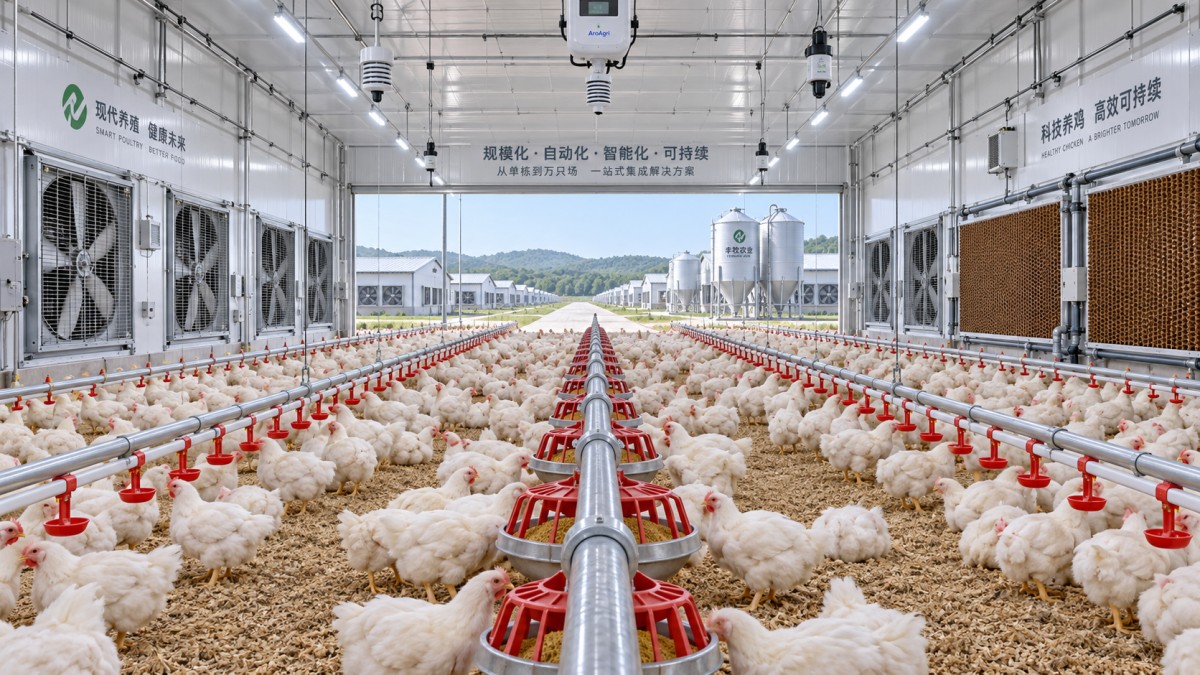
A growing multi-house farm needs system consistency, not just more units
Once several houses are operating, management weaknesses become harder to correct through manual observation. Differences in feed distribution, water pressure, inlet adjustment, sensor calibration, or fan performance can produce inconsistent house conditions. The cost is not limited to maintenance hours; uneven environments can complicate flock management and make performance comparisons between houses less meaningful.
At this stage, the appropriate broiler chicken farming equipment manufacturer should be able to provide a coordinated house package rather than a shipment of unrelated equipment. That does not mean every component must come from one factory. It means one party must take responsibility for confirming interfaces, load requirements, control logic, installation drawings, and commissioning sequence.
Questions that reveal whether a supplier has this capability include:
- Can it provide a layout showing feeder and drinker line spacing, winching points, inlet positions, fan locations, sensors, control panels, and service clearances?
- Does the ventilation calculation account for the actual house width, length, ceiling profile, insulation level, local temperature range, and intended stocking program?
- How are fan stages, inlet actuation, cooling pads, heating equipment, and alarms coordinated by the controller?
- Are wiring diagrams, cable schedules, and electrical load data supplied before installation?
- Can the farm add houses later while retaining compatible controllers, communication protocols, and spare-parts inventory?
Phased automation is often sensible for this scale. Automatic feed delivery and nipple drinking systems are usually foundational. Environmental control may then be expanded from timer-based operation to sensor-driven control, followed by remote monitoring where local support and connectivity are adequate. The sequence should follow management needs, not a supplier’s catalogue hierarchy.
Durability deserves closer scrutiny as farms scale. Galvanized steel quality, corrosion protection, plastic formulation, bearing protection, fan shutter design, cable protection, and water-line sealing are not cosmetic details. Poultry houses combine dust, humidity, corrosive gases, pressure washing, disinfectants, and repeated mechanical movement. A lower initial quote can become expensive if suspension components corrode early, fan assemblies become difficult to balance, or plastic parts degrade under cleaning and heat exposure.
Large operations should assess manufacturers as engineering and service partners
For large commercial farms, contract growing networks, and integrated poultry businesses, equipment selection becomes a continuity-of-operations decision. The equipment must deliver environmental control reliably across multiple houses, support standard operating procedures, and allow managers to identify deviations before they become major losses. A manufacturer that is acceptable for a small farm may not have the project controls or service structure needed at this level.
Large-scale procurement should examine four linked capabilities: engineering, manufacturing control, deployment, and lifecycle support.
Engineering capability is demonstrated through more than sales drawings. The supplier should define design assumptions, ventilation targets, airflow paths, fan performance conditions, cooling-pad sizing, heating integration, sensor locations, and emergency operating modes. In tunnel-ventilated houses, for example, fan capacity on paper is not enough. Air leakage, inlet design, house tightness, obstruction, and fan performance under real static pressure all influence whether air moves as intended.
Manufacturing control concerns repeatability. Large projects need consistent specifications across batches and houses. Procurement documents should identify material grades where relevant, coating requirements, motor data, controller versions, electrical enclosure ratings, and acceptable substitutions. If a supplier reserves the right to make broad substitutions without written approval, the delivered system may no longer match the evaluated design.
Deployment capability includes packing discipline, export documentation, installation supervision, commissioning, and handover records. Equipment may arrive in separate shipments or be installed by local contractors. Clear labeling, assembly manuals, wiring documents, and a defined responsibility matrix reduce the risk of disputes between the equipment supplier, civil contractor, electrical contractor, and farm operator.
Lifecycle support should be tested before contract award. Ask for a recommended two-year spare-parts list, lead times for critical items, warranty exclusions, remote diagnostic arrangements, escalation contacts, and terms for software or controller updates. The need is not merely fast technical support; it is a service model that distinguishes between a non-critical component issue and a failure that threatens ventilation, water availability, feeding, or alarm function.
Do not compare quotations until the scope is normalized
Manufacturer quotations frequently appear comparable when they are not. One quote may include feed bins, boot augers, winching systems, control panels, sensors, installation tools, and commissioning support; another may cover only the internal lines. A lower-priced offer can therefore conceal missing equipment or responsibilities that later return as variation costs.
A normalized comparison should separate the proposal into functional packages: feeding, drinking, ventilation, cooling, heating, environmental controls, lighting, electrical works, structural supports, installation, training, spare parts, and logistics. For each package, identify quantities, specifications, inclusions, exclusions, warranty terms, and delivery responsibility.
It is especially important to clarify the boundary between equipment and building works. Fan openings, cooling-pad frames, floor slopes, water filtration, drainage, electrical distribution, backup generation, and house sealing may fall outside the equipment supplier’s scope. Yet each can determine whether the equipment performs correctly. A manufacturer should state the site conditions required for its performance assumptions, rather than treating building readiness as someone else’s problem.
Controls, power resilience, and water quality can invalidate an otherwise sound choice
Broiler-house automation is often evaluated by screen features: remote access, data logging, programmable stages, and alarms. These functions have value only when the control architecture fits site conditions. A farm exposed to unstable grid power needs an integrated approach to backup generation, automatic transfer arrangements, alarm power, and restart behavior after an outage. A controller that resumes incorrectly, loses settings, or cannot trigger clear alarm escalation may create greater risk than a less sophisticated but dependable system.
Water conditions require the same discipline. High mineral content, sediment, iron, or microbiological contamination can affect regulators, nipples, filters, and medication systems. Equipment manufacturers should specify filtration, flushing, and pressure requirements. If a supplier does not ask about water source and quality, its drinker-line recommendation is incomplete.
For connected systems, clarify who owns operating data, whether remote access depends on recurring subscriptions, how software updates are managed, and whether local control remains available if internet service fails. These issues are particularly relevant when equipment will remain in operation for many production cycles.
Verify compliance through documents relevant to the destination market
Compliance should not be reduced to a generic request for “all certificates.” Requirements vary with the importing country, the equipment category, electrical configuration, and the contractual specification. Electrical panels, motors, heaters, control systems, and pressure-related components may be subject to different conformity expectations than mechanical feeders or drinker lines.
For shipments into markets where CE marking applies, the relevant equipment and documentation must meet the applicable legal requirements; a CE logo on a brochure is not evidence by itself. Importers should request declarations, technical documentation where contractually appropriate, electrical component data, and labeling samples tied to the offered configuration. Where local electrical codes or third-party certification schemes apply, those requirements should be stated in the purchase specification before supplier selection.
Documentation also matters for customs clearance and installation: commercial invoice, packing list, origin documentation where needed, manuals, wiring diagrams, and parts lists should use consistent product descriptions and model references. A mismatch between quotation, invoice, labels, and manuals creates unnecessary import and warranty complications.
The recommendation should be conditional, not brand-led
When asked to recommend a broiler chicken farming equipment manufacturer, the most defensible answer is a conditional one. Recommend a manufacturer of robust, modular systems when the farm is building its first controlled house and depends on local mechanical support. Recommend a supplier with integrated layout and commissioning capability when multiple houses require comparable conditions and gradual automation. Recommend an engineering-led manufacturer with formal project management, control-system support, and critical-spares planning when downtime across a large operation carries material operational risk.
Before issuing a purchase order, require a final technical clarification that records house dimensions, climate assumptions, capacity basis, component models, electrical requirements, exclusions, delivery terms, commissioning obligations, acceptance criteria, warranty coverage, and spare-parts commitments. That document is more valuable than a broad claim of superior quality. It turns a catalogue comparison into a decision about whether the manufacturer can reliably support the farm that will actually be built.
Recommended News
- How to Specify Energy-Efficient Poultry Ventilation for Broiler HousesSep 20, 2026Energy efficient poultry ventilation systems: learn how to specify fans, inlets, controls, and cooling for lower energy use, healthier broilers, and reliable airflow.
- Which Broiler Chicken Farming Equipment Manufacturer Fits Your Farm Scale?Sep 16, 2026Recommend a broiler chicken farming equipment manufacturer by matching automation, reliability, engineering support, and service to your farm scale.
- Layer Cage Selection Criteria for Small-Scale Poultry Farms in NigeriaSep 12, 2026poultry cages for sale in Nigeria — discover durable, climate-tested layer cages optimized for small-scale farms: corrosion resistance, space efficiency & real-world TCO savings.
- How to Evaluate a Broiler Farming Systems Manufacturer for Large-Scale ProjectsSep 07, 2026Broiler farming systems manufacturer evaluation guide for large projects: compare engineering, durability, lifecycle cost, commissioning, and service with confidence.
- How to Evaluate a Poultry Farming Supplier for Quality and Reliable SupportSep 05, 2026Choose a poultry farming supplier with confidence: compare system fit, build quality, clear scope, documentation, spare parts, and responsive technical support.
- Can Bulldozers Be Adapted for Precision Agriculture Applications?Sep 16, 2026Can bulldozers be converted for precision agriculture applications? Discover how guided grading, soil protection, and data-driven planning improve farm infrastructure.
- REACH Compliance in B2B Market Analysis: Assessing Supplier Risk and Market AccessSep 12, 2026B2B market analysis REACH compliance: assess supplier risk, strengthen evidence controls, and protect EEA market access with practical sourcing insights.
- Analyzing Pressure Ratings in Technical Specifications for Safe Equipment SelectionSep 10, 2026Technical specifications analysis for pressure rating selection: learn how to assess temperature, materials, transients, and connections for safer equipment choices.
- How Often Should Heavy Excavators Be Serviced in Mining Operations?Sep 03, 2026What are the maintenance intervals for heavy excavators in mining? Discover practical service schedules, severe-duty adjustments, oil analysis, and uptime-focused maintenance tips.
- Which mining equipment performance standards matter most on site?Sep 03, 2026Mining equipment performance industry standards: assess availability, payload, fuel efficiency, durability, and safety to improve on-site productivity.
- Prefab Building Cost Factors: How to Budget for Design, Transport, and Site WorkSep 17, 2026Explore prefab building cost factors and learn how to budget smarter for design, transport, foundations, utilities, installation, and approvals.
- Which Emerging Destinations Offer the Best Manufacturing Tax Incentives in 2026?Sep 03, 2026What emerging destinations offer the best manufacturing tax incentives 2026? Compare Vietnam, India, Morocco, Egypt, and Gulf zones for tax, duty, and export advantages.
- Can Data Analysis Tools Detect Supplier Fraud in Procurement Data?Sep 03, 2026Can data analysis tools detect supplier fraud in procurement data? Discover key red flags, analytics methods, and practical controls to investigate risks sooner.
- What are the current pricing structures for industrial automation solutions?Sep 03, 2026What are the current pricing structures for industrial automation solutions? Compare upfront, subscription, usage-based, RaaS, and lifecycle costs to make smarter investment decisions.
- How German bulk pricing changes the cost of industrial machinerySep 03, 2026Industrial machinery and supplies price list and bulk purchase costs in Germany: uncover real savings across equipment, logistics, service, and compliance.
All Categories
Hot Articles
- Eco Construction for Warehouses: How to Cut Energy Use Without Disrupting OperationsSep 22, 2026Eco construction for warehouses: cut energy use with phased upgrades, smarter controls, and resilient materials—without disrupting logistics or daily operations.
- How Distributors Can Select Digital Marketing Software That Integrates With Their Sales ProcessSep 21, 2026Digital marketing software for distributors: learn how to select an integrated platform that improves lead routing, sales follow-up, account data, and measurable commercial results.
- How to Specify Energy-Efficient Poultry Ventilation for Broiler HousesSep 20, 2026Energy efficient poultry ventilation systems: learn how to specify fans, inlets, controls, and cooling for lower energy use, healthier broilers, and reliable airflow.