
Matching Poultry Feeding and Drinking Equipment to Flock Size
TIME
Click count
A feeder or drinker system should be sized for the birds that must use it at the most demanding stage of production, not simply for the number placed in the house. Flock size is the starting point. Bird type, market weight, usable floor area, feeding behavior, water supply, and equipment layout determine whether that nominal capacity is usable.
For technical evaluators, the key distinction is between installed capacity and accessible capacity. A house may contain enough feeding pans on paper while leaving an occupied brooding area short of feeding positions. A drinking system may have sufficient nipples but inadequate delivery at the far end of a line. Selection therefore needs two checks: enough access points for the flock and enough supply capacity to serve those points under operating conditions. Poultry management guidance treats equipment availability, distribution, and adjustment as connected requirements.[1][2]
Define the flock and housing conditions before comparing equipment
“Equipment for a poultry flock” is too broad a procurement specification. Broilers, replacement pullets, commercial layers, and breeders have different feeding arrangements and management requirements. A floor-reared broiler house cannot be evaluated using the same access assumptions as a layer cage installation. Breeder systems may also require controlled feed allocation and separate arrangements for males and females.[1][2][3]
The design brief should identify the maximum birds present in each production phase, their expected age and weight range, and the housing system. Include partial-house brooding, partitions, thinning plans, and any proposed expansion. A single flock total can conceal several different equipment requirements over the production cycle.
Record the physical constraints just as carefully: house length, internal obstructions, floor slope, service access, available headroom, and the position of feed and water entry points. Utility information should cover water-source capacity, supply-pressure variation, electrical availability, and the proposed backup arrangements.
Capacity assumptions should come from the relevant bird-management guide and the selected equipment manufacturer’s documented application limits. Where those recommendations differ, the discrepancy needs resolution before ordering. A quoted birds-per-pan figure without a stated bird category, production stage, and operating condition is not a sufficient design basis.
Size feeding access separately from feed delivery
Feeding systems have two capacities that are easily confused: the number of birds that can use the feeding equipment and the quantity of feed that the distribution system can deliver. Increasing auger throughput does not correct inadequate feeder access. Adding pans does not resolve an undersized feed transfer system.
Calculate the required access, then test the layout
For pan systems, the initial calculation is the design flock divided by the approved birds-per-pan allowance, rounded up to a whole pan. For trough systems, divide the flock’s required accessible feeding length by the usable feeding length of each section. These are counting methods, not universal stocking recommendations; the allowance must match the bird and equipment application.[1][2][3]
Do not count inaccessible equipment. Trough length obstructed by supports, end fittings, or partitions may not provide usable feeding space. Likewise, equipment outside an occupied brooding zone cannot serve chicks inside it. The drawing should show feeding access within each management zone, rather than only a total for the building.
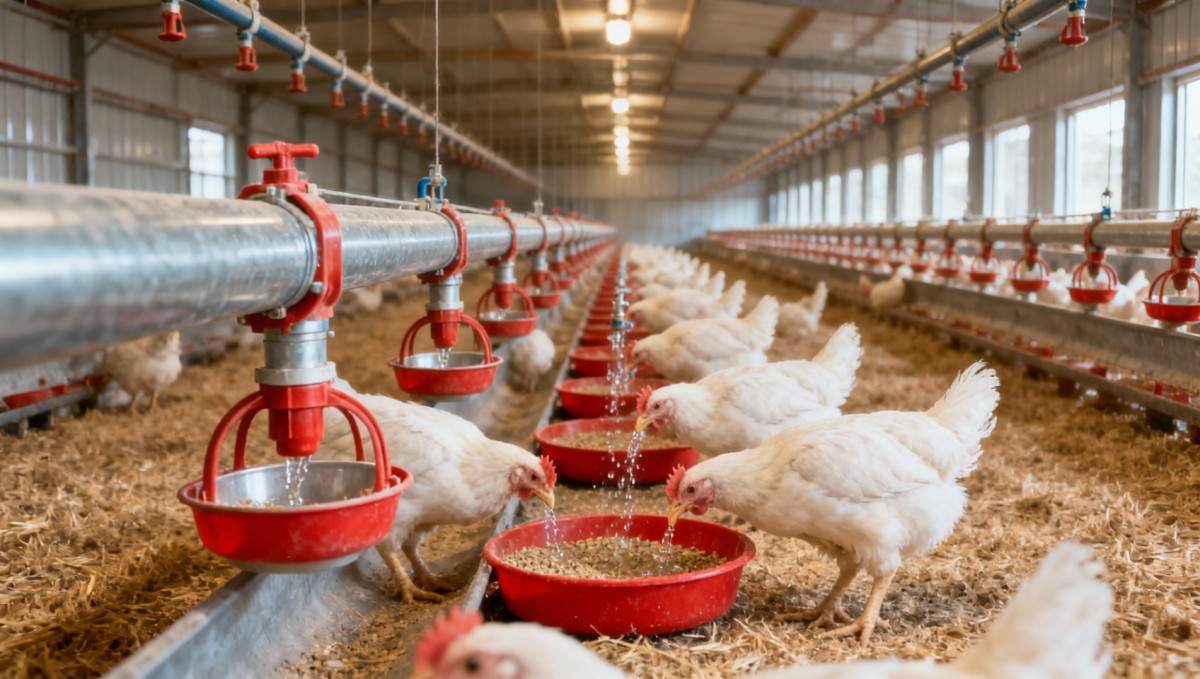
Pan diameter alone is an incomplete comparison. Evaluation should include the usable feeding perimeter, grill configuration, feed-depth adjustment, suitability for young birds, and the height range available as the flock grows. Those details affect how the equipment can be managed across the cycle; they should be checked against the manufacturer’s instructions rather than inferred from photographs.
Check distribution performance under the intended feeding program
Request feed-delivery capacity for the proposed line length and configuration, including transfer points and relevant feed characteristics. A motor rating by itself does not establish delivered throughput. Ask how the system behaves during initial filling, normal replenishment, and restart after an interruption.
The feeding program changes the importance of these questions. In a controlled-allocation system, the distribution sequence must support the intended feeding schedule and uniformity of access. In an ad-libitum system, the evaluator should still examine whether remote pans can be replenished reliably. Manufacturer data and the applicable bird-management guidance should support the proposed operating sequence.[1][2]
Bulk storage belongs in the calculation too. Define storage capacity from expected consumption, delivery frequency, and the farm’s contingency policy. State whether the proposal includes usable storage volume, transfer equipment, level indication, and provisions for changing diets without unintended mixing.
Evaluate drinking systems as a hydraulic network
Counting drinkers is necessary, but the water system must also deliver suitable flow throughout the occupied house. Nipple availability, line pressure, drinker height, and water management are interdependent in poultry husbandry guidance.[1][2]
The initial drinker count follows the same principle as feeder sizing: divide the design flock by the application-specific birds-per-drinker allowance and round up. Then check distribution in each occupied zone. Avoid applying a ratio from another bird type, nipple design, or management system without supporting documentation.
The hydraulic review should cover the complete route from the water source to the most remote drinker:
- Source and storage: available supply during the design demand period and the planned response to an interruption.
- Treatment and controls: filtration, dosing equipment, meters, valves, and their pressure or flow requirements.
- Distribution: header size, line length, elevation changes, regulators, and sectional isolation.
- End points: drinker performance at the specified operating pressure, plus flushing and drainage arrangements.
Use a demand profile appropriate to the bird type and operating environment, not daily consumption divided evenly across the day. Confirm whether other users, such as cooling equipment, draw from the same supply. The design submission should explain which demands are assumed to occur together and provide the calculation supporting the selected pipes and controls.
For nipple lines, request the supplier’s pressure-setting method and flow-test procedure. Acceptance testing should compare representative positions, including the remote end of the system, under a defined operating condition. A satisfactory reading near the inlet alone does not establish performance across the house.
Higher pressure should not be treated as an automatic remedy for inadequate delivery. Pressure, nipple operation, adjustment, and leakage must be assessed together. Poultry management manuals link drinking-system management with water availability and litter condition; adjustments should follow the equipment instructions and flock requirements.[1][2]
Match system complexity to flock size and operating resources
A smaller flock does not automatically justify manual equipment, nor does a larger flock automatically justify every available automation feature. Compare the work required per feeding cycle, inspection round, cleaning period, and equipment adjustment. Include the skills and spare parts needed to keep the proposed system operational.
Expansion deserves a separate design case. A larger main supply may accommodate future demand, but future birds still require additional usable feeding and drinking positions. Ask which components can remain, which need extension, and which would require replacement. “Expandable” should be supported by a revised layout and capacity calculation.
Build a complete equipment list around interfaces
A complete poultry farm equipment list should distinguish the feeding and drinking package from the infrastructure that makes it work. Otherwise, quotations may appear comparable while excluding different components.
A complete-farm equipment reference, such as view poultry equipment details, can help structure the component review. It does not establish suitability for a particular flock; that requires a house-specific equipment schedule, drawings, and documented operating limits.
The project schedule should identify the following scope, with exclusions stated explicitly:
- Feed handling: storage, unloading interface, transfer augers, hoppers, distribution lines, feeders, drives, controls, and suspension components.
- Water delivery: storage where required, pumps, filtration, dosing interface, meters, regulators, drinker lines, flushing outlets, and isolation valves.
- Housing support: ventilation, environmental controls, lighting, heating or brooding equipment, and any cooling system that shares utilities.
- Production-specific equipment: nests, perches, egg handling, cage or aviary components, and manure handling where applicable.
- Operational support: electrical distribution, alarms, backup provisions, cleaning equipment, initial spares, manuals, and maintenance tools.
Assign responsibility for every interface. Who supplies the pipe between the storage tank and the drinker control panel? Who provides cable protection, structural attachment points, and commissioning labor? These questions belong in the tender schedule, not in a discussion after delivery.
Use commissioning to verify the capacity assumptions
Acceptance criteria should be agreed before purchase. Begin with document checks: component quantities, model identification, layout dimensions, utility requirements, installation instructions, and a list of locally serviceable parts. Any substitutions should be reviewed against the original design assumptions.
Mechanical inspection should confirm that installed feeder and drinker positions match the drawings, suspension systems permit the required adjustment, and valves and service points remain accessible. Electrical and structural work should be assessed by appropriately qualified personnel against the requirements applicable at the installation location; a generic equipment description cannot establish local compliance.
Functional testing should use agreed procedures. For feed equipment, document filling sequence, replenishment, control response, and operation of remote sections. For drinking equipment, record supply conditions, regulator settings, representative delivery measurements, leakage observations, and flushing operation. Repeat relevant checks under the defined simultaneous-demand condition.
Keep installation acceptance separate from early-flock monitoring. Commissioning can verify equipment operation, but bird access and management adjustments still need observation after placement. The handover plan should specify who reviews feed availability, water use, equipment height, and uneven use of the house, using the applicable management guide.[1][2][3]
The defensible selection is the one whose capacity can be traced from flock requirements through access calculations, layout, utility demand, and field verification. If a quotation provides only a bird-count label and an equipment total, the technical evaluation is not yet complete.
Sources
[1] Aviagen, Ross Broiler Management Handbook, 2018. Reference for broiler feeding access, drinking systems, housing preparation, and management adjustments.
[2] Cobb-Vantress, Cobb Broiler Management Guide. Reference for broiler feed and water systems, equipment distribution, and operating management. Application should follow the edition relevant to the flock program.
[3] Hy-Line International, Hy-Line Brown Commercial Layers Management Guide. Reference for production-stage equipment requirements and layer management. Requirements should be checked against the relevant housing system and regional edition.
Recommended News
- Matching Poultry Feeding and Drinking Equipment to Flock SizeOct 27, 2026view poultry equipment details to match feeders and drinkers to your flock size. Compare access, feed delivery, and water capacity to make a confident purchase.
- Matching Poultry Farm Equipment Capacity to Housing and Flock SizeOct 21, 2026Match Taiyu(HK) poultry farm equipment to your housing and flock size. Discover how to size feeding, water, and ventilation systems to avoid bottlenecks and invest with confidence.
- Comparing Layer Battery Cage Quotes in Nigeria: What Is Included?Oct 21, 2026Planning to buy poultry cage in nigeria? Compare layer cage quotes, uncover hidden costs, and check delivery, installation and warranty details before choosing your supplier.
- Battery Cage Size Guide: Stocking Density, Welfare Rules, and Farm LayoutOct 09, 2026Battery cage size guide for calculating stocking density, usable area, welfare compliance, and efficient farm layouts. Plan safer, audit-ready hen housing today.
- Where Semi-Automatic Poultry Farms Fit Between Manual and Smart SystemsOct 09, 2026Semi automatic poultry farm solutions bridge manual labor and smart systems, improving feeding, watering, waste handling, and control. Explore the right upgrade path for your farm.
All Categories
Hot Articles
- Sourcing-Oriented Content Review: How to Verify Supplier ClaimsOct 30, 2026Sourcing-oriented content review helps you verify supplier claims, assess certificates and specifications, and reduce purchasing risks before placing an order.
- TrendForce: Seasonal Slowdown Puts Solar Supply Chain Prices Under PressureOct 30, 2026Solar supply chain prices face seasonal pressure. Explore TrendForce’s analysis of polysilicon oversupply, wafer inventories and stabilizing cell prices.
- Product Safety for Green Materials: Selecting Chemical Tests by End UseOct 29, 2026Product safety for green materials starts with end use. Learn how to select emissions, migration, and chemical tests to close evidence gaps and support credible safety claims.