
Comparing Layer Battery Cage Quotes in Nigeria: What Is Included?
TIME
Click count
A low layer cage quotation may cover only the cage structure, while a higher offer includes drinkers, feed troughs, installation materials and delivery to the farm. Neither price is meaningful until the scope is clear. For procurement teams in Nigeria, the practical comparison is the cost of a complete, usable installation—not simply the advertised price per cage or bird.
A comparable quotation should identify the cage configuration, capacity assumptions, material specification, included equipment, delivery boundary and commissioning responsibilities. It should also state exclusions. Building modifications, water storage, electrical work, unloading and installation can otherwise become separate costs after the purchase order has been approved.
Start with the same farm specification
Before requesting prices, issue a common specification to every bidder. Include the proposed flock size, bird strain, available house dimensions, operating model and intended level of automation. State whether the project involves a new building or an existing poultry house. A supplier designing around an empty site is solving a different problem from one fitting cages between existing columns.
For buyers planning to buy poultry cage in nigeria, a layer battery cage system is one equipment category to assess against the farm’s layout and operating requirements. A product description can establish the system type, but the quotation and approved drawings must establish exactly what will arrive.
Define ambiguous terms before comparing totals. “One set” could mean a single cage compartment, a multi-tier section, a complete row or a larger assembly. Ask each supplier to express quantities in the same units: rows, sections per row, tiers, compartments and proposed birds per compartment.
Capacity also needs a stated basis. Request usable compartment dimensions and the proposed stocking calculation rather than accepting a headline bird count. Check that calculation against the selected strain’s management guidance and any applicable requirements or customer welfare commitments. Housing and equipment recommendations should be checked against a relevant reference, such as the Hy-Line Brown Commercial Layers Management Guide, rather than inferred from supplier capacity claims alone.
Separate the cage structure from the operating package
The most useful quotation is an itemized bill of quantities linked to a drawing. A package described as “complete” should still show which components are included, their quantities and the limits of supply.
For a manually operated farm, a simpler package may be appropriate. However, the buyer should budget for the associated labor and handling arrangements. An automated offer deserves the opposite scrutiny: motors, controls, wiring interfaces and protection devices need explicit scope boundaries. The word “automatic” does not establish which farm operations are actually mechanized.
Ask for measurable material specifications
“Galvanized cage” is too broad a description for technical comparison. Request the base material, wire dimensions, frame sections, coating process and the supplier’s declared coating specification. Ask which components receive that treatment; mesh, frames and fasteners may not share the same specification.
These details provide a basis for checking delivered goods against the order. They do not, by themselves, establish service life. Farm conditions, cleaning methods, manure exposure and maintenance also need consideration. Where bidders claim equivalent durability, request the evidence behind that claim rather than assigning both products the same expected replacement interval.
Sample inspection can address practical questions that photographs leave unanswered: whether doors open properly, cut edges are finished, mesh joints are secure and replacement fittings match. Record the approved sample or drawing revision in the purchasing documents so that acceptance does not depend on memory.
Check the layout before accepting the capacity
A quotation can be internally consistent yet unsuitable for the building. Require a dimensioned layout showing cage rows, working aisles, end clearances, doors, columns, water connections and the proposed manure-handling route. Confirm whether dimensions refer to the cage frame alone or include projecting troughs and egg collection surfaces.
The drawing should account for daily tasks. Can workers inspect birds, reach drinkers, collect eggs and remove equipment for repair? Can feed and manure move without blocking access? A layout that fits geometrically may still create awkward handling or inaccessible maintenance points.
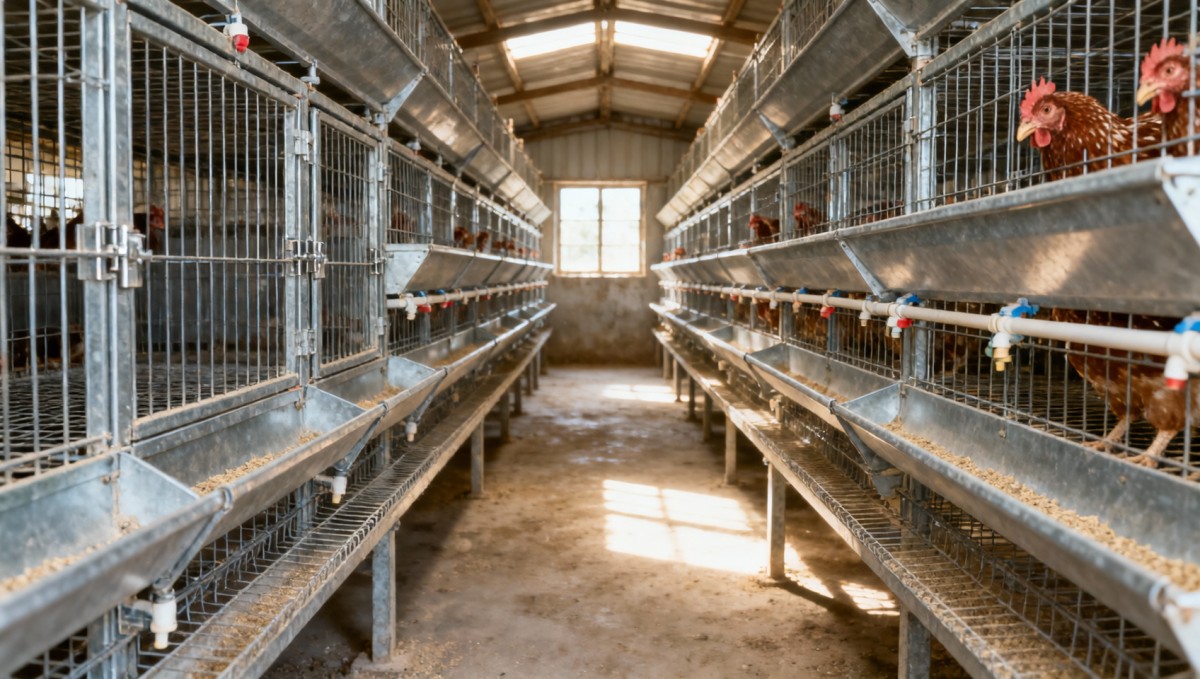
Ventilation must be assessed for the proposed building and cage arrangement, rather than assumed to be adequate because the cages fit. Ask the farm designer to review airflow, bird distribution and heat-management needs. The Hy-Line Brown Commercial Layers Management Guide discusses ventilation and environmental management as flock-management considerations; it is not a substitute for a site-specific ventilation design.
Also identify civil work before ordering. Floor condition, drainage, support locations and fixing requirements should be reviewed against the equipment drawings. If the supplier requires a particular floor level or foundation arrangement, that requirement belongs in the pre-installation documents, not in instructions received after delivery.
Compare the cost to the farm gate—and to working condition
For an imported cage package, separate the equipment price from transport, import-related charges, inland delivery and installation. For equipment already held in Nigeria, establish whether the offer includes delivery from the warehouse, unloading and assembly. A local invoice does not automatically include those services.
Every bidder should identify the named delivery point and the commercial basis of its price. If an Incoterms rule is used, record the rule, named place or port, and edition. ICC’s Incoterms® 2020 sets out the respective delivery obligations, costs and risk allocation under those rules; the label should not replace a clear written scope.
Do not apply an assumed flat import percentage to every quotation. Request a shipment-specific estimate from the appointed customs broker or logistics provider, showing the classification basis, applicable charges and exclusions. Keep that estimate distinct from confirmed supplier charges.
A purchasing worksheet can use the following structure:
Comparable installed cost = equipment + packing + transport + applicable import charges + inland delivery + unloading + installation + required site work + initial spare parts.
Show currency exposure separately. Record the quotation currency, validity period, payment schedule and exchange-rate assumption used for internal comparison. If bids are converted on different dates or payment milestones, the apparent price difference may reflect the conversion method rather than the equipment.
Unloading deserves its own line. Obtain package dimensions and weights, then confirm access, lifting arrangements and responsibility for damage during handling. “Delivery to farm” should identify the actual handover point and whether unloading is included.
Test the offer against everyday farm use
The operating package should match available labor, utilities and maintenance skills. Ask suppliers to describe the work required during feeding, inspection, egg collection, cleaning and manure removal. This helps procurement distinguish a genuinely suitable system from one whose purchase price excludes substantial operating inputs.
Water-system boundaries are particularly important. Establish the required inlet conditions, filtration arrangements, flushing method and connection point. Ask who supplies the tank, pump, treatment equipment and connecting pipework. The Hy-Line Brown Commercial Layers Management Guide provides management guidance on drinking water and water-system operation; the supplier must still specify the requirements of its own components.
For powered equipment, request connected loads, supply requirements and the proposed response to an outage. Confirm whether backup power, control panels and farm-side cabling are included or excluded. A procurement team should not assume that the farm’s existing electrical installation can support new equipment without review.
Maintenance access and parts compatibility can materially affect the decision. Request a priced spare-parts list identifying component references, availability and expected delivery arrangements. Separate items that can be sourced locally from proprietary parts. A low-cost fitting may become operationally significant if there is no compatible replacement when needed.
Make installation, acceptance and warranty specific
“Installation support included” may mean remote instructions, a visiting supervisor or a full assembly crew. The quotation should specify labor responsibilities, travel and accommodation costs, tools, local assistance and the expected installation sequence. Define what must be ready before the installation team arrives.
Acceptance should follow agreed checks rather than delivery alone. Suitable purchasing checks include:
- Reconciliation of delivered quantities against the packing list and bill of quantities.
- Inspection for transit damage and conformity with agreed material specifications.
- Verification of layout, assembly, door operation and access against approved drawings.
- Water-system flushing, leakage checks and functional checks of included equipment.
- Recorded operating checks for powered feeding, egg collection or manure-handling systems, where supplied.
These are contractual inspection points, not proof of regulatory compliance or a guarantee of flock performance. Any claimed certification or test result should identify its issuer, scope and the equipment covered. Generic certificates should not be treated as evidence for an unidentified shipment.
Warranty wording needs similar precision. Confirm when coverage starts, what constitutes a defect, which parts are excluded and who pays freight or labor for replacements. Distinguish the warranty period from the supplier’s response commitment. A long warranty offers limited purchasing clarity if the replacement process is undefined.
Approve the clearest scope, not simply the lowest total
Build the final comparison around a common technical specification and a common delivery boundary. Mark every item as included, excluded, optional or unresolved. Do not treat a blank cell as zero cost; obtain clarification or carry a clearly labeled allowance.
Keep commercial and technical evaluation connected. A cheaper offer may remain attractive after missing items are priced, while a more expensive package may include equipment the farm does not need. Neither outcome can be judged from price per bird alone.
Before issuing the purchase order, attach the agreed bill of quantities, layout revision, delivery terms, installation scope and acceptance checklist. The decisive question is whether the quotation describes a system the farm can install, operate and maintain within its actual conditions—and whether the contract makes that scope enforceably clear.
Recommended News
- Matching Poultry Farm Equipment Capacity to Housing and Flock SizeOct 21, 2026Match Taiyu(HK) poultry farm equipment to your housing and flock size. Discover how to size feeding, water, and ventilation systems to avoid bottlenecks and invest with confidence.
- Comparing Layer Battery Cage Quotes in Nigeria: What Is Included?Oct 21, 2026Planning to buy poultry cage in nigeria? Compare layer cage quotes, uncover hidden costs, and check delivery, installation and warranty details before choosing your supplier.
- Battery Cage Size Guide: Stocking Density, Welfare Rules, and Farm LayoutOct 09, 2026Battery cage size guide for calculating stocking density, usable area, welfare compliance, and efficient farm layouts. Plan safer, audit-ready hen housing today.
- Where Semi-Automatic Poultry Farms Fit Between Manual and Smart SystemsOct 09, 2026Semi automatic poultry farm solutions bridge manual labor and smart systems, improving feeding, watering, waste handling, and control. Explore the right upgrade path for your farm.
- Layer Battery Cage System Selection: Capacity, Access, and Welfare FactorsSep 22, 2026Poultry cage system selection guide: compare capacity, access, automation, and welfare factors to build a reliable, efficient layer operation.
- Product Safety for Green Materials: Selecting Chemical Tests by End UseOct 29, 2026Product safety for green materials starts with end use. Learn how to select emissions, migration, and chemical tests to close evidence gaps and support credible safety claims.
- CNESA Approves Lithium-Plating Test Standard Project for Energy Storage BatteriesOct 29, 2026CNESA approves a lithium-plating test standard project for energy storage batteries. Explore potential impacts on battery testing, supplier evaluation and procurement.
- TBEA’s 29 New Energy and Power Equipment Products Pass National-Level AppraisalOct 26, 2026TBEA’s 29 new energy and power equipment products reportedly passed national-level appraisal. Explore the results and key checks for smarter procurement decisions.
- Baby Sleeping Bags: Choosing the Right TOG Rating and a Safe FitOct 25, 2026Choosing babysleepingbags? Discover how to match TOG ratings to room temperature, check for a safe fit, and avoid overheating with practical tips to help you shop confidently.
- Eco Building Solutions in the UAE: Estidama vs. Al Sa'fat RequirementsOct 21, 2026Explore eco building solutions UAE projects need. Compare Estidama and Al Sa’fat ratings, technical requirements and compliance evidence to reduce approval risks and choose with confidence.
- Outdoor Furniture Prices by Material: Purchase, Delivery, and Upkeep CostsOct 27, 2026Compare outdoor furniture price by material, including purchase, delivery, and upkeep costs. Discover how to evaluate supplier quotes and choose better long-term value.
- Real-Time Industrial Trend Analysis: Which Indicators Signal Demand Shifts?Oct 23, 2026Use real time industrial trend analysis to spot demand shifts early. Discover how orders, inventory, and factory activity reveal buying signals and guide smarter business decisions.
- Global Sourcing for Procurement: How to Compare Total Landed CostsOct 22, 2026Optimize global sourcing for procurement by comparing total landed costs, from freight and duties to quality risks. Discover how to uncover hidden costs and choose suppliers with confidence.
- How Can Data Analysis Compare Global Supplier Pricing Trends?Oct 12, 2026How to use data analysis to compare global supplier pricing trends? Learn to align quotes, track currency impacts, and compare landed costs for smarter sourcing decisions.
- Vietnam Precast Concrete Market: Demand Drivers, Capacity, and Buyer RisksOct 09, 2026Vietnam precast concrete market insights: assess demand drivers, production capacity, logistics, quality compliance, and buyer risks for smarter sourcing and investment decisions.
All Categories
Hot Articles
- Product Safety for Green Materials: Selecting Chemical Tests by End UseOct 29, 2026Product safety for green materials starts with end use. Learn how to select emissions, migration, and chemical tests to close evidence gaps and support credible safety claims.
- CNESA Approves Lithium-Plating Test Standard Project for Energy Storage BatteriesOct 29, 2026CNESA approves a lithium-plating test standard project for energy storage batteries. Explore potential impacts on battery testing, supplier evaluation and procurement.
- Choosing a Market Trends Dashboard: Data Sources, Coverage, and FreshnessOct 28, 2026Choose a Market Trends dashboard with confidence. Learn how to verify data sources, compare coverage, and assess freshness to find reliable insights for smarter business decisions.