
Where Semi-Automatic Poultry Farms Fit Between Manual and Smart Systems
TIME
Click count
The practical middle ground in poultry farm automation
Commercial poultry farms rarely move from fully manual work directly to a highly connected smart facility. More often, automation is introduced one task at a time: a drinker line replaces hand-filled troughs, feed is distributed mechanically, manure removal becomes scheduled, or environmental controls are added to stabilize house conditions. This middle stage is where semi-automatic operations fit.
A semi-automatic setup is not defined by a single machine. It is an operating model in which repetitive, labor-intensive tasks are mechanized while people still make many daily decisions, perform checks, respond to exceptions, and handle some physical work. It can suit growers who need more consistency than a manual house can reliably provide but do not yet have the capital, power infrastructure, management systems, or flock scale required for a fully integrated smart poultry facility.
The distinction matters because automation choices affect more than labor. They influence flock observation, maintenance workload, biosecurity routines, spare-parts planning, building design, utility reliability, and the level of technical skill required from farm staff. A system that is too simple may create avoidable handling work; one that is too complex may be difficult to operate or repair in a location with limited technical support.
Three operating models, not three fixed equipment packages
Manual, semi-automatic, and smart poultry systems are best understood as points on a spectrum. Individual farms can combine elements of each. A broiler house may use automatic nipple drinkers and mechanical feeding while relying on staff for environmental adjustments, visual flock checks, recordkeeping, and manure management. Another farm may use programmable controllers and sensors but still require people to inspect lines, remove mortality, calibrate equipment, and verify that alarms reflect actual house conditions.
For information-stage buyers, the central question is not whether “automation” is good. It is which tasks create the greatest operational pressure and whether the farm can support the next level of mechanization without introducing new failure points.
What semi-automation usually changes on a commercial farm
In a manual house, labor is often concentrated around recurring physical tasks: carrying feed, filling or checking water systems, moving materials, removing manure, regulating curtains or ventilation equipment, and cleaning areas between flocks. Semi-automation typically targets the tasks that repeat frequently and need a more even routine.
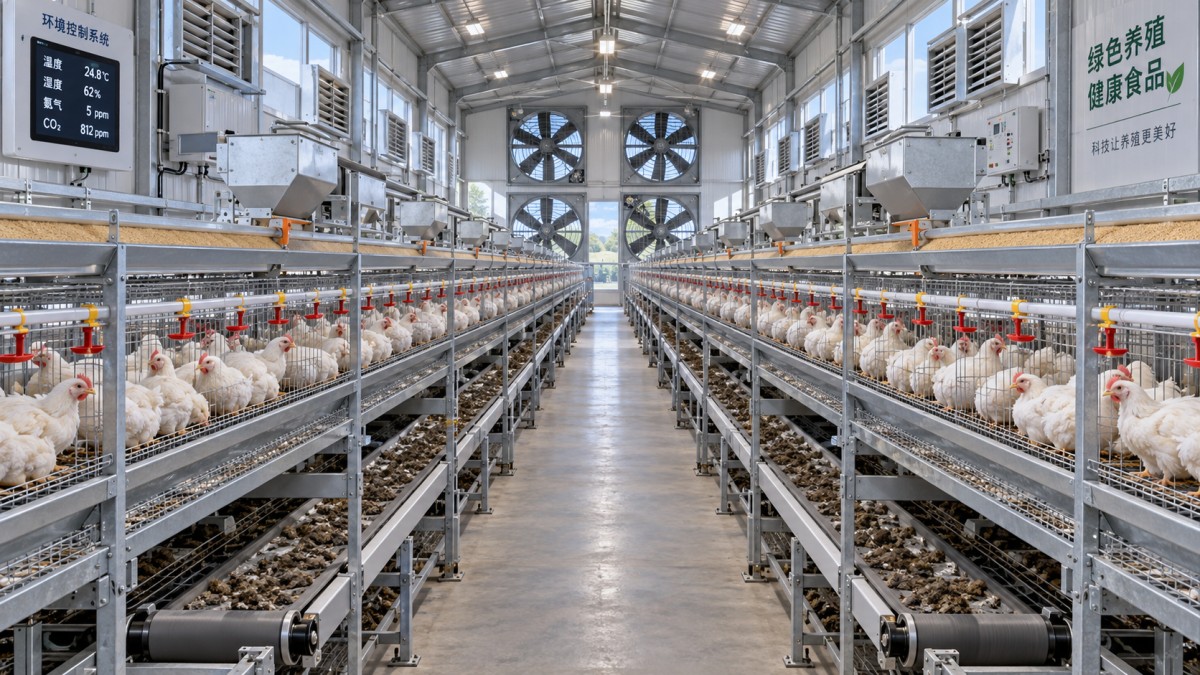
Feed distribution is a common starting point. A mechanical feed line can move feed more consistently through cages or along a housing line than hand distribution, provided the system is correctly adjusted and routinely checked for bridging, empty hoppers, worn drives, blocked outlets, or uneven flow. It does not remove the need to monitor bird access to feed. Poor distribution can be caused by equipment settings, feed characteristics, slope, mechanical wear, or an unnoticed obstruction.
Water systems are another important step. Nipple drinkers and regulated water lines can reduce the labor involved in filling vessels and may help keep water delivery more consistent. However, line pressure, leakage, flushing, water quality, and drinker height still require active supervision. Wet litter or wet areas beneath drinker lines can quickly become a welfare, sanitation, and maintenance issue if they are treated as a minor inconvenience rather than an early warning sign.
Manure handling may be partly mechanized through belts, scrapers, or collection arrangements, especially in cage-based housing. The value is not simply faster removal. Regular removal can reduce the need for repeated manual handling inside the building, but only if the collection route, discharge location, cleaning procedures, and downstream storage plan are aligned. A manure belt is not a complete waste-management program.
For farms using broiler cages, evaluating a semi automatic poultry farm concept can help clarify which processes should remain operator-controlled and which are suitable for mechanized feeding, watering, manure removal, or environmental support. The useful comparison is between operating requirements, not between labels such as “basic” and “advanced.”
Why this middle stage can be harder to manage than it appears
Semi-automation reduces certain kinds of labor, but it raises the importance of inspection. When a person carries feed by hand, an empty feeder is immediately visible. When feed is delivered by a mechanical line, an operator may assume the process occurred correctly unless a formal inspection routine confirms it. The same principle applies to water delivery, ventilation equipment, lighting circuits, and manure removal systems.
This changes the role of farm workers. Their time may shift away from repetitive carrying and toward observation, cleaning, adjustment, maintenance, and recordkeeping. That can be a positive change when staff receive clear responsibilities and training. It can be problematic when the farm treats mechanization as a substitute for supervision.
A practical daily inspection routine usually includes checking feed availability at several points rather than one convenient location; observing drinker lines for leaks and pressure-related problems; reviewing the condition of birds, litter, or cage areas; listening for unusual motor or gearbox noise; confirming that backup power arrangements are available where electrically driven equipment is essential; and documenting faults before they become recurring problems.
Environmental control is often the dividing line
Feed and water automation are relatively easy to understand because their functions are visible. Environmental control is more difficult because the equipment must respond to conditions that vary throughout the day and across the house. Ventilation, temperature, humidity, air quality, and airflow patterns interact with bird age, stocking arrangement, insulation, local climate, and building leakage.
A semi-automatic house may use fans, side curtains, inlets, heaters, or cooling equipment while operators make manual adjustments based on observation and thermometer readings. A more automated house may use controllers to activate equipment at set thresholds. Neither arrangement is automatically appropriate in every building. A controller cannot compensate for poorly positioned inlets, undersized fans, inadequate insulation, unreliable electricity, or insufficient maintenance.
Environmental systems deserve careful attention because poor air conditions can affect bird health and worker conditions. The World Organisation for Animal Health describes ventilation, housing conditions, litter management, and stocking density as elements of broiler chicken welfare management (WOAH, Terrestrial Animal Health Code, Chapter 7.10, “Animal Welfare and Broiler Chicken Production Systems”). The practical implication is that automation should support regular observation rather than replace it.
How to decide whether semi-automation is an appropriate fit
A farm considering an upgrade should begin with workflow rather than with a catalog of equipment. Mapping one production cycle can reveal where labor is actually spent, where errors occur, and where delays have consequences. For example, a farm may find that water-line reliability is a higher priority than mechanical feeding, or that electrical resilience must be addressed before adding any motor-driven equipment.
Labor availability and supervision capacity
Semi-automation is often useful where labor is available but repetitive handling is difficult to sustain consistently. It is less suitable when the farm lacks personnel who can perform checks, clean equipment, recognize abnormal flock behavior, and carry out basic maintenance. Reduced manual work should not be confused with unattended operation.
House layout and retrofit constraints
Existing building geometry can determine whether an upgrade is sensible. Ceiling height, aisle width, support structure, drainage, floor condition, cage rows, feed-storage location, and access for maintenance may all affect installation. Retrofitting equipment into a poorly prepared house can create difficult cleaning zones or restrict access to components that need routine service.
Power, water, and spare-parts reliability
Mechanized equipment introduces dependence on utilities. Before selecting systems with motors, controllers, pumps, or electrically operated ventilation, buyers should assess voltage stability, generator capacity, fuel availability, water pressure, filtration, and the likely lead time for replacement parts. A simple equipment package supported by readily available components may be more workable than a sophisticated system that cannot be repaired promptly.
Production records and management discipline
Automation produces value when its output is observed and used. Even basic records can help managers identify recurring faults: feed interruptions, water consumption changes, repeated motor trips, unusual mortality patterns, or frequent leakage at the same section of a line. The record does not need to be complex, but it should support decisions about maintenance and operational changes.
Procurement questions that prevent expensive mismatches
Buyers should request a clear description of what is included in the proposed system and what remains the responsibility of the farm. “Automatic feeding,” for example, may refer only to transport from a hopper to a line, not to storage, weighing, refill scheduling, backup operation, or cleaning. “Climate control” may mean manually switched fans, a basic thermostat, or a multi-input controller. Ambiguous language can lead to unrealistic expectations during installation.
- Which daily tasks are mechanized, and which still require a worker?
- What electrical load, water pressure, building dimensions, and structural preparation are required?
- Which components require routine lubrication, cleaning, calibration, or replacement?
- How are blockages, power interruptions, overflows, and equipment stoppages detected?
- What access is needed to inspect feed lines, drinker lines, motors, belts, and collection points?
- Which spare parts should be stocked on site before the flock is placed?
- What installation drawings, operating instructions, and commissioning checks are supplied?
Inspection and acceptance should also focus on practical workmanship. Equipment may appear complete at delivery but still be unsuitable if moving parts are misaligned, fasteners are inaccessible, electrical protection is inadequate for the environment, water connections leak, or cleaning access is limited. For electrically powered installations, local electrical rules and qualified installation practices should be followed. In many markets, electrical equipment used in agricultural settings must also be selected with moisture, dust, corrosion, and cleaning exposure in mind.
Biosecurity and cleaning cannot be added after equipment selection
Poultry equipment affects how easily a house can be cleaned and how effectively movement can be controlled between flocks. Complex layouts, inaccessible corners, poorly drained surfaces, and equipment that traps dust or organic material can increase the workload of turnaround cleaning. The design question is not only whether machinery performs its task, but whether staff can safely inspect, wash, dry, and maintain it.
The Food and Agriculture Organization of the United Nations identifies biosecurity as a combination of management and physical measures intended to reduce the risk of introducing, establishing, and spreading animal diseases (FAO, Biosecurity Guide for Live Poultry Markets, 2015). Although farm design requirements vary by region and production system, the underlying principle applies broadly: equipment layout should support controlled workflows, cleaning, and separation of clean and dirty activities.
Farm operators should also verify applicable local animal-welfare, environmental, building, waste-handling, and food-safety obligations before installation. Requirements may differ by country, farm size, housing system, and destination market. Equipment capability does not remove the need for compliant stocking, ventilation, sanitation, mortality handling, or waste-management practices.
When a smart system may be the better next step
More advanced controls can be justified when a farm has large enough scale, reliable utilities, trained personnel, a clear maintenance plan, and a genuine need for tighter environmental control or more detailed operating records. Remote alarms and sensors can be valuable, but their usefulness depends on accurate calibration, prompt response, and backup plans when communication or power fails.
For many commercial farms, the better sequence is to stabilize the basics before adding layers of automation: secure water supply, maintain electrical reliability, improve building condition, establish cleaning procedures, train staff, and document routine checks. Once those foundations are in place, a semi-automatic system can provide a workable bridge between intensive manual labor and a fully connected poultry house.
The most suitable level of automation is the one a farm can inspect, maintain, clean, and operate consistently through an entire production cycle—not merely the one with the longest feature list.
Recommended News
- Where Semi-Automatic Poultry Farms Fit Between Manual and Smart SystemsOct 09, 2026Semi automatic poultry farm solutions bridge manual labor and smart systems, improving feeding, watering, waste handling, and control. Explore the right upgrade path for your farm.
- Layer Battery Cage System Selection: Capacity, Access, and Welfare FactorsSep 22, 2026Poultry cage system selection guide: compare capacity, access, automation, and welfare factors to build a reliable, efficient layer operation.
- How to Specify Energy-Efficient Poultry Ventilation for Broiler HousesSep 20, 2026Energy efficient poultry ventilation systems: learn how to specify fans, inlets, controls, and cooling for lower energy use, healthier broilers, and reliable airflow.
- Which Broiler Chicken Farming Equipment Manufacturer Fits Your Farm Scale?Sep 16, 2026Recommend a broiler chicken farming equipment manufacturer by matching automation, reliability, engineering support, and service to your farm scale.
- Layer Cage Selection Criteria for Small-Scale Poultry Farms in NigeriaSep 12, 2026poultry cages for sale in Nigeria — discover durable, climate-tested layer cages optimized for small-scale farms: corrosion resistance, space efficiency & real-world TCO savings.
- How to Evaluate Technology Options Against Inspection Standards for Project ApprovalOct 07, 2026Technology option analysis inspection standards: compare evidence, testing, compliance, and lifecycle risk to make faster, approval-ready project decisions.
- How to Specify Manufacturing Equipment Systems for Throughput, Uptime, and SafetyOct 05, 2026Manufacturing equipment systems: learn how to specify sustained throughput, uptime, safety, controls, and acceptance tests for dependable production.
- How to Define Technical Buying Criteria for Reliable Category ResearchSep 28, 2026Technical buying criteria for category research: build measurable requirements, assess risk, compliance, and lifecycle value for smarter supplier decisions.
- B2B Market Analysis Compliance Guide: How to Validate Data, Claims, and SourcesSep 25, 2026B2B market analysis compliance guide: learn to validate data, supplier claims, methodologies, and cross-border sources for credible, decision-ready market intelligence.
- When R&D in manufacturing is ready to move beyond the pilot stageSep 22, 2026R&D in manufacturing: discover the five signs your pilot is ready to scale, from process control and quality to integration, ownership, and real-world economics.
- Technology Advancements Dashboards: What Metrics Reveal Emerging Industry Shifts?Oct 02, 2026Technology advancements dashboard insights reveal investment, adoption, supply-chain, and policy signals—helping leaders spot real industry shifts before competitors.
- How to Compare Global Sourcing Information Before Shortlisting Overseas SuppliersSep 30, 2026Global sourcing information comparison made practical: verify suppliers, assess compliance, capacity, landed cost, and delivery risk before building a confident overseas shortlist.
- Battery Cage Price in Nigeria: Cost Drivers for Farm Project BudgetsSep 22, 2026Battery cage price in Nigeria explained: compare installed costs, steel quality, logistics, water systems and project budget risks before choosing poultry housing.
- How to Build a Poultry Equipment Price List for a New Farm SetupSep 22, 2026Poultry equipment price list guide for new farm setups: compare systems, uncover hidden costs, assess quality, and plan installation with confidence.
- Which digital export channels fit products with longer sales cycles?Sep 21, 2026Digital export channels for long sales cycles: learn how websites, industry platforms, marketplaces, and targeted outreach build trust, qualify buyers, and drive complex B2B export deals.
All Categories
Hot Articles
- Where Semi-Automatic Poultry Farms Fit Between Manual and Smart SystemsOct 09, 2026Semi automatic poultry farm solutions bridge manual labor and smart systems, improving feeding, watering, waste handling, and control. Explore the right upgrade path for your farm.
- How Industrial Sites Can Integrate Solar, Storage, and Grid Power Without Disrupting OperationsOct 09, 2026Renewable energy integration for industrial sites: learn how to combine solar, storage, and grid power to reduce costs, strengthen resilience, and protect production continuity.
- How to Evaluate a Prefabricated Housing Supplier for Remote Site ProjectsOct 08, 2026Choose a prefabricated housing supplier for remote sites with confidence. Compare scope, durability, logistics, installation support, and lifecycle value.