
Broiler Cage System Procurement: Assessing Between-Flock Cleaning
TIME
Click count
A cage installation can look easy to wash while leaving workers unable to reach the surfaces that matter. Floor supports, feed channels, belt returns and drinker brackets may remain concealed until the house is empty. By then, the equipment has been purchased and the turnaround schedule is already under pressure.
For procurement teams, between-flock cleaning should be an acceptance requirement, not a general promise in a quotation. The useful question is whether the installed equipment can be emptied, accessed, cleaned, inspected and returned to service within the farm’s actual operating conditions. That assessment must cover floors, feeding equipment, manure handling and the building interfaces around them.
The World Organisation for Animal Health identifies cleaning and disinfection between flocks as part of poultry biosecurity in its Terrestrial Animal Health Code, Chapter 6.5, “Biosecurity procedures in poultry production.” That guidance establishes the management context; it does not certify any particular cage design or guarantee that an automated installation will be easy to clean.
Define the cleaning task before comparing quotations
Suppliers cannot provide comparable cleaning proposals when buyers specify only bird capacity, house dimensions and automation level. The enquiry should also describe the available turnaround window, water supply, drainage arrangement, cleaning equipment and normal staffing. Where these conditions remain undecided, ask suppliers to identify their assumptions explicitly.
Separate the turnaround into practical stages: removal of birds and residual material, dry cleaning, washing, inspection, disinfection, drying and recommissioning. Some tasks may overlap; others depend on access becoming available. A proposal that quotes only washing time leaves much of the work unaccounted for.
When evaluating an automated H-frame broiler cage system, request drawings that show cleaning access as clearly as they show feeding and manure-removal routes. Equipment layout establishes where components sit, but procurement needs to establish how workers will reach their undersides, dismantle removable sections and inspect the surfaces behind them.
Define the operating boundary as well. Does the supplier’s cleaning procedure include the complete feed circuit, transfer points, belt discharge, drains and service passages, or only the cage modules? Assigning these interfaces to another contractor does not remove them from the farm’s turnaround workload.
Read floor design from both sides
Broiler floor selection involves more than choosing a material or aperture pattern. Buyers need to reconcile bird support, manure passage, handling requirements and cleaning access. A surface that appears straightforward from above may have reinforcing ribs, joints or support rails underneath that require separate attention.
Ask for a full-size floor sample with its actual supports and fasteners. Examine the assembled unit rather than a loose panel. Can the underside be seen? Can a brush or wash lance reach the support interface? If panels lift or slide out, is there enough clearance to remove them after adjacent modules, pipes and guards are installed?
Removable floors can improve access, but they introduce handling work. Panels need somewhere to be cleaned, drained and stored without obstructing the wash crew. Buyers should establish panel weight, removal method, replacement identification and whether repeated dismantling affects clips or connectors. Fixed floors avoid that handling step but require a credible method for reaching concealed surfaces in place.
Material names alone do not settle the choice. Request material specifications and written compatibility information for the proposed detergents and disinfectants, including relevant concentration and temperature limits. Chemical suitability depends on the actual formulation, exposure conditions and component material; it should not be inferred from a generic description such as “plastic” or “corrosion-resistant.”
Inspect transitions carefully: panel edges, hinge areas, wire intersections, end closures and connections to the frame. The procurement objective is not an unsupported claim of perfect hygiene. It is a design in which likely residue-retention points can be reached, inspected and maintained using a documented procedure.
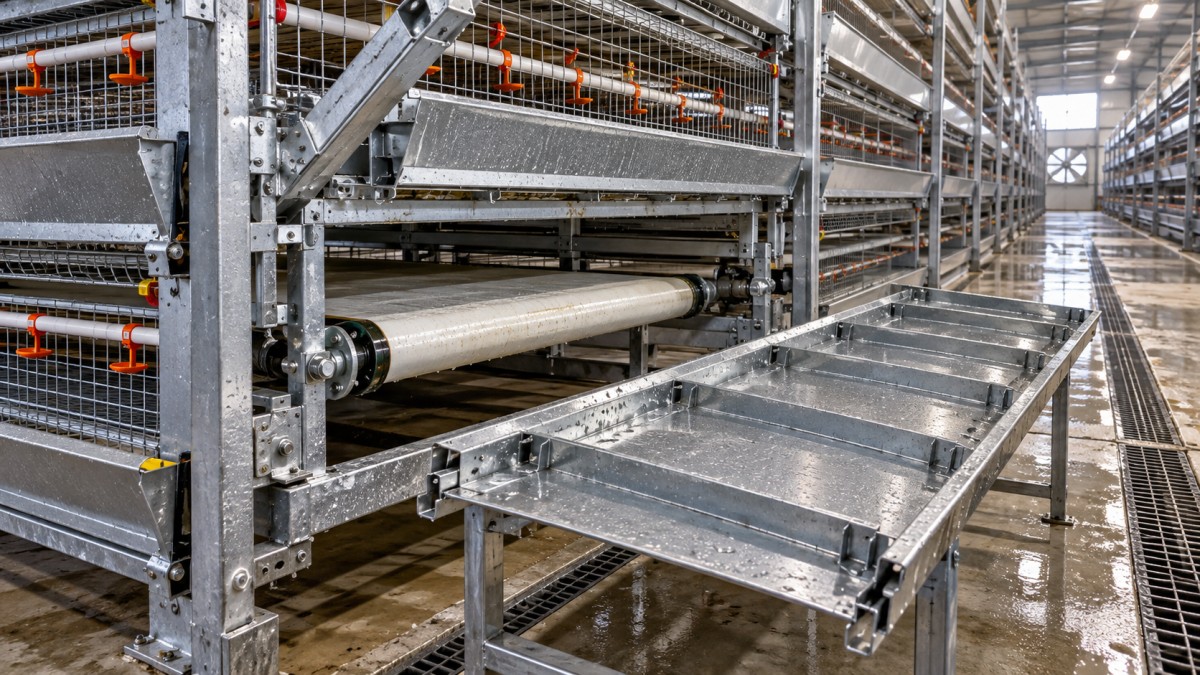
Feeding and manure equipment can determine the turnaround
Feed equipment deserves its own cleaning review. Ask how residual feed leaves each circuit, how trough ends or pans open, and which parts may be washed. Do not assume that a feeding mechanism designed to operate reliably during a flock is also designed for unrestricted wet cleaning.
A workable procedure should distinguish components that are emptied and dry-cleaned from those approved for washing. Motors, sensors, junction boxes and control equipment need manufacturer-specific cleaning restrictions. Ask the supplier to identify those restrictions on the layout so operators are not left to improvise around electrical equipment.
For feed lines serving multiple tiers, check access to outlets, bends and terminal sections. A detachable cover may be convenient at floor level but awkward on an upper tier. The quoted cleaning method should state what access equipment is needed and whether the task can be completed from the supplied service platform.
Manure belts require a similar distinction between normal operation and turnaround cleaning. Removing manure from the house does not, by itself, demonstrate that the return run, rollers, scrapers or discharge housing are accessible. Request a demonstration of how these areas are exposed, inspected and restored to operating condition.
Track any dismantling through to reassembly. If cleaning requires belt-tension adjustment or removal of scraper assemblies, determine who performs the work and how alignment is checked afterward. Otherwise, a seemingly simple washing operation may conceal a maintenance task requiring skills that the cleaning crew does not have.
Check whether the house supports the proposed method
A cleaning-friendly component can become difficult to service in a tightly fitted building. Review the installed arrangement, including wall clearances, cross-passages, end-of-row space and access around discharge equipment. Clearance should accommodate the worker, tools and removed parts—not merely allow a person to pass through.
Water and drainage should be assessed against the proposed cleaning sequence. Ask for the supplier’s assumed flow, pressure and simultaneous hose use, then have the site team confirm whether those conditions are available. Avoid accepting a time estimate produced under conditions the farm cannot reproduce.
Map where wash water and removed material will go. The review should cover the cage structure, manure-handling area and building drainage together. Standing water beneath equipment, inaccessible drain inlets or a discharge route through a cleaned area are design issues to resolve before installation.
Cleaning instructions should also define how cleaned sections are protected while adjacent work continues. WOAH’s poultry biosecurity chapter supports cleaning, disinfection and measures against recontamination; the specific zoning and work sequence should be developed for the farm’s layout and veterinary biosecurity plan. A drawing showing worker movement and waste removal can make these interfaces easier to evaluate.
Require a cleaning trial, not a showroom rinse
A demonstration using clean, unassembled components can confirm accessibility, but it cannot establish performance under farm conditions. Ask suppliers to distinguish what their demonstration proves from what remains to be verified after installation. Any test material or simulated soiling should be agreed in advance, with its limitations recorded.
The trial should include representative floor joints, feed outlets, belt returns and frame connections. Observe preparation and reassembly as well as washing. Record crew size, tools, access equipment, water conditions and interruptions. Without those details, an elapsed-time figure is difficult to compare or reproduce.
Visual inspection is useful for checking remaining feed, manure and other visible deposits, but it should not be presented as proof of microbiological clearance. If swabs or other hygiene tests form part of acceptance, agree the sampling locations, timing, methods and interpretation with the farm veterinarian or laboratory before testing.
ATP readings, where used, should be treated according to the instrument and test-system instructions, not as a universal pathogen test. The US Centers for Disease Control and Prevention’s “Best Practices for Environmental Cleaning in Healthcare Facilities in Resource-Limited Settings,” section on monitoring environmental cleanliness, describes ATP monitoring limitations, including the absence of standardized “safe” thresholds. That is a measurement caution, not a poultry acceptance standard; farm-specific limits require an appropriate validation basis.
Build safety and serviceability into the specification
Access for cleaning must be assessed alongside safe isolation. Belt drives, feed mechanisms and other powered assemblies need a documented method for preventing unexpected movement during servicing. For US workplaces within its scope, OSHA’s 29 CFR 1910.147, “The control of hazardous energy,” addresses hazardous-energy control during servicing and maintenance. Buyers elsewhere should establish the applicable local requirements rather than treating a foreign regulation as universal.
Request equipment-specific isolation instructions, accessible isolation points and identification of any stored energy. The supplier should also state which guards may be removed, how they are secured afterward and what checks precede restart. These requirements belong in the operating documentation and training scope.
Cleaning access should not depend on unplanned climbing or improvised platforms. Ask the site safety team to review upper-tier access and component handling before contract award. Where chemical handling or wastewater management is involved, use the product safety data sheets and applicable local requirements to define protective measures and disposal arrangements.
Compare the cost of a complete turnaround
The cheapest installation may not produce the least expensive cleaning cycle. Compare bids using the same task boundary and site assumptions. Include preparation, dismantling, washing, inspection, drying, reassembly and functional checks, together with consumables and replacement parts used during those tasks.
A useful commercial comparison is the expected cleaning cost per flock, supported by separately stated assumptions. Labour hours are not the same as elapsed downtime: several workers may shorten a task while increasing labour cost. Conversely, a low-labour process may occupy the house longer because equipment must drain or dry before the next stage.
Keep estimates distinct from guarantees. Where performance commitments are negotiated, state the test conditions, evidence required, exclusions and remedy if the agreed result is not achieved. Spare clips, seals, scraper parts and other cleaning-related wear items should have identifiable part numbers and a documented supply arrangement.
The purchase decision should rest on a demonstrated cleaning method matched to the actual house, workforce and biosecurity programme. A design earns preference when its difficult surfaces are accessible, its restrictions are documented and its turnaround assumptions survive a realistic trial—not simply when its quotation describes it as easy to clean.
Recommended News
- Broiler Cage System Procurement: Assessing Between-Flock CleaningOct 27, 2026Buying a broiler cage system? Learn how to assess cleaning access, test supplier claims and compare turnaround costs before you commit to a purchase.
- Matching Poultry Feeding and Drinking Equipment to Flock SizeOct 27, 2026view poultry equipment details to match feeders and drinkers to your flock size. Compare access, feed delivery, and water capacity to make a confident purchase.
- Matching Poultry Farm Equipment Capacity to Housing and Flock SizeOct 21, 2026Match Taiyu(HK) poultry farm equipment to your housing and flock size. Discover how to size feeding, water, and ventilation systems to avoid bottlenecks and invest with confidence.
- Comparing Layer Battery Cage Quotes in Nigeria: What Is Included?Oct 21, 2026Planning to buy poultry cage in nigeria? Compare layer cage quotes, uncover hidden costs, and check delivery, installation and warranty details before choosing your supplier.
- Battery Cage Size Guide: Stocking Density, Welfare Rules, and Farm LayoutOct 09, 2026Battery cage size guide for calculating stocking density, usable area, welfare compliance, and efficient farm layouts. Plan safer, audit-ready hen housing today.
All Categories
Hot Articles
- Audience Targeting for Regional Cultural Promotion: A Practical GuideNov 16, 2026Master regional cultural promotion audience targeting with practical tips to reach the right people, craft compelling messages, and drive participation.
- Oman Awards Two Duqm Green Hydrogen Projects and Opens Fourth Auction at COP31Nov 15, 2026Oman green hydrogen projects in Duqm target 121,000 tonnes annually by 2032. Explore the awards and a new auction linking hydrogen with green-powered data centers.
- Supplier Capability Metrics: How to Assess Capacity, Quality and DeliveryNov 15, 2026Use supplier capability metrics to assess capacity, quality and delivery. Learn how to verify claims, compare suppliers and reduce sourcing risks.