
Thailand Halts Chinese Cattle and Carcass Imports
TIME
Click count
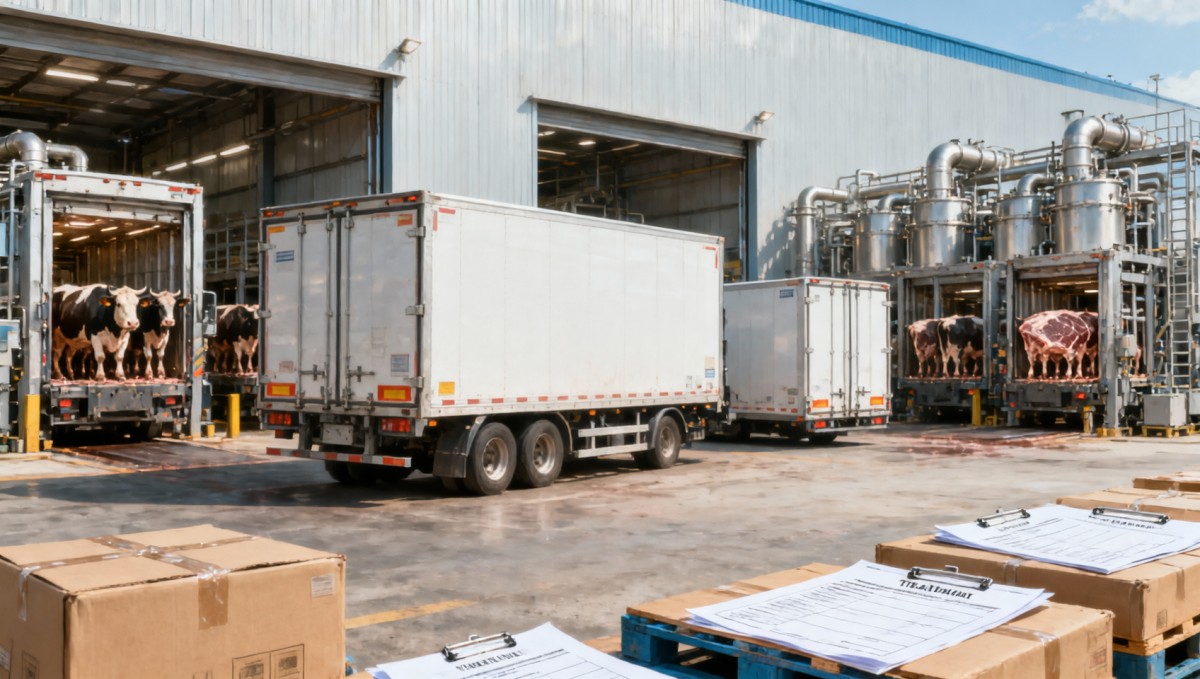
On May 26, 2026, Thailand notified G/SPS/N/THA/809 and introduced an immediate temporary ban on the import or transit of cattle, buffalo, and their carcasses from China, unless the shipments pass a risk assessment by the livestock authority and meet specified disease-control measures. Although the measure is centered on agricultural trade, it is also relevant to equipment exporters, cold-chain system suppliers, smart slaughter-line providers, and supporting machinery makers for prepared meat products, because project execution, installation timing, and after-sales maintenance arrangements may now face added compliance and delivery uncertainty.
What the Thai notification clearly changes
The confirmed change is a temporary restriction, effective immediately from May 26, 2026, covering the import or transit from China of cattle, buffalo, and their carcasses. The notification number provided is G/SPS/N/THA/809. The restriction is not described as absolute in all circumstances: import or transit may proceed only if the case passes a risk assessment by the Department of Livestock Development and satisfies the designated prevention and control measures. The information provided also indicates that, while the rule targets agricultural products, it is expected to affect the implementation of export projects and the scheduling of after-sales service for Chinese suppliers of livestock equipment, cold-chain transport systems, intelligent slaughter lines, and supporting equipment used in prepared meat processing.
Why the effect goes beyond farm products
Export projects tied to livestock processing demand
From an industry perspective, suppliers whose projects depend on animal intake, slaughter throughput, or carcass handling demand may face delays in project launch or adjustment in buyer procurement schedules. If a customer’s operating plan is affected by the new import restriction, the demand timetable for related equipment may also shift. What deserves closer attention is not only the goods directly restricted, but also whether downstream project milestones, acceptance plans, and installation windows remain unchanged.
Cold-chain and transport system providers may see delivery friction
Cold-chain transport and carcass-handling system suppliers may be affected because the new rule directly concerns the movement of regulated animals and carcasses. Analysis shows that for companies already negotiating supply, commissioning, or service plans connected to these flows, contract execution may require renewed checks on customer-side compliance status, cargo eligibility, and whether operating conditions still match the original technical scope. Even where equipment itself is not restricted by the notification, the business case for delivery may be altered by the trade control.
Smart slaughter lines and prepared meat support equipment face execution risk
Manufacturers of slaughter automation systems and supporting equipment for prepared meat production may need to watch for changes in customer investment rhythm. If the regulated raw material flow is interrupted or made conditional on risk assessment and disease-prevention measures, equipment deployment plans may no longer follow the expected timetable. In practical terms, this can affect factory acceptance planning, installation sequencing, spare-parts preparation, and the scheduling of field service teams.
After-sales and maintenance teams need a compliance lens
For companies with existing projects in the market, the issue is not limited to new sales. After-sales maintenance, line upgrades, and on-site technical support may also be influenced if client facilities adjust operating plans in response to the restriction. Observably, service providers should pay closer attention to whether maintenance visits, replacement parts delivery, and technical documentation requests are now being reviewed under a different compliance or operational context.
Practical checkpoints for companies now
Recheck whether customer projects now depend on regulatory clearance
Companies involved in livestock-related equipment exports should review whether ongoing or upcoming projects are connected to the affected product flows. If a project depends on imported or transiting cattle, buffalo, or carcasses from China, it is prudent to verify whether the customer has obtained, or is seeking, the required risk assessment and whether the designated disease-control conditions have become a prerequisite for project continuation.
Review documents used in bids, contracts, and technical delivery
Where project execution is still under discussion, businesses should examine whether existing bid documents, technical proposals, delivery schedules, and acceptance terms still align with the changed trade condition. The information provided does not include detailed implementation rules, so this should not be treated as a settled execution outcome. However, it is reasonable to monitor whether customers begin requesting updated compliance statements, operational assumptions, or revised timelines in procurement documentation.
Prepare for changes in service scheduling and spare-parts planning
For companies already committed to installation or maintenance work, it is advisable to reassess field service plans, spare-parts stock arrangements, and customer response timelines. Analysis shows that even without a direct restriction on equipment shipments, project dependencies may create indirect delays. Firms should therefore keep records, service plans, and customer communications organized in case timetable changes need to be formally documented.
Follow official wording and market-side implementation closely
Because the summary only confirms the temporary ban, the conditional path through risk assessment, and the requirement for specified preventive measures, businesses should continue to track any later clarification in official wording, execution practice, or customer-side procurement behavior. It is more appropriate to understand this stage as one that requires close monitoring rather than one that already provides a complete operational rulebook for every affected transaction.
How this should be read at this stage
Observably, this development is both an implemented trade-control signal and a rule dynamic that still requires follow-up. The immediate element is clear: Thailand has announced a temporary halt affecting imports or transit of specified bovine products from China. The less clear element is how broadly and how quickly the resulting compliance pressure will reshape equipment orders, project approvals, and service execution in related industrial segments. For that reason, the market should not read the notice only as an agricultural SPS update; it also functions as a risk indicator for adjacent exporters whose business depends on livestock processing continuity.
A narrower measure with wider project implications
The industry significance of this notice lies in its spillover effect. The confirmed rule change is focused on live bovines and carcasses, yet the business impact may extend to equipment supply, cold-chain systems, slaughter-line deployment, and after-sales support linked to those activities. At present, it is more appropriate to understand the development as an already effective control measure with secondary commercial implications that still need to be verified through actual implementation, customer feedback, and any later clarification of compliance practice.
Basis of this article and what still needs verification
This article is generated based on the user-provided news title, event date, and event summary. For developments of this kind, relevant source types usually include official notifications, releases by regulatory authorities, customs or trade administration updates, industry association notices, standard-setting documents, and reporting by authoritative media. No specific official source link was provided in the input, so the exact official link remains to be verified on an ongoing basis. Further observation is still needed regarding detailed implementation wording, compliance interpretation, procurement document changes, certification or documentation expectations, market feedback, and how companies actually adjust project execution and after-sales arrangements.
Recommended News
- Battery Cage Size Guide: Stocking Density, Welfare Rules, and Farm LayoutOct 09, 2026Battery cage size guide for calculating stocking density, usable area, welfare compliance, and efficient farm layouts. Plan safer, audit-ready hen housing today.
- Where Semi-Automatic Poultry Farms Fit Between Manual and Smart SystemsOct 09, 2026Semi automatic poultry farm solutions bridge manual labor and smart systems, improving feeding, watering, waste handling, and control. Explore the right upgrade path for your farm.
- Layer Battery Cage System Selection: Capacity, Access, and Welfare FactorsSep 22, 2026Poultry cage system selection guide: compare capacity, access, automation, and welfare factors to build a reliable, efficient layer operation.
- How to Specify Energy-Efficient Poultry Ventilation for Broiler HousesSep 20, 2026Energy efficient poultry ventilation systems: learn how to specify fans, inlets, controls, and cooling for lower energy use, healthier broilers, and reliable airflow.
- Which Broiler Chicken Farming Equipment Manufacturer Fits Your Farm Scale?Sep 16, 2026Recommend a broiler chicken farming equipment manufacturer by matching automation, reliability, engineering support, and service to your farm scale.
- TBEA’s 29 New Energy and Power Equipment Products Pass National-Level AppraisalOct 26, 2026TBEA’s 29 new energy and power equipment products reportedly passed national-level appraisal. Explore the results and key checks for smarter procurement decisions.
- Baby Sleeping Bags: Choosing the Right TOG Rating and a Safe FitOct 25, 2026Choosing babysleepingbags? Discover how to match TOG ratings to room temperature, check for a safe fit, and avoid overheating with practical tips to help you shop confidently.
- Eco Building Solutions in the UAE: Estidama vs. Al Sa'fat RequirementsOct 21, 2026Explore eco building solutions UAE projects need. Compare Estidama and Al Sa’fat ratings, technical requirements and compliance evidence to reduce approval risks and choose with confidence.
- CE Marking: How to Identify Your Product Category and Applicable EU RulesOct 19, 2026Explore product category analysis CE assessors can use to identify applicable EU rules, resolve overlapping obligations, and plan conformity assessment before costly testing.
- What Drives the Cost of Technical Specification Analysis Before Procurement?Oct 14, 2026Understand technical specification analysis cost before procurement. Explore key cost drivers, compare review scopes, and reduce unnecessary spend without compromising purchasing confidence.
- Outdoor Furniture Prices by Material: Purchase, Delivery, and Upkeep CostsOct 27, 2026Compare outdoor furniture price by material, including purchase, delivery, and upkeep costs. Discover how to evaluate supplier quotes and choose better long-term value.
- Real-Time Industrial Trend Analysis: Which Indicators Signal Demand Shifts?Oct 23, 2026Use real time industrial trend analysis to spot demand shifts early. Discover how orders, inventory, and factory activity reveal buying signals and guide smarter business decisions.
- Global Sourcing for Procurement: How to Compare Total Landed CostsOct 22, 2026Optimize global sourcing for procurement by comparing total landed costs, from freight and duties to quality risks. Discover how to uncover hidden costs and choose suppliers with confidence.
- How Can Data Analysis Compare Global Supplier Pricing Trends?Oct 12, 2026How to use data analysis to compare global supplier pricing trends? Learn to align quotes, track currency impacts, and compare landed costs for smarter sourcing decisions.
- Vietnam Precast Concrete Market: Demand Drivers, Capacity, and Buyer RisksOct 09, 2026Vietnam precast concrete market insights: assess demand drivers, production capacity, logistics, quality compliance, and buyer risks for smarter sourcing and investment decisions.
All Categories
Hot Articles
- Outdoor Furniture Prices by Material: Purchase, Delivery, and Upkeep CostsOct 27, 2026Compare outdoor furniture price by material, including purchase, delivery, and upkeep costs. Discover how to evaluate supplier quotes and choose better long-term value.
- Chile’s BESS Cut Curtailment as Projects Under Construction Are Expected to Triple CapacityOct 27, 2026Chile’s BESS are cutting renewable curtailment, while ACERA expects projects under construction to triple storage capacity. Explore what this could mean for developers and suppliers.
- Energy Management in North America: Using Demand Response to Cut Facility CostsOct 26, 2026Explore energy management North America facilities can use to cut costs with demand response. Learn to assess programs, protect operations, and unlock reliable savings.