
Are Energy Storage Systems Compatible With Existing Solar Panels?
TIME
Click count
Yes—energy storage systems can often be added to existing solar panels without replacing the panels themselves. The deciding factors are usually the inverter, electrical layout, battery controls, and whether you want everyday energy savings, backup power, or both. A solar array that exports surplus electricity during the afternoon may be a good candidate for storage, but connecting a battery does not automatically make it capable of powering your property during an outage.
When asking, “Are ESS systems compatible with existing solar panel setups?”, start with the equipment already installed. An AC-coupled battery can often work alongside an existing solar inverter, while a DC-coupled battery generally requires a compatible hybrid inverter or another specifically supported configuration. That distinction determines how much equipment you can retain, how installation proceeds, and which operating features are available.
The panels are usually not the main compatibility barrier
Solar panels produce direct-current electricity. A solar inverter converts that electricity into alternating current for building loads and, where permitted, export to the grid. Battery storage adds another power-conversion and control layer, so compatibility depends on the complete system rather than simply matching a battery to the panels.
A useful first distinction is between electrical compatibility and functional compatibility. Equipment may connect successfully and store excess solar energy while still being unable to support the existing solar inverter during a blackout. Likewise, a battery may work electrically but lack the controls needed for export limits or time-of-use scheduling.
The panel brand does not necessarily need to match the battery brand. However, inverter-to-battery combinations often require explicit manufacturer approval because battery voltage, communications, protection settings, and firmware must work together. A physical connection or a similar voltage rating is not proof of compatibility.
AC coupling versus DC coupling for an existing installation
AC coupling: keeping the existing solar inverter
An AC-coupled battery has its own bidirectional inverter. The existing solar inverter continues supplying the property's AC electrical system, and the battery inverter converts available AC electricity into DC for storage. During discharge, the battery inverter converts stored energy back into AC.
This arrangement is often practical when the solar installation is working well and its inverter still has useful service life. It can also suit systems with microinverters, where conversion already happens at individual panels. The battery connects on the AC side rather than requiring the rooftop array to be rebuilt around a different DC architecture.
The trade-off is that storing solar electricity involves additional conversion stages. Actual losses depend on the equipment and operating conditions, so compare documented system performance rather than assuming every AC-coupled installation performs identically. Backup operation also requires separate verification of the solar inverter's behavior within the battery-created local grid.
DC coupling: sharing a compatible conversion platform
In a typical DC-coupled system, solar panels and the battery connect through a compatible hybrid inverter or integrated power-conversion arrangement. Solar energy can charge the battery without first passing through the building's AC network, potentially reducing conversion losses along that charging path.
An existing battery-compatible hybrid inverter may make this upgrade relatively straightforward, but only if it supports the proposed battery model and required functions. “Hybrid” or “battery-ready” labeling alone is insufficient: supported battery lists, firmware requirements, and any additional hardware must be checked.
Where the existing inverter is solar-only, moving to DC coupling commonly means replacing it and reassessing the panel strings. Their voltage and current must fit the new inverter's input limits across expected operating temperatures. Some supported retrofit architectures use additional DC conversion equipment, but these should not be assumed to work with arbitrary components.
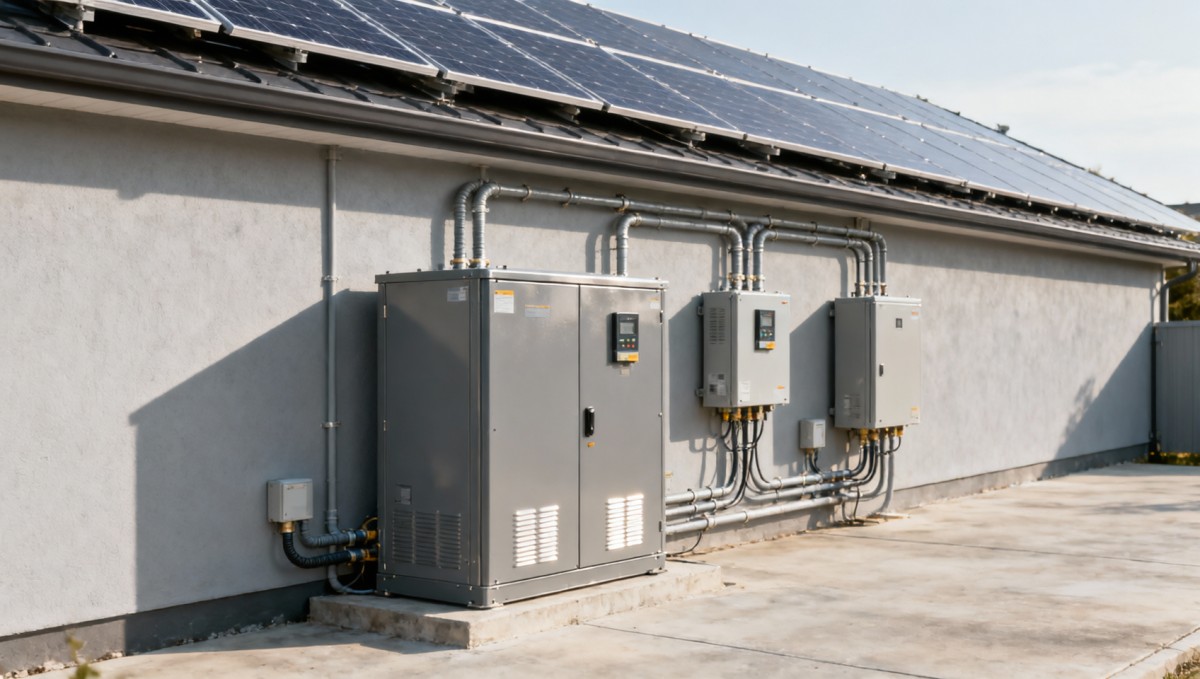
Check these details before requesting a retrofit design
A quote based only on annual electricity use or panel capacity leaves important uncertainties unresolved. Collect the original installation documents, recent bills, and clear photographs of accessible equipment labels. Do not open electrical enclosures or disconnect equipment to obtain this information.
- Identify the exact inverter and system architecture. Record model numbers, rated output, installation date, and whether the array uses string inverters, optimizers, or microinverters. Ask for written confirmation of supported operating modes, not just a general statement that storage can be added.
- Confirm the electrical supply arrangement. Single-phase and three-phase properties have different design considerations. A battery connected to one phase may not back up loads on other phases, even where metering allows favorable energy accounting.
- Review the switchboard and connection capacity. The installer must assess conductor sizes, protective devices, available connection space, and the combined effects of solar and storage. A battery retrofit may require board modifications even when the panels remain untouched.
- Verify metering and control support. The system may need current sensors or a compatible meter to measure imports and exports. Incorrect sensor placement can cause charging, discharge, or export-control errors.
- Check installation conditions. Battery location, temperature limits, required clearances, environmental exposure, and local fire and electrical requirements affect feasibility. Available wall space is not enough to establish a suitable installation location.
Also review warranties and approval requirements. Altering the solar configuration may affect existing equipment warranties, and adding storage may require utility notification, revised interconnection approval, permits, or inspection. Requirements vary by jurisdiction and connection arrangement.
Backup power needs a separate compatibility decision
A property can have solar panels, a charged battery, and no usable power during a grid outage if the system was designed only for grid-connected energy management. Ordinary grid-following solar inverters shut down when the grid fails to prevent unsafe energization of external lines.
To supply loads during an outage, the storage system must safely isolate the backed-up installation from the utility supply and establish a stable local electrical reference. Depending on the design, this involves a backup gateway, transfer equipment, dedicated backup circuits, and a battery inverter with grid-forming capability.
Solar charging during an outage is not guaranteed simply because the battery provides backup. In an AC-coupled arrangement, the battery system must support the existing solar inverter and regulate its production when demand is low or the battery is full. Unsupported combinations may cause solar disconnection or unstable operation. Confirm the exact inverter pairing and permitted solar capacity.
Ask which circuits will remain energized and how the system handles motor starting, overloaded outputs, and depleted batteries. Whole-property backup can be constrained by inverter output and service configuration. Essential-load backup may be more achievable when large heating, cooling, cooking, or machinery loads would otherwise exceed the battery's capabilities.
Choose capacity around the job the battery must perform
Compatibility does not establish useful sizing. A technically supported battery may still be too small for the desired outage duration, too weak for peak loads, or larger than the solar surplus can regularly charge.
Separate energy capacity, measured in kilowatt-hours, from power output, measured in kilowatts. Capacity influences how long loads can run; output determines how much equipment can operate simultaneously. Starting a pump or compressor may require brief power above its normal running demand, making surge capability relevant.
For backup planning, estimate essential-load energy using:
Required usable energy ≈ average essential-load power × desired operating time.
This is only a starting point. The design must account for conversion losses, reserve settings, battery operating limits, and changing loads. Do not count on full solar production throughout an outage, especially when uninterrupted operation is important.
For evening self-consumption, compare daytime exports with electricity purchased after solar production falls. Interval meter data is more useful than annual totals because it shows when surplus and demand actually occur. A large annual solar yield can hide days with little spare energy available for charging.
For a business managing peak demand, discharge power and control timing may matter more than maximum storage capacity. Confirm that the proposed controller supports the relevant demand-measurement interval and tariff structure rather than relying on a generic “bill savings” mode.
When retaining the inverter makes sense—and when it does not
Retain a healthy solar inverter when an approved AC-coupled solution delivers the functions you need without extensive electrical changes. This avoids replacing working equipment solely to obtain a different coupling architecture. It is particularly relevant when preserving an established microinverter installation.
Evaluate inverter replacement when the existing unit is nearing replacement, lacks required controls, or cannot support the intended backup arrangement. A compatible hybrid system may then consolidate functions and simplify coordination. However, include panel-string redesign, wiring changes, and any optimizer compatibility restrictions in the assessment.
A site planning to expand its solar array should evaluate storage and expansion together. The existing inverter may have insufficient input capacity, while a replacement inverter may require different string arrangements. Adding panels, changing the inverter, and adding storage separately can create avoidable redesign work.
Compare quotations on the same scope: usable battery capacity, continuous and surge output, backed-up circuits, solar operation during outages, metering, switchboard work, approvals, and commissioning. A lower equipment price may exclude the components needed to deliver the operating mode you actually want.
Require a demonstrated operating sequence before handover
The final design should state what happens during ordinary solar production, evening demand, a grid failure, and grid restoration. It should also explain behavior when the battery reaches its reserve level or becomes full while solar production remains high.
Have the qualified installer verify metering direction, charging and discharge controls, applicable export limits, and backup transfer under safe commissioning procedures. Where outage solar charging is included, request confirmation that it has been tested within the manufacturer's commissioning requirements. Do not test islanding by disconnecting utility wiring yourself.
The practical acceptance standard is specific: the existing panels remain within supported electrical limits, the inverter and battery pairing is approved for the intended architecture, and the installed system demonstrates the promised functions. If a proposal cannot confirm whether your present solar inverter will recharge the battery during an outage, treat that feature as unconfirmed—not as an automatic benefit of adding storage.
Recommended News
- Chile’s BESS Cut Curtailment as Projects Under Construction Are Expected to Triple CapacityOct 27, 2026Chile’s BESS are cutting renewable curtailment, while ACERA expects projects under construction to triple storage capacity. Explore what this could mean for developers and suppliers.
- Faria Renewables Commissions 134MWh Huawei Storage Project in GreeceOct 23, 2026Faria Renewables commissions a 49.9MW/134.16MWh Huawei battery storage project in Greece. Explore the Galani facility’s liquid-cooled technology and auction-backed path to operation.
- What Does GISN Mean? Identifying the Right Organization or NetworkOct 21, 2026GISN means Global Industry Synergy Network in this article. Discover how to verify names, sources, and affiliations to identify the right organization with confidence.
- Akaysha Energy Secures A$1.75 Billion Financing to Expand Australian Storage ProjectsOct 21, 2026Akaysha Energy secures A$1.75 billion to refinance Australian BESS assets and support a pipeline targeting 25 GWh. Explore the implications for suppliers and project delivery.
- Sizing Commercial Solar and Battery Storage for Peak Demand ReductionOct 18, 2026Size commercial solar systems with battery storage to cut peak demand charges. Discover how tariffs, load data, and battery sizing can help maximize savings and strengthen your investment.
All Categories
Hot Articles
- Sourcing-Oriented Content Review: How to Verify Supplier ClaimsOct 30, 2026Sourcing-oriented content review helps you verify supplier claims, assess certificates and specifications, and reduce purchasing risks before placing an order.
- TrendForce: Seasonal Slowdown Puts Solar Supply Chain Prices Under PressureOct 30, 2026Solar supply chain prices face seasonal pressure. Explore TrendForce’s analysis of polysilicon oversupply, wafer inventories and stabilizing cell prices.
- Product Safety for Green Materials: Selecting Chemical Tests by End UseOct 29, 2026Product safety for green materials starts with end use. Learn how to select emissions, migration, and chemical tests to close evidence gaps and support credible safety claims.