
Best Travel Policy Compliance Software for Complex Approval Workflows
TIME
Click count
A project engineer needs to reach an overseas site tomorrow. The fare exceeds the regional limit, the trip uses a client-funded budget, and the usual approver is on leave. A basic approval chain sends the request to one manager and waits. A well-designed workflow identifies the right budget owner, routes the policy exception to an authorized reviewer, and records why the booking was allowed.
For procurement teams, this is where the search for the best travel policy compliance software becomes more demanding than comparing booking interfaces. The real question is whether a platform can enforce company rules without making urgent, legitimate travel unnecessarily difficult.
SAP Concur, Navan, TravelPerk, and Amex GBT Egencia are useful candidates to evaluate, but they should not be treated as interchangeable. Their suitability depends on your operating model, regional coverage, existing systems, and the approval logic you can demonstrate in a configured environment—not simply a feature checklist.
Start with the approval problem, not the vendor ranking
Complexity rarely comes from the number of approvers alone. It comes from the conditions that determine who must approve, what they are approving, and when that approval becomes invalid.
A manufacturer sending technicians to a commissioning site may need project authorization and an exception for short-notice fares. A renewable-energy developer may allocate one itinerary across several project entities. A professional-services company may distinguish reimbursable client travel from internal overhead. These situations require different controls, even when all three organizations describe their need as “multilevel approval.”
Before approaching suppliers, document a small set of representative rules:
- Organizational rules: employing entity, department, reporting line, and delegated authority.
- Financial rules: estimated trip cost, project code, budget owner, and spending threshold.
- Policy exceptions: cabin class, hotel rate, advance-booking window, or restricted supplier.
- Travel-risk rules: destination, itinerary, and requirements defined by your security team.
- Timing rules: approval deadlines, fare expiry, escalation, and after-hours handling.
Separate mandatory authorization from notification. Copying a regional director on every request is not the same as requiring that director’s approval—and treating both alike creates avoidable delays.
A practical shortlist of travel compliance platforms
The following comparison is a starting point for procurement research, not a claim that every capability is included in every subscription. Approval options, integrations, inventory, and service arrangements can differ by package and country. Ask each supplier to confirm requirements against the proposed configuration and contract.
SAP Concur: investigate the complete architecture
SAP Concur deserves consideration when travel authorization must connect closely with expense and finance processes. Its product family includes Concur Request, Concur Travel, and Concur Expense, making the relationship between modules an important purchasing question.
Do not assume that approving an estimated trip automatically governs every subsequent booking or expense. Ask the implementation team to demonstrate how a request identifier, approved amount, itinerary, and final expenditure remain connected. Also establish which workflow changes your administrators can make without external assistance.
Navan: test convenience against control depth
Navan is worth evaluating when procurement wants travelers to book within a connected travel and expense environment. A usable booking experience matters: controls have limited value when employees routinely avoid the approved channel.
For complex organizations, the decisive test is conditional routing. Demonstrate a request that needs both a project owner and an exception approver, then change the traveler’s department or itinerary. Confirm how the platform handles those changes rather than inferring capability from a standard manager-approval demonstration.
TravelPerk: examine the boundaries of the proposed setup
TravelPerk belongs on a shortlist where centralized booking and manageable policy administration are priorities. Buyers should focus on whether the proposed package supports their actual organizational structure, rather than assuming all approval arrangements are equally configurable.
Test multiple legal entities, temporary approver delegation, and different rules for employees and guests. Where local offices have distinct travel policies, establish whether administrators can maintain those differences without creating overlapping or contradictory rules.
Amex GBT Egencia: include service channels in the assessment
Egencia merits evaluation when the purchasing decision includes managed-travel support as well as software. For international businesses, the service model can be as important as the booking workflow, particularly during disruptions.
Ask what happens when a traveler contacts an agent after hours to replace an approved flight. The critical issue is whether the service channel follows the relevant authorization rules and leaves evidence accessible to the company. Confirm this for each important market rather than assuming uniform arrangements everywhere.
What the best travel policy compliance software must prove
A platform can offer policy settings and still struggle with your approval logic. The following capabilities distinguish a workable control environment from a booking tool with approval notifications attached.
Routing that reflects decision rights
Sequential approval suits decisions that depend on an earlier authorization. Parallel approval is more appropriate when independent reviewers can assess a request simultaneously. Your software should support the pattern your governance requires.
Delegation needs equal attention. A substitute approver should receive authority for a defined period and scope, not inherit unrestricted access indefinitely. Test self-approval prevention, missing-manager scenarios, and what happens when an employee leaves during an active request.
Exceptions that preserve the reason for the decision
“Out of policy” is too broad to be useful on its own. A high hotel rate caused by a trade fair differs from an unnecessary premium-room upgrade. Both may trigger a threshold, but they require different judgment.
Look for exception reasons, supporting information, reviewer comments, and a record of the relevant policy rule. Ideally, reviewers can compare the proposed booking with practical alternatives. A cheaper flight involving an extra overnight stay may not represent lower total trip cost.
Control at the booking and change stages
Approval is not ticketing. Ask whether the selected fare is held, whether its price can change, and what happens if approval arrives after availability disappears. Understand whether noncompliant bookings are blocked, permitted with warnings, or routed for authorization.
The same scrutiny applies after booking. A date change, upgraded cabin, or additional destination may materially alter the original decision. Define which changes require reapproval and how emergency exceptions are documented.
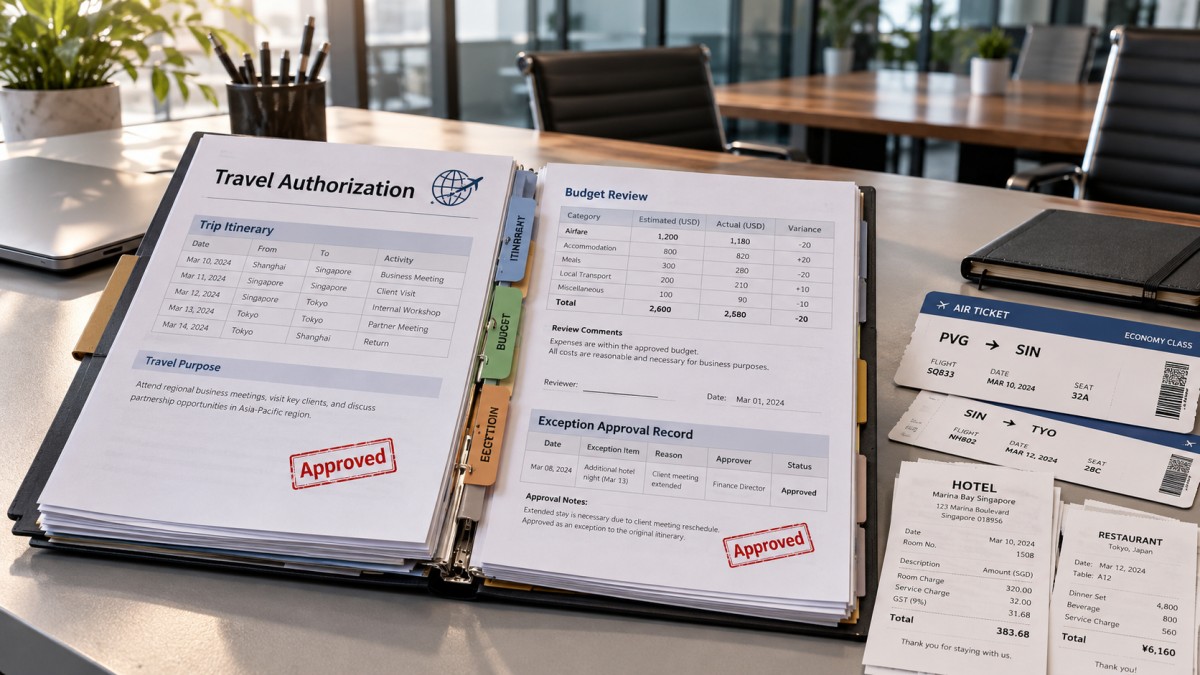
A useful workflow map follows the full sequence: request submission, policy evaluation, budget review, exception authorization, ticketing, itinerary change, and expense reconciliation. Mark every point where a person can override a rule or where information moves between systems.
Evidence that survives an audit
An approval timestamp alone is insufficient. Procurement and finance may need to establish who approved, under what authority, against which policy, and with what information available at the time.
Request a sample export containing the request history, exception explanation, delegation record, and subsequent changes. Confirm retention settings and access permissions. For cross-border organizations, involve privacy and security specialists in reviewing hosting arrangements, subprocessors, and international data transfers; do not treat a general compliance statement as a complete assessment.
Run a demonstration that exposes workflow weaknesses
Give shortlisted suppliers the same scripted scenarios before their demonstrations. Ask them to identify which steps are native, which require configuration or integration, and which depend on manual work.
- Split responsibility: An employee travels for another department’s project. The reporting manager reviews business necessity, while the project owner authorizes spending.
- Multiple exceptions: A short-notice international trip exceeds both the airfare and hotel limits. Determine whether exceptions reach the appropriate reviewers without duplicate approvals.
- Absent approver: The primary manager is unavailable and the fare is nearing expiry. Test delegation, escalation, and traveler notifications.
- Post-approval change: The itinerary changes after ticketing and crosses a spending threshold. Check reapproval and linkage to the original request.
- Agent-assisted booking: An urgent booking occurs outside the normal online flow. Inspect the resulting policy checks and audit record.
Include an ordinary, fully compliant trip too. Overengineered controls can make every booking feel exceptional. Measure whether routine travel proceeds with minimal intervention while genuinely sensitive requests receive scrutiny.
Evaluate integrations as control dependencies
HR integration determines whether the platform knows who the traveler is, where they work, and who has authority over their request. Finance integration determines whether cost centers, entities, and project codes are valid. Expense integration helps connect approved intent with actual spending.
For each interface, establish the data owner, synchronization frequency, failure alerts, and reconciliation process. An approval rule can be logically correct but still route to the wrong person because yesterday’s reporting structure remains in the system.
Ask specifically how the platform handles contractors, guest travelers, employees with multiple assignments, and inactive project codes. “API available” is not equivalent to a maintained integration. Responsibility for building, monitoring, and repairing the connection belongs in the implementation scope.
Score the shortlist—and price the operating model
Use mandatory requirements as gates before applying a weighted score. If a platform cannot prevent prohibited self-approval or provide required audit evidence, an attractive interface should not compensate.
For suppliers that pass, an illustrative weighting is 30% workflow fit, 20% policy enforcement and auditability, 20% integrations and data quality, 15% traveler experience and service coverage, and 15% total cost and administration. Adjust these weights before demonstrations so presentation quality does not reshape your priorities.
Total cost should include subscription and transaction charges where applicable, implementation, integration maintenance, configuration support, agent assistance, and internal administration. Clarify charges associated with changes, cancellations, after-hours service, and additional entities. Compare the same countries, booking volumes, and support assumptions across proposals.
Then pilot the preferred configuration with users representing the difficult cases—not only headquarters travelers. Track approval turnaround, exception frequency, routing errors, bookings outside the approved channel, and administrator effort. Interpret those measures together: fast approval achieved through indiscriminate authorization is not better compliance.
The strongest purchasing decision is therefore conditional, not universal. Favor the platform that can demonstrate your decision rights, preserve evidence across booking changes, and operate reliably within your regional and financial systems. That is what makes travel policy compliance software “best” for a complex organization: routine trips move easily, unusual trips receive informed review, and nobody has to reconstruct the decision from an inbox months later.
Recommended News
- How Travel Policy Compliance Software Flags Out-of-Policy BookingsOct 21, 2026Discover how travel policy compliance software flags out-of-policy bookings, routes approvals, and helps teams resolve alerts without unnecessary rebooking.
- Best Travel Policy Compliance Software for Complex Approval WorkflowsOct 21, 2026Find the best travel policy compliance software for complex approvals. Compare top platforms, test exception routing, and uncover audit-ready controls to choose with confidence.
- Clarify travel approval authority before choosing a workflow platformOct 12, 2026What helps companies strengthen travel approval workflows before choosing a platform? Discover how clear authority, spending limits, and escalation rules prevent delays and improve control.
- How to evaluate travel policy enforcement software for exception handlingOct 12, 2026What is the best software for travel policy enforcement? Compare exception handling, approval workflows, and audit trails to choose a platform that keeps business travel moving.
- Should corporate travel approval happen before tickets are booked?Oct 12, 2026Corporate travel approval should precede ticket purchases. Discover how to control costs, speed up approvals, and handle urgent trips without losing attractive fares.
- TBEA’s 29 New Energy and Power Equipment Products Pass National-Level AppraisalOct 26, 2026TBEA’s 29 new energy and power equipment products reportedly passed national-level appraisal. Explore the results and key checks for smarter procurement decisions.
- Baby Sleeping Bags: Choosing the Right TOG Rating and a Safe FitOct 25, 2026Choosing babysleepingbags? Discover how to match TOG ratings to room temperature, check for a safe fit, and avoid overheating with practical tips to help you shop confidently.
- Eco Building Solutions in the UAE: Estidama vs. Al Sa'fat RequirementsOct 21, 2026Explore eco building solutions UAE projects need. Compare Estidama and Al Sa’fat ratings, technical requirements and compliance evidence to reduce approval risks and choose with confidence.
- CE Marking: How to Identify Your Product Category and Applicable EU RulesOct 19, 2026Explore product category analysis CE assessors can use to identify applicable EU rules, resolve overlapping obligations, and plan conformity assessment before costly testing.
- What Drives the Cost of Technical Specification Analysis Before Procurement?Oct 14, 2026Understand technical specification analysis cost before procurement. Explore key cost drivers, compare review scopes, and reduce unnecessary spend without compromising purchasing confidence.
- Outdoor Furniture Prices by Material: Purchase, Delivery, and Upkeep CostsOct 27, 2026Compare outdoor furniture price by material, including purchase, delivery, and upkeep costs. Discover how to evaluate supplier quotes and choose better long-term value.
- Real-Time Industrial Trend Analysis: Which Indicators Signal Demand Shifts?Oct 23, 2026Use real time industrial trend analysis to spot demand shifts early. Discover how orders, inventory, and factory activity reveal buying signals and guide smarter business decisions.
- Global Sourcing for Procurement: How to Compare Total Landed CostsOct 22, 2026Optimize global sourcing for procurement by comparing total landed costs, from freight and duties to quality risks. Discover how to uncover hidden costs and choose suppliers with confidence.
- How Can Data Analysis Compare Global Supplier Pricing Trends?Oct 12, 2026How to use data analysis to compare global supplier pricing trends? Learn to align quotes, track currency impacts, and compare landed costs for smarter sourcing decisions.
- Vietnam Precast Concrete Market: Demand Drivers, Capacity, and Buyer RisksOct 09, 2026Vietnam precast concrete market insights: assess demand drivers, production capacity, logistics, quality compliance, and buyer risks for smarter sourcing and investment decisions.
All Categories
Hot Articles
- Outdoor Furniture Prices by Material: Purchase, Delivery, and Upkeep CostsOct 27, 2026Compare outdoor furniture price by material, including purchase, delivery, and upkeep costs. Discover how to evaluate supplier quotes and choose better long-term value.
- Chile’s BESS Cut Curtailment as Projects Under Construction Are Expected to Triple CapacityOct 27, 2026Chile’s BESS are cutting renewable curtailment, while ACERA expects projects under construction to triple storage capacity. Explore what this could mean for developers and suppliers.
- Energy Management in North America: Using Demand Response to Cut Facility CostsOct 26, 2026Explore energy management North America facilities can use to cut costs with demand response. Learn to assess programs, protect operations, and unlock reliable savings.