
What Excavator Hydraulic Specs Matter for Tropical Terrain?
TIME
Click count
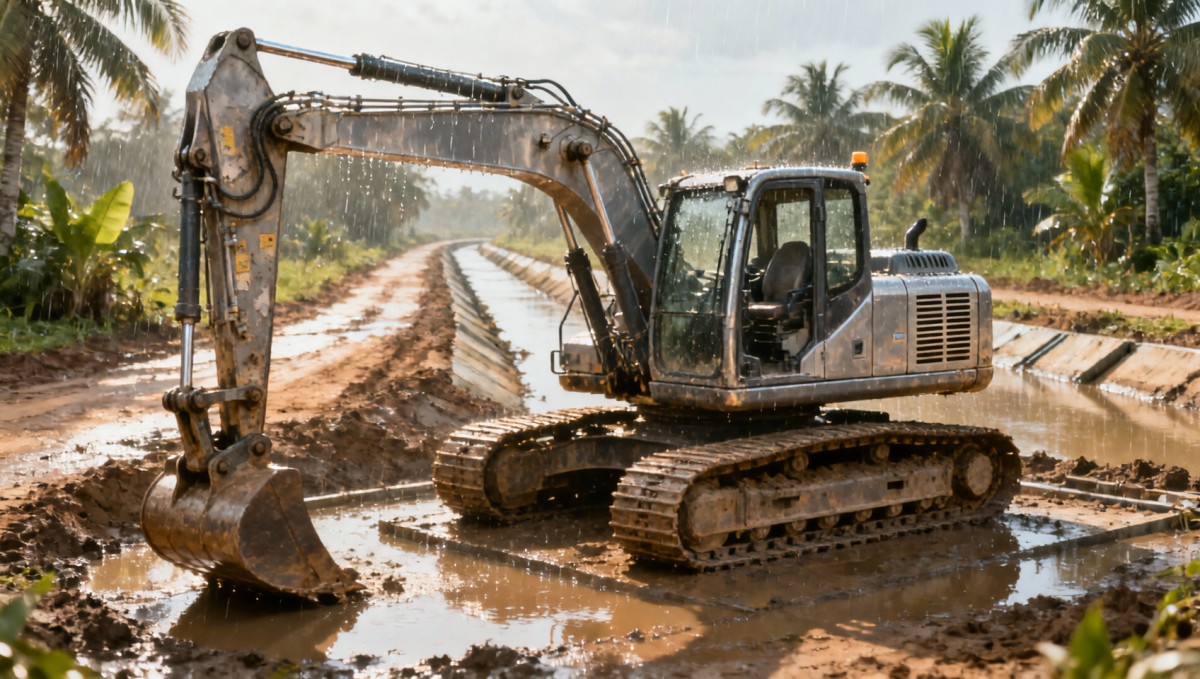
An excavator can look convincing on a specification sheet and still struggle halfway through a tropical afternoon. Oil temperature climbs, combined movements become sluggish, and an attachment that worked well in the morning starts demanding pauses. Meanwhile, heavy rain turns access routes into soft ground and makes routine servicing harder to keep clean.
When comparing excavators hydraulics specs for tropical terrain, maximum pressure is only one part of the decision. Pump flow, power management, cooling performance, filtration, and attachment circuits determine whether the machine can sustain useful work. The better purchase is not necessarily the excavator with the highest numbers; it is the one whose hydraulic system matches the workload, climate, and maintenance conditions.
Start with the tropical jobsite, not the pressure rating
“Tropical terrain” covers very different operating environments. A coastal drainage project may combine saline air, saturated soil, and frequent storms. An inland quarry may face high ambient temperatures and airborne dust. Plantation maintenance can involve mud, vegetation debris, and long travel distances between work areas.
Those differences change which specifications deserve priority:
- Hot, continuous excavation: prioritize sustained hydraulic cooling, pump efficiency, and engine-to-pump power matching.
- Wet earthworks and drainage: examine contamination control, cylinder protection, hose routing, and approved operating-depth limits.
- Attachment-intensive work: verify continuous auxiliary flow, allowable return pressure, and dedicated cooling requirements.
- Remote operations: compare diagnostic access, filter availability, oil requirements, and practical service procedures.
Soft-ground performance also depends heavily on operating weight, track configuration, ground pressure, and soil bearing capacity. Strong hydraulics cannot compensate for an unstable working platform. Keep terrain suitability and hydraulic capability connected in the purchasing discussion, but do not treat them as interchangeable.
Pressure versus flow: force and speed are different promises
Hydraulic pressure supports force; flow supports actuator speed. Neither figure, viewed alone, tells you how quickly an excavator will complete a productive cycle.
Bucket breakout force depends on cylinder dimensions and linkage geometry as well as pressure. Similarly, a large advertised pump flow does not mean every function can receive that flow simultaneously. Engine power, control settings, operating mode, and circuit priorities determine what is actually available.
A useful reality check is hydraulic power: power in kW is approximately pressure in bar multiplied by flow in L/min, divided by 600. Delivering 200 L/min at 300 bar represents about 100 kW of hydraulic output, before accounting for losses. This is an illustrative calculation, not a recommended machine specification.
If the engine must also supply cooling fans, travel, and other loads, the machine cannot sustain arbitrary combinations of maximum pressure and maximum flow. Ask suppliers what the system delivers during your actual work sequence, rather than adding together brochure maxima.
Cooling capacity often separates a good comparison from a costly mistake
In hot weather, the temperature difference between the hydraulic oil and surrounding air becomes smaller. Rejecting heat becomes more difficult just when sustained excavation or attachment use may be generating substantial losses.
A larger oil reservoir is not proof of adequate cooling. More oil can slow the initial temperature rise, but continuous operation still requires the cooling system to reject heat at a sufficient rate. Likewise, the phrase “tropical package” is incomplete unless the supplier explains what changes it includes.
Request the following evidence:
- The permitted ambient-temperature range for the proposed machine configuration.
- Hydraulic oil temperature limits, warning thresholds, and any automatic power reduction.
- The workload and attachment conditions used to assess thermal performance.
- Cooling-pack access, cleaning procedures, and fan-control arrangements.
- Any restrictions associated with guards, screens, or optional equipment that affect airflow.
Compare an integrated cooling package with a basic package on more than cooler dimensions. Fan capacity, airflow management, cooler arrangement, and debris accumulation all matter. Reversible fans can help remove loose debris, but they do not replace inspection and proper cleaning.
For a contractor, the practical question is simple: Will this machine maintain acceptable oil temperature through the busiest part of the shift? A short demonstration from a cold start cannot answer it.
Compare hydraulic control systems by behavior, not labels
Variable-displacement pumps, load-sensing controls, and electronically managed hydraulic systems can reduce unnecessary flow and improve power allocation. However, excavators use different circuit architectures, and a system label is not a reliable ranking of performance.
A well-matched conventional arrangement may outperform a poorly calibrated alternative on a specific task. The meaningful comparison is how much useful work reaches the cylinders and motors, how smoothly functions combine, and how much energy becomes heat.
Where combined movements reveal the difference
Try boom raising while swinging with a loaded bucket, arm movement during bucket curl, and controlled travel where appropriate. Watch for one function starving another, abrupt speed changes, or repeated engine droop. These symptoms can reflect control priorities or power limitations rather than insufficient maximum pressure.
For finishing drains and shaping wet embankments, predictable low-speed control may be worth more than a small advantage in peak cycle speed. Smooth metering helps operators place material accurately and avoid sudden movements near unstable edges. It does not make an unsafe slope or unsupported bank acceptable.
Ask what happens when the oil is hot
As oil temperature rises, viscosity falls and internal leakage can increase. A machine that feels responsive at startup may behave differently after sustained operation. Compare hot-state controllability and cycle consistency within the manufacturer’s approved temperature range.
Filtration, breathers, and seals: the less visible reliability specs
Tropical rain does not automatically contaminate a sealed hydraulic system. Water commonly enters through poor storage practices, dirty servicing, compromised seals, exposed connections, or unsuitable breathing arrangements. High humidity and condensation can add to the challenge.
Filter specifications need careful reading. A micron number without a stated efficiency or test basis is not enough to compare two filters. Request the filtration efficiency, relevant test standard, bypass arrangement, and restriction monitoring. Also establish which circuits receive that protection.
Return-line filtration, pilot filtration, and any dedicated offline filtration serve different purposes. Finer filtration is not automatically better if an unapproved element creates excessive restriction. Replacement elements should meet the machine manufacturer’s requirements.
For wet and muddy work, inspect the physical protection as closely as the paperwork:
- Cylinder rods and wipers: look for effective mud exclusion, protected positioning, and appropriate corrosion resistance.
- Hoses and fittings: check abrasion protection, secure routing, and exposure to debris or trapped mud.
- Reservoir breathing: confirm the approved breather arrangement and whether moisture-control options suit the application.
- Service points: favor accessible sampling ports and connections that can be cleaned before opening.
Underwater work requires particular caution. Standard excavators have manufacturer-defined immersion limits, and hydraulic components are only part of that restriction. Do not assume that sealed fittings make a machine suitable for deep-water operation.
Hydraulic oil choice: compare operating viscosity, not just grade
It is tempting to choose thicker oil simply because the climate is hot. That shortcut can create problems during startup, increase flow resistance, or conflict with pump requirements.
The correct choice depends on the manufacturer’s approved viscosity range, expected startup conditions, stabilized operating temperature, and component requirements. Viscosity index also matters because it describes how viscosity changes with temperature.
Ask suppliers to identify approved fluid grades for the site’s temperature range and explain any restrictions on high-viscosity-index or biodegradable fluids. Environmentally sensitive drainage and forestry projects may require a particular fluid type, but compatibility with seals, residual oil, and service procedures must be checked.
Water separation and oxidation resistance deserve attention in humid, high-temperature service. Establish an oil-analysis plan that tracks viscosity, water, particle contamination, and fluid condition. Use the manufacturer’s limits and trend data rather than assuming one universal replacement interval suits every tropical site.
Attachment circuits: match the entire circuit, not the connection size
Two excavators with similar digging performance can differ significantly when running a breaker, auger, grapple, or mulcher. The auxiliary circuit needs to match the attachment’s working requirements, not merely its maximum tolerated pressure.
Compare these details before ordering:
- Adjustable flow range: can the operator set and retain the correct delivery for each attachment?
- Continuous-duty capability: can the excavator sustain the required flow without exceeding thermal limits?
- Return-line backpressure: are hoses, valves, filters, and couplers suitable at the intended flow?
- Case drain: is a separate low-pressure drain available when the attachment requires one?
- Circuit configuration: does the tool need one-way flow, two-way operation, or additional control functions?
Excess flow may generate unnecessary heat or exceed attachment limits. Excessive backpressure can damage sensitive components. Obtain compatibility confirmation for the exact excavator, attachment, plumbing, and coupler combination; a generic “attachment-ready” description leaves too much unresolved.
Turn the shortlist into a fair field comparison
For international equipment sourcing, normalize the quotations before comparing them. Regional versions of the same excavator may have different cooling packages, auxiliary plumbing, or standard equipment. Specify the actual configuration and ask suppliers to separate standard features from options.
Then arrange a representative operating trial. Use comparable buckets, attachments, operating modes, material, and operator technique. Bring the machines to normal working temperature and record ambient conditions, oil temperature, cycle consistency, fuel use, and any warnings or derating. Keep all testing within approved operating limits.
One machine may show higher peak flow while another maintains steadier cycles with less thermal stress. For intermittent digging, the first might be entirely suitable. For continuous attachment work in intense heat, the second could be the more dependable choice. The result should follow the duty cycle, not brand assumptions.
Before committing, obtain written answers on hot-weather operating limits, continuous auxiliary capability, approved oils, filtration requirements, and local parts support. Ask how faults are diagnosed and whether technicians can access the information needed to investigate overheating or poor hydraulic response.
The hydraulic specifications that matter most are the ones that remain useful after the machine is hot, loaded, and working in real site conditions. Pressure and flow establish potential. Cooling, control quality, contamination protection, and serviceability determine how much of that potential becomes dependable production in tropical terrain.
Recommended News
- What Excavator Hydraulic Specs Matter for Tropical Terrain?Oct 27, 2026Compare excavators hydraulics specs for tropical terrain, from pump flow and cooling to filtration. Discover what keeps machines productive in heat and rain before you buy.
- Integrating Sensors into Harvesters: Placement, Calibration, and Data FlowOct 27, 2026Improve sensor integration for harvesting with practical guidance on placement, calibration, and data flow. Learn how to achieve reliable yield maps and dependable machine control.
- Tracked or Wheeled Excavators: Which Should You Choose for Muddy Sites?Oct 12, 2026Should I choose a tracked or wheeled excavator for muddy sites? Compare traction, ground pressure, safety, and project costs to select the right machine with confidence.
- Heavy Equipment Sourcing: A Due-Diligence Checklist for Reliable SuppliersOct 06, 2026Heavy equipment sourcing information: use this due-diligence checklist to verify suppliers, compare true costs, control delivery risks, and secure reliable equipment support.
- What to Evaluate When Selecting a Radiator Manufacturer for Heavy-Duty EquipmentSep 27, 2026Radiators manufacturer selection guide for heavy-duty equipment: evaluate thermal performance, durability, quality control, supply reliability, and lifecycle value.
All Categories
Hot Articles
- Audience Targeting for Regional Cultural Promotion: A Practical GuideNov 16, 2026Master regional cultural promotion audience targeting with practical tips to reach the right people, craft compelling messages, and drive participation.
- Oman Awards Two Duqm Green Hydrogen Projects and Opens Fourth Auction at COP31Nov 15, 2026Oman green hydrogen projects in Duqm target 121,000 tonnes annually by 2032. Explore the awards and a new auction linking hydrogen with green-powered data centers.
- Supplier Capability Metrics: How to Assess Capacity, Quality and DeliveryNov 15, 2026Use supplier capability metrics to assess capacity, quality and delivery. Learn how to verify claims, compare suppliers and reduce sourcing risks.