
Which Solar Technology Works Best in Humid Tropical Climates?
TIME
Click count
Which Solar Technology Works Best in Humid Tropical Climates?
Abundant sunshine makes the tropics attractive for solar power, but persistent humidity, intense heat, and coastal salt exposure can undermine long-term performance. Which solar energy technology suits high-humidity tropical climates best? The answer depends on more than panel efficiency: temperature coefficients, moisture resistance, corrosion protection, and installation quality all matter.
For most commercial rooftops, high-quality monocrystalline silicon modules are a practical starting point, particularly where usable roof area is limited. Cadmium telluride thin-film modules deserve consideration for larger projects where hot-weather energy yield and land availability shape the economics. Neither technology is automatically humidity-proof. The deciding factor is often the complete module package, supported by relevant testing and a well-engineered installation.
This comparison focuses on photovoltaic electricity generation. Solar thermal systems serve a different purpose and should be assessed against heating or process-heat requirements rather than electrical output.
Humidity is only one part of the tropical operating environment
A tropical solar installation faces several stresses at once. High module temperatures reduce instantaneous power. Moisture can penetrate packaging and contribute to corrosion, insulation deterioration, or delamination. Repeated heating and cooling strain interfaces between glass, encapsulant, cells, and electrical connections. Near the coast, salt deposits add another corrosion mechanism.
These effects should not be confused. A favorable temperature coefficient tells you how power changes as cell temperature rises; it does not demonstrate moisture resistance. Likewise, a salt-mist test report does not establish that the mounting structure, inverter, and connectors will survive a marine environment.
Rainfall also creates a misleading sense of security. Rain may remove loose dust, but it does not reliably eliminate bird droppings, persistent organic deposits, or contamination trapped near module frames. Poor roof drainage and standing water can create maintenance and electrical-safety problems even when the panels themselves are suitable.
The useful question is therefore not simply “Which cell works in humidity?” It is “Which module and system design can maintain dependable energy production under this site’s combined stresses?”
Where crystalline silicon makes the strongest case
Monocrystalline silicon offers a strong balance of conversion efficiency, product availability, and installation familiarity. On factories, warehouses, hotels, and commercial buildings, higher power density can help make better use of a constrained roof. That advantage matters when access routes, shading, equipment, and structural limits reduce the available installation area.
Within this category, cell architecture still matters. N-type TOPCon and heterojunction modules are worth comparing with conventional PERC products. Heterojunction modules often have favorable power temperature coefficients, while other performance differences depend on the specific design. Buyers should compare actual datasheets and reliability evidence rather than assume every n-type module behaves identically.
For humid environments, packaging deserves as much attention as cell efficiency. Glass-glass construction can reduce moisture transmission through the rear surface compared with polymer-backsheet designs, but the module edges remain important. Encapsulant selection, edge sealing, junction-box construction, and manufacturing consistency all influence durability. A poorly executed glass-glass module is not preferable merely because it has two sheets of glass.
There are trade-offs. Glass-glass products can be heavier than some alternatives, affecting handling and rooftop loading. Bifacial versions may provide additional energy where the rear surface receives useful reflected light, but a closely mounted panel above a dark roof may gain little. Bifaciality should be modeled against the actual mounting geometry, not treated as a guaranteed tropical-climate benefit.
Polycrystalline silicon can function in tropical conditions too. However, its generally lower efficiency makes it less attractive where installation area is valuable. Existing projects should assess replacement availability and electrical compatibility rather than replace functioning modules solely because newer cell technologies exist.
Thin-film deserves a closer look on larger sites
Thin-film is not a single technology. Cadmium telluride, copper indium gallium selenide, and amorphous silicon have different performance characteristics, packaging options, and supply chains. Grouping them together as “better in heat” hides differences that matter to project economics.
Cadmium telluride, or CdTe, is a credible option for large ground-mounted installations. Commercial CdTe modules commonly offer favorable temperature behavior compared with many crystalline silicon products. Depending on the module and local conditions, spectral response can also influence energy yield. However, any advantage should be evaluated through a site-specific simulation using appropriate weather data and validated module parameters.
Cloudy weather alone does not establish thin-film superiority. Diffuse irradiance, temperature, spectral conditions, and system losses interact. A claim that one technology “works better in tropical clouds” needs more support than a broad description of low-light performance.
CIGS products may be useful where lightweight or flexible formats solve a building constraint, but moisture-barrier performance becomes particularly important in those designs. Amorphous silicon generally requires more area for a given rated capacity than higher-efficiency alternatives. Both require product-specific assessment rather than selection based on the thin-film label.
Also check replacement supply, installer familiarity, inverter compatibility, and end-of-life arrangements. For CdTe projects, establish applicable handling and recycling requirements before procurement. A projected energy-yield advantage is less valuable if servicing or replacing damaged modules becomes difficult.
Read the evidence behind “tropical-ready” claims
Testing standards provide a useful screening framework, but they are not lifetime guarantees. IEC 61215 addresses PV module design qualification and includes environmental stress testing. IEC 61730 addresses module safety qualification. Relevant certification is an essential starting point, not proof that a product will perform equally well at every humid site.
- Check the exact product scope. Confirm that reports cover the proposed module model and relevant construction, rather than a related product with different materials.
- Request damp-heat evidence. Review the test conditions, duration, acceptance criteria, and measured changes. Extended testing can add confidence, but its meaning depends on the protocol and results.
- Assess salt exposure separately. For coastal sites, examine IEC 61701 salt-mist corrosion testing and whether the tested severity is appropriate to the exposure being considered.
- Investigate potential-induced degradation. Ask about PID testing under relevant voltage polarity and environmental conditions. IEC TS 62804-1 provides test methods for crystalline silicon modules; applicability must match the technology.
- Read warranty exclusions. Check installation requirements, environmental restrictions, claim procedures, and whether removal, transport, and reinstallation costs are covered.
Field-performance evidence from comparable climates strengthens the assessment. Look for documented operating conditions and transparent measurement methods. An unexplained performance graph or a photograph of a coastal installation is not enough.
The installation can undo a good module choice
Consider a coastal warehouse with a hot metal roof. Selecting modules with a favorable temperature coefficient helps, but mounting them with inadequate rear ventilation can increase operating temperatures and reduce that benefit. Roof loading, waterproofing, uplift resistance, and safe access may ultimately determine the viable mounting arrangement.
A useful site review follows the entire exposure path: rain across the roof, air beneath the modules, salt deposition on fasteners, and moisture around cable entries and junction boxes.
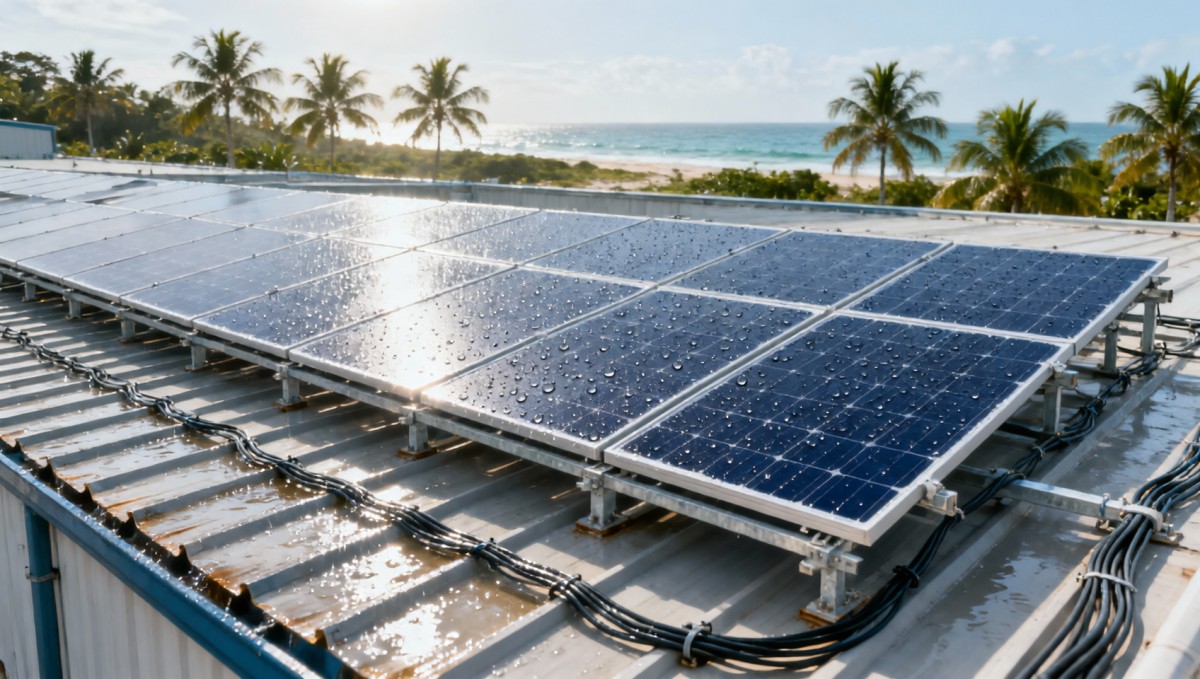
Specify corrosion-resistant mounting components appropriate to the location and manage contact between dissimilar metals. Route cables away from standing water and abrasive edges. Avoid unverified cross-mating of connectors from different manufacturers, even when they appear physically compatible. Connection faults can become more consequential under wet operating conditions.
Inverters need their own environmental assessment. An ingress-protection rating alone does not establish resistance to condensation or salt corrosion. Installation location, ventilation, temperature derating, cable-entry sealing, and flood exposure all need attention. Surge protection and earthing should follow the site risk assessment and applicable electrical requirements.
Where energy storage is included, treat the battery enclosure as a separate thermal and safety problem. A module suitable for tropical exposure says nothing about whether the associated battery system can operate safely in a hot, humid equipment area.
Choose on lifetime output, not one headline specification
Compare shortlisted systems using annual energy production, available area, expected degradation, maintenance access, and total installed cost. Keep assumptions consistent. Otherwise, a thin-film design with generous ventilation may appear superior to a crystalline design modeled with hotter operating conditions, even when the comparison is really about layout rather than technology.
Ask for the maximum-power temperature coefficient, not an unspecified “temperature coefficient.” Review energy-model assumptions for module temperature, shading, soiling, inverter losses, and any bifacial contribution. Run sensitivity checks where local weather data or long-term degradation evidence is uncertain.
For a space-constrained commercial roof, a well-qualified monocrystalline module will often be the most practical candidate. For a large hot-climate ground-mounted project, compare CdTe against crystalline silicon on modeled yield and complete project economics. For lightweight or unusual building surfaces, prioritize structural suitability and moisture-barrier evidence before choosing a flexible product.
At the Global Industry Synergy Network, this distinction between component claims and project outcomes informs our Renewable Energy & ESS coverage. Connecting manufacturers, service providers, and international decision-makers is useful only when the comparison includes reliability documentation, delivery capability, and local service arrangements—not just efficiency rankings.
Before final selection, assemble a site exposure profile, comparable energy models, model-specific test evidence, and a written installation and maintenance plan. The strongest tropical solar proposal is the one that can explain how its components and engineering choices address heat, moisture, corrosion, and serviceability together.
Recommended News
- China Solar: High Polysilicon Stocks, LONGi–Engie 800 MW Module DealOct 24, 2026Explore China solar trends as polysilicon stocks top 560,000 tonnes and tenders rebound. Discover what LONGi–Engie’s 800 MW module framework means for supply and demand.
- Sri Lanka Orders Rooftop Solar Disconnection After Nationwide BlackoutOct 20, 2026Sri Lanka rooftop solar disconnection follows a nationwide blackout. Learn why systems were taken offline, how owners are affected, and what to watch for on grid reconnection.
- Which Solar Technology Works Best in Humid Tropical Climates?Oct 12, 2026Which solar energy technology suits high-humidity tropical climates best? Compare monocrystalline and CdTe options, moisture resistance, and lifetime value to choose with confidence.
- Solar Project Delivery Assurance: Controls That Protect Schedule and PerformanceOct 09, 2026Solar project delivery assurance: discover practical controls that protect schedules, commissioning readiness, quality, grid compliance, and long-term plant performance.
- What Does a Solar Module Assembly Line Do From Cell Stringing to Testing?Sep 16, 2026Discover the functional purpose of a solar module assembly line, from precise cell stringing and lamination to EL testing, reliable output, and field-ready panel quality.
- TBEA’s 29 New Energy and Power Equipment Products Pass National-Level AppraisalOct 26, 2026TBEA’s 29 new energy and power equipment products reportedly passed national-level appraisal. Explore the results and key checks for smarter procurement decisions.
- Baby Sleeping Bags: Choosing the Right TOG Rating and a Safe FitOct 25, 2026Choosing babysleepingbags? Discover how to match TOG ratings to room temperature, check for a safe fit, and avoid overheating with practical tips to help you shop confidently.
- Eco Building Solutions in the UAE: Estidama vs. Al Sa'fat RequirementsOct 21, 2026Explore eco building solutions UAE projects need. Compare Estidama and Al Sa’fat ratings, technical requirements and compliance evidence to reduce approval risks and choose with confidence.
- CE Marking: How to Identify Your Product Category and Applicable EU RulesOct 19, 2026Explore product category analysis CE assessors can use to identify applicable EU rules, resolve overlapping obligations, and plan conformity assessment before costly testing.
- What Drives the Cost of Technical Specification Analysis Before Procurement?Oct 14, 2026Understand technical specification analysis cost before procurement. Explore key cost drivers, compare review scopes, and reduce unnecessary spend without compromising purchasing confidence.
- Outdoor Furniture Prices by Material: Purchase, Delivery, and Upkeep CostsOct 27, 2026Compare outdoor furniture price by material, including purchase, delivery, and upkeep costs. Discover how to evaluate supplier quotes and choose better long-term value.
- Real-Time Industrial Trend Analysis: Which Indicators Signal Demand Shifts?Oct 23, 2026Use real time industrial trend analysis to spot demand shifts early. Discover how orders, inventory, and factory activity reveal buying signals and guide smarter business decisions.
- Global Sourcing for Procurement: How to Compare Total Landed CostsOct 22, 2026Optimize global sourcing for procurement by comparing total landed costs, from freight and duties to quality risks. Discover how to uncover hidden costs and choose suppliers with confidence.
- How Can Data Analysis Compare Global Supplier Pricing Trends?Oct 12, 2026How to use data analysis to compare global supplier pricing trends? Learn to align quotes, track currency impacts, and compare landed costs for smarter sourcing decisions.
- Vietnam Precast Concrete Market: Demand Drivers, Capacity, and Buyer RisksOct 09, 2026Vietnam precast concrete market insights: assess demand drivers, production capacity, logistics, quality compliance, and buyer risks for smarter sourcing and investment decisions.
All Categories
Hot Articles
- Outdoor Furniture Prices by Material: Purchase, Delivery, and Upkeep CostsOct 27, 2026Compare outdoor furniture price by material, including purchase, delivery, and upkeep costs. Discover how to evaluate supplier quotes and choose better long-term value.
- Chile’s BESS Cut Curtailment as Projects Under Construction Are Expected to Triple CapacityOct 27, 2026Chile’s BESS are cutting renewable curtailment, while ACERA expects projects under construction to triple storage capacity. Explore what this could mean for developers and suppliers.
- Energy Management in North America: Using Demand Response to Cut Facility CostsOct 26, 2026Explore energy management North America facilities can use to cut costs with demand response. Learn to assess programs, protect operations, and unlock reliable savings.