
How rooftop solar changes smart grid distribution automation
TIME
Click count
How rooftop solar changes smart grid distribution automation
Rooftop solar is turning distribution feeders from one-way delivery networks into systems with variable generation and bidirectional power flows. That changes the questions utilities must answer before automating switching, voltage regulation, or fault recovery. Can existing protection handle export? Will tap changers and smart inverters work together, or fight each other? Can an automated restoration sequence remain safe when generation is scattered across the feeder?
The issue is not simply whether the network can connect more solar capacity. It is whether smart grid distribution automation can recognize changing operating conditions and respond without creating another problem downstream. Reliable evaluation therefore starts with feeder behavior, control authority, and evidence from testing—not the number of features on an automation platform.
The feeder’s operating envelope is no longer predictable from demand alone
A feeder with moderate rooftop solar may still behave conventionally during evening demand peaks. Around midday, however, local generation can exceed local consumption. Power then flows toward the substation, potentially changing voltage profiles and the loading of individual network sections. A low substation demand reading does not necessarily mean every conductor or transformer has spare capacity.
Solar location matters as much as aggregate capacity. Concentrated installations near the end of a long feeder can produce different voltage constraints from the same capacity distributed close to the substation. On low-voltage networks, conductor resistance, phase allocation, and service connections can make customer-level voltage conditions quite different from those measured upstream.
Hosting-capacity assessment should therefore distinguish thermal loading, voltage limits, protection constraints, and power quality. A single percentage of solar penetration cannot describe all four. Time-series studies are useful because minimum daytime demand, passing cloud cover, and evening load pickup expose conditions that a peak-load snapshot misses.
Automation depends on model quality, too. Incorrect phase assignments, outdated switch positions, or missing rooftop systems can undermine state estimation and control recommendations. Before adding sophisticated optimization, establish how network records and distributed energy resource data will stay synchronized.
Protection needs a fresh coordination study, not a blanket relay replacement
Reverse power flow does not automatically make every protection device unsuitable. The actual concern is whether fault detection, selectivity, and clearing behavior remain dependable across credible network configurations. Rooftop solar changes some of the assumptions behind those functions, but the remedy depends on the feeder and connected equipment.
Inverter-based generation behaves differently from rotating machines during faults. Its contribution is constrained and shaped by inverter controls, operating conditions, and applicable interconnection requirements. Protection studies should use validated inverter models where available rather than treating photovoltaic systems as conventional generators with large, sustained fault currents.
Issues worth examining include reduced current seen by an upstream relay for certain faults, additional contribution through devices on other branches, and changes to fuse–recloser coordination. Directional protection or revised settings may be justified, but only after assessing grounding, fault types, sensitivity, and alternative switching arrangements.
Reclosing deserves particular attention. The system must coordinate inverter disconnection, ride-through behavior, and reconnection with utility protection. An unintentional island must not be confused with an intentionally engineered microgrid. A feeder that appears disconnected at the substation is not, by that fact alone, verified safe for restoration or maintenance.
Voltage control becomes a coordination problem
Traditional voltage regulation often assumes a reasonably consistent relationship between downstream demand and voltage drop. Rooftop export can weaken that relationship. Line-drop compensation and regulator control modes should be checked for reverse-flow conditions; their suitability depends on the equipment and configuration, not merely on whether communications are available.
Smart inverters add useful controls. Volt-var functions adjust reactive power in response to voltage, while volt-watt functions can reduce active-power output at elevated voltage. These capabilities are not interchangeable. Reactive-power support is limited by inverter capability and operating point, and its effectiveness depends on feeder impedance. Active-power curtailment has a direct energy consequence that must be measured and governed.
A workable control hierarchy usually separates local response from supervisory coordination. Inverters handle local conditions within approved settings; feeder-level systems coordinate regulators, capacitors, and operating targets; broader optimization considers constraints across the network. Exact response times and settings require project-specific analysis.
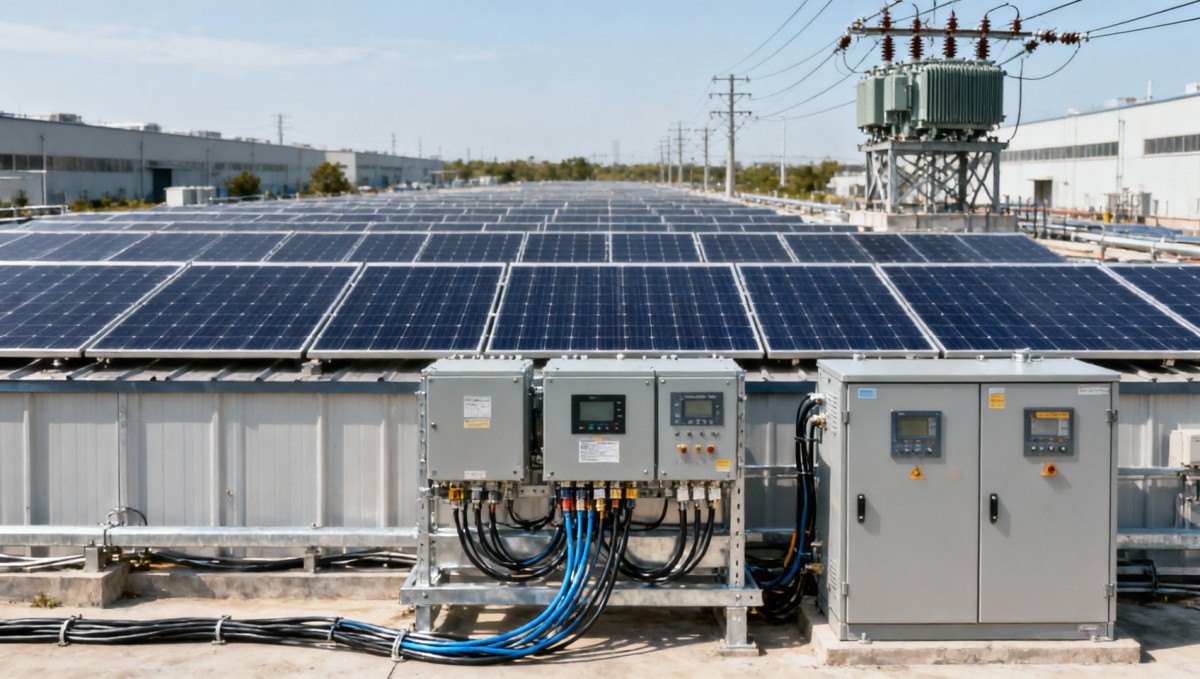
The important test is interaction. Individually acceptable controllers can still produce repeated tap operations, unnecessary capacitor switching, or voltage oscillation when their deadbands and delays overlap. Simulation should include cloud-driven ramps and communications loss, not just steady sunshine. Battery storage can help manage export, but only when available power, state of charge, and dispatch permissions support that role.
More visibility does not mean every device needs continuous telemetry
Substation measurements alone can miss phase-specific voltage problems and local reverse flows. Feeder sensors, selected transformer monitoring, and inverter telemetry can improve observability. Advanced metering infrastructure also supplies valuable voltage and consumption information, although its reporting intervals and communications architecture may not support fast operational control.
The practical question is which measurements support which decisions. Fault isolation needs dependable event and switch-status information. Voltage optimization needs adequate spatial coverage and trustworthy voltage data. Forecast-driven scheduling needs estimates of load and generation, with uncertainty represented rather than hidden behind a single forecast value.
An advanced distribution management system can maintain network topology and coordinate feeder operations. A distributed energy resource management system can provide visibility and dispatch across participating resources. Their boundaries vary by implementation. Specifications should identify which system owns each operating limit, who authorizes dispatch, and how conflicting instructions are resolved.
Stale data must trigger defined behavior. If an optimizer loses trustworthy measurements, the system may need to suspend optimization, apply conservative limits, or fall back to approved local controls. Protective functions should not rely on a cloud connection remaining available.
Standards define capabilities; implementation profiles determine compatibility
Interconnection requirements and communications interoperability are related, but they answer different questions. IEEE 1547-2018 addresses distributed energy resource interconnection and interoperability in its applicable context, including voltage regulation capabilities and abnormal-condition response. IEEE 1547.1-2020 specifies conformance test procedures. Neither reference, on its own, proves that a complete feeder automation scheme will perform correctly.
Outside that context, requirements may draw on frameworks such as EN 50549 and national connection rules. Applicable editions, local adoption, utility settings, and certification expectations must be verified for the project. A compliant device supplied for one market should not be assumed ready for another.
Communications standards also serve different roles. IEC 61850 supports standardized information models and communication services for power utility automation, with extensions relevant to distributed resources. IEEE 2030.5 is used for application-level energy communications in some deployments. SunSpec Modbus models provide standardized representations of inverter and related equipment data. Naming a protocol does not establish end-to-end interoperability.
A technical specification should go further and define:
- Supported functions, data models, units, sign conventions, and phase identifiers.
- Timestamp handling, data-quality flags, reporting intervals, and command acknowledgments.
- Control priority, command expiry, and behavior after restart or connection loss.
- Authentication, authorization, certificate management, and supported security profiles.
These details expose integration risks that a protocol checklist misses. The IEC 62351 series addresses security for power-system communications, but referencing it broadly is insufficient: the relevant parts and implementation responsibilities must be explicit. Remote access, firmware updates, and credential lifecycle management also need operational ownership.
Restoration automation must account for generation after switching
Fault location, isolation, and service restoration can reconfigure feeders into arrangements that were acceptable under conventional demand assumptions but problematic with solar export. Transferring a section to an adjacent feeder changes voltage conditions, protection coordination, and available hosting capacity.
Restoration logic should therefore evaluate the proposed topology using credible load and generation conditions. It must also consider what happens when disconnected inverters subsequently reconnect. A transfer may appear feasible immediately after switching, then encounter voltage or loading constraints as generation returns.
Where resource visibility is incomplete, conservative operating envelopes may be more defensible than precise-looking dispatch calculations. The system should make uncertainty visible to operators and distinguish automatic actions from those requiring confirmation. Faster restoration is useful only when the restored configuration remains within its operating limits.
Evaluate the operating behavior before scaling the platform
Acceptance testing should move beyond proving that dashboards display inverter values. Useful scenarios include high generation with minimum demand, uneven phase loading, rapid output changes, unavailable controllable resources, stale telemetry, and feeder transfers. Controller- or hardware-in-the-loop testing can expose interactions before live deployment, provided the network and device models are representative.
Judge results against agreed criteria: voltage-limit excursions, thermal loading, protection selectivity, switching frequency, curtailed energy, and recovery after communications failure. No single improvement proves success. Reducing voltage excursions through excessive curtailment may be technically effective but operationally unacceptable; reducing losses while increasing regulator wear is another trade-off worth exposing.
For the Global Industry Synergy Network (GISN), connecting renewable-energy intelligence with global industrial trade means examining these deployment details alongside equipment capabilities. Manufacturers, service providers, and utilities need a shared view of local connection rules, integration scope, and lifecycle support—not just comparable feature lists.
Before expanding smart grid distribution automation, establish a validated feeder model, a clear allocation of control authority, and measurable acceptance criteria. Rooftop solar does not demand centralized control of every inverter. It demands enough visibility, coordination, and fail-safe behavior to keep each automated action valid as generation and network topology change.
Recommended News
- Energy Management in North America: Using Demand Response to Cut Facility CostsOct 26, 2026Explore energy management North America facilities can use to cut costs with demand response. Learn to assess programs, protect operations, and unlock reliable savings.
- China’s First Regional Electricity Market Begins Formal OperationOct 25, 2026Explore China’s first regional electricity market across five regions. Discover what its trading framework could mean for power procurement, contracts and business planning.
- Fixing timestamp mismatches in distribution automation data integrationOct 21, 2026Fix distribution automation data integration timestamp mismatches. Learn to trace events, resolve clock and time-zone errors, and restore reliable event records.
- When is manual override needed in automated power distribution?Oct 21, 2026When does automated power distribution need manual override? Explore key triggers, safety checks, and control limits to support safer decisions and protect critical power systems.
- 400V Three-Phase Grid Integration: Inverter and Protection RequirementsOct 13, 2026Explore grid integration 400V requirements for three-phase inverters, anti-islanding, earthing, and fault protection. Learn what to verify for compliant, reliable connections.
- TBEA’s 29 New Energy and Power Equipment Products Pass National-Level AppraisalOct 26, 2026TBEA’s 29 new energy and power equipment products reportedly passed national-level appraisal. Explore the results and key checks for smarter procurement decisions.
- Baby Sleeping Bags: Choosing the Right TOG Rating and a Safe FitOct 25, 2026Choosing babysleepingbags? Discover how to match TOG ratings to room temperature, check for a safe fit, and avoid overheating with practical tips to help you shop confidently.
- Eco Building Solutions in the UAE: Estidama vs. Al Sa'fat RequirementsOct 21, 2026Explore eco building solutions UAE projects need. Compare Estidama and Al Sa’fat ratings, technical requirements and compliance evidence to reduce approval risks and choose with confidence.
- CE Marking: How to Identify Your Product Category and Applicable EU RulesOct 19, 2026Explore product category analysis CE assessors can use to identify applicable EU rules, resolve overlapping obligations, and plan conformity assessment before costly testing.
- What Drives the Cost of Technical Specification Analysis Before Procurement?Oct 14, 2026Understand technical specification analysis cost before procurement. Explore key cost drivers, compare review scopes, and reduce unnecessary spend without compromising purchasing confidence.
- Outdoor Furniture Prices by Material: Purchase, Delivery, and Upkeep CostsOct 27, 2026Compare outdoor furniture price by material, including purchase, delivery, and upkeep costs. Discover how to evaluate supplier quotes and choose better long-term value.
- Real-Time Industrial Trend Analysis: Which Indicators Signal Demand Shifts?Oct 23, 2026Use real time industrial trend analysis to spot demand shifts early. Discover how orders, inventory, and factory activity reveal buying signals and guide smarter business decisions.
- Global Sourcing for Procurement: How to Compare Total Landed CostsOct 22, 2026Optimize global sourcing for procurement by comparing total landed costs, from freight and duties to quality risks. Discover how to uncover hidden costs and choose suppliers with confidence.
- How Can Data Analysis Compare Global Supplier Pricing Trends?Oct 12, 2026How to use data analysis to compare global supplier pricing trends? Learn to align quotes, track currency impacts, and compare landed costs for smarter sourcing decisions.
- Vietnam Precast Concrete Market: Demand Drivers, Capacity, and Buyer RisksOct 09, 2026Vietnam precast concrete market insights: assess demand drivers, production capacity, logistics, quality compliance, and buyer risks for smarter sourcing and investment decisions.
All Categories
Hot Articles
- Outdoor Furniture Prices by Material: Purchase, Delivery, and Upkeep CostsOct 27, 2026Compare outdoor furniture price by material, including purchase, delivery, and upkeep costs. Discover how to evaluate supplier quotes and choose better long-term value.
- Chile’s BESS Cut Curtailment as Projects Under Construction Are Expected to Triple CapacityOct 27, 2026Chile’s BESS are cutting renewable curtailment, while ACERA expects projects under construction to triple storage capacity. Explore what this could mean for developers and suppliers.
- Energy Management in North America: Using Demand Response to Cut Facility CostsOct 26, 2026Explore energy management North America facilities can use to cut costs with demand response. Learn to assess programs, protect operations, and unlock reliable savings.