
How does distribution automation differ from SCADA?
TIME
Click count
How does distribution automation differ from SCADA?
Distribution automation and SCADA both support smarter power grids, but they are not interchangeable. SCADA provides supervisory monitoring, data acquisition, and remote control. Distribution automation applies coordinated control logic to distribution-network tasks such as fault isolation, service restoration, and voltage optimization—often using SCADA infrastructure.
The distinction matters when researching grid modernization. A utility can have extensive remote visibility without automated restoration. Equally, a feeder can perform certain automatic switching functions locally without relying on a central SCADA decision for every action. Understanding that overlap helps separate an operational capability from the infrastructure that enables it.
SCADA provides supervision; automation defines what happens next
SCADA stands for supervisory control and data acquisition. In an electricity network, it gathers measurements and equipment status from substations and field devices, presents information to operators, generates alarms, and carries supervisory commands back to equipment.
Typical information includes feeder current, bus voltage, breaker position, transformer temperature, and communications status. An operator might acknowledge a fault alarm, examine the available measurements, and remotely open a switch. SCADA makes that interaction possible, but remote control alone does not make the switching decision automatic.
Distribution automation is a broader set of functions applied to electricity distribution networks. It combines sensing, communications, controllable equipment, and decision logic to carry out defined tasks with reduced manual intervention. Those tasks may involve a single voltage regulator, several switches along a feeder, or coordinated operation across multiple feeders.
The useful distinction is not “manual software versus automatic software.” SCADA platforms can contain scripts, interlocks, and sequencing features. Distribution automation can also run in advisory mode, requiring operator approval. What distinguishes them is their primary role: SCADA provides supervisory access, while distribution automation implements distribution-specific operating functions.
A feeder fault makes the difference visible
Consider a permanent fault on an overhead distribution feeder. Protection equipment detects the abnormal condition and interrupts fault current. That immediate protective action is distinct from the subsequent supervisory and restoration processes; it should not be described simply as SCADA opening a breaker.
In a SCADA-supported operation, the control room receives breaker status, fault indications, and available measurements. Operators assess the likely faulted section, check switching options, and issue remote commands where equipment permits. Field crews may still be needed to confirm conditions or operate unmotorized devices.
With fault location, isolation, and service restoration—commonly called FLISR—automation can evaluate fault indications and network conditions, isolate the affected section, and restore eligible healthy sections through an alternative supply path. Depending on the design, it may execute the sequence automatically or submit a proposed plan for approval.
That restoration decision needs more than a switch-status display. The logic must respect equipment loading, voltage limits, protection constraints, switching permissions, and the availability of the alternate source. A normally open tie switch is not useful for restoration if transferring the load would overload the neighboring feeder.
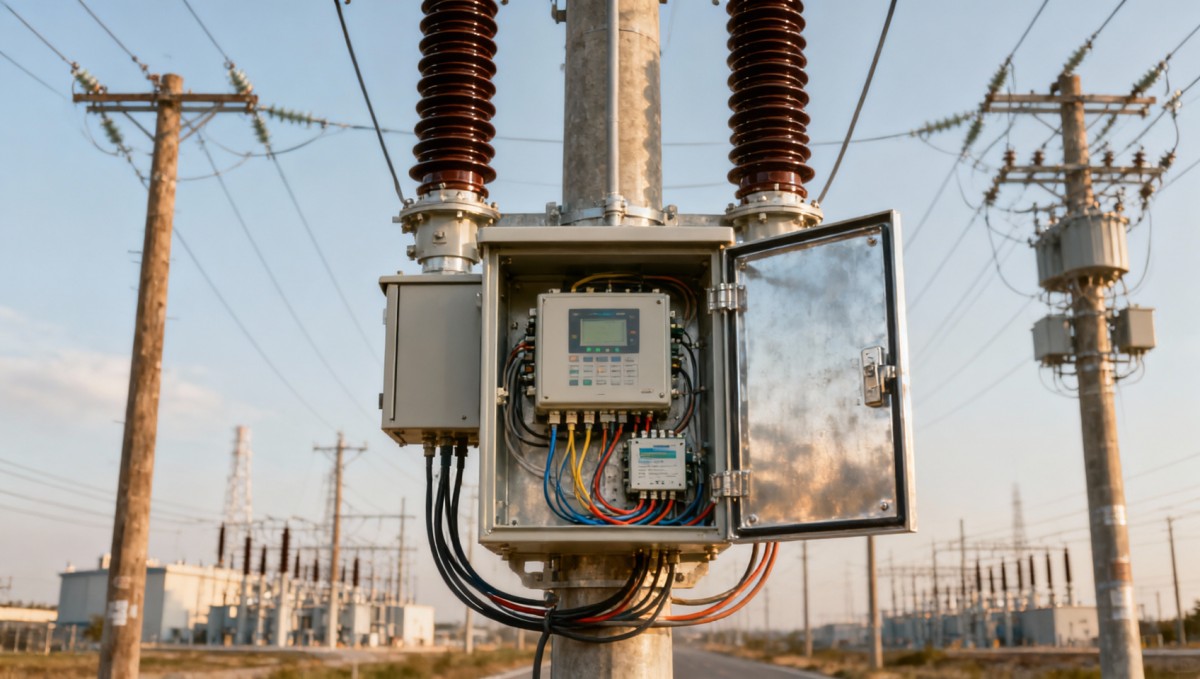
The same physical switches and communications network may support both approaches. The additional capability lies in reliable decision logic, sufficient network information, and verified operating rules—not simply in installing another control-room screen.
Where the intelligence sits changes the architecture
Centralized automation gathers field information and makes decisions in a control-center application. This can support wider network coordination, especially where a maintained network model and suitable measurements are available. It also makes communications availability and model quality central design concerns.
Decentralized schemes place more decision-making in field controllers. Devices may exchange information directly or follow pre-engineered local sequences. Such arrangements can reduce dependence on a control-center connection for particular functions, but their behavior must remain appropriate when feeder configurations change.
Hybrid architectures combine these approaches. A local controller might regulate voltage continuously, while a central application adjusts its target or coordinates it with other assets. SCADA can provide supervisory visibility and control across those layers without being the sole location of the automation logic.
This is also where distribution management systems and advanced distribution management systems enter the discussion. A DMS or ADMS may host network analysis, switching support, FLISR, and volt/VAR optimization. SCADA may be integrated into that platform or connected to it. Product names vary, so a system label is weaker evidence than a documented functional architecture.
Voltage control shows why the distinction goes beyond outages
Distribution automation is not limited to restoring interrupted supply. Voltage and reactive-power management is another useful example because it can involve both local control and network-wide coordination.
SCADA can show voltage measurements, capacitor-bank status, and regulator tap positions. It may also allow operators to change settings or issue switching commands. A volt/VAR optimization application uses available measurements, operating constraints, and an appropriate network representation to coordinate these assets toward defined objectives.
The objective could involve maintaining acceptable voltage, managing reactive power, or reducing losses. These objectives are not identical, and one operating strategy will not suit every feeder. Distributed solar generation, changing demand, and reverse power flow can alter which control actions are appropriate.
Battery storage and inverter-based resources can also participate where equipment capabilities, permissions, and control interfaces allow. Their coordination may involve a distributed energy resource management system rather than SCADA alone. For researchers, this is a reminder to examine responsibility boundaries between applications, not assume one platform controls everything.
Shared infrastructure does not guarantee automation readiness
An existing SCADA installation can be a foundation for distribution automation. It may already provide communications, telemetry, device addressing, operator workflows, and historical records. However, information adequate for human supervision may not be sufficient for unattended decisions.
An operator may recognize that a measurement is stale or reconcile an inconsistent switch indication using other information. Automated logic needs explicit rules for those situations. Data quality flags, timestamps, topology accuracy, and device-state confirmation therefore become part of the operating design, not merely database housekeeping.
Communications requirements also depend on the function. Periodic monitoring, event reporting, switching coordination, and protection-related messaging do not have interchangeable timing requirements. There is no single latency specification that proves a network is ready for every automation application. End-to-end performance must be assessed against the intended sequence and failure conditions.
Protocols such as DNP3, IEC 60870-5-104, and IEC 61850 may appear in utility architectures. Supporting a named protocol does not, by itself, establish interoperability. Device data models, supported services, configuration, security provisions, and application behavior still require verification.
Cybersecurity becomes especially consequential when compromised commands could initiate coordinated switching. Access controls, network segmentation, secure remote maintenance, logging, and recovery procedures need to match the operational environment. Automation should also have defined behavior when communications fail: continuing limited local control, blocking selected actions, or reverting to operator supervision as appropriate.
How to compare modernization proposals without confusing the terms
The most revealing question is simple: what operational decision will the proposed system make that the existing system cannot? If the answer is only “display more measurements,” the project may primarily improve SCADA coverage. That can be worthwhile, but it should not be mistaken for automated network restoration.
A technical review should follow the decision from input to execution:
- Inputs: Which measurements, switch states, network models, and equipment limits are required?
- Authority: Does the application recommend actions, request approval, or operate automatically?
- Constraints: How are work permits, local-control selections, maintenance blocks, and protection requirements enforced?
- Exceptions: What happens when a switch fails to operate, telemetry becomes stale, or the expected supply path is unavailable?
- Verification: How will normal operation, abnormal conditions, and recovery be tested before deployment?
Performance measures should follow the function as well. SCADA assessments may emphasize telemetry availability, command success, alarm handling, and event visibility. Restoration automation additionally requires evaluation of valid switching decisions, restoration eligibility, unsuccessful sequences, and post-transfer operating limits. Reliability indicators such as SAIDI and SAIFI can provide broader context, but their interpretation depends on local reporting rules and other network factors.
For the Global Industry Synergy Network (GISN), this functional approach connects smart-grid research with practical industrial analysis: examining equipment, software, integration, and operating conditions together rather than comparing isolated technology labels. It is particularly relevant where renewable generation and energy storage change distribution-network behavior.
SCADA and distribution automation are usually complementary, not competing alternatives. Before comparing platforms, define one intended operating sequence and ask who detects the condition, who decides, who authorizes, and who executes. Then check what happens when any link fails. Those answers reveal the actual capability far more clearly than the word “automated” in a proposal.
Recommended News
- Energy Management in North America: Using Demand Response to Cut Facility CostsOct 26, 2026Explore energy management North America facilities can use to cut costs with demand response. Learn to assess programs, protect operations, and unlock reliable savings.
- China’s First Regional Electricity Market Begins Formal OperationOct 25, 2026Explore China’s first regional electricity market across five regions. Discover what its trading framework could mean for power procurement, contracts and business planning.
- How does distribution automation differ from SCADA?Oct 21, 2026Distribution automation vs. SCADA: discover how control logic, fault restoration, and voltage optimization differ—and what to evaluate for smarter grid upgrades.
- Fixing timestamp mismatches in distribution automation data integrationOct 21, 2026Fix distribution automation data integration timestamp mismatches. Learn to trace events, resolve clock and time-zone errors, and restore reliable event records.
- When is manual override needed in automated power distribution?Oct 21, 2026When does automated power distribution need manual override? Explore key triggers, safety checks, and control limits to support safer decisions and protect critical power systems.
- Product Safety for Green Materials: Selecting Chemical Tests by End UseOct 29, 2026Product safety for green materials starts with end use. Learn how to select emissions, migration, and chemical tests to close evidence gaps and support credible safety claims.
- CNESA Approves Lithium-Plating Test Standard Project for Energy Storage BatteriesOct 29, 2026CNESA approves a lithium-plating test standard project for energy storage batteries. Explore potential impacts on battery testing, supplier evaluation and procurement.
- TBEA’s 29 New Energy and Power Equipment Products Pass National-Level AppraisalOct 26, 2026TBEA’s 29 new energy and power equipment products reportedly passed national-level appraisal. Explore the results and key checks for smarter procurement decisions.
- Baby Sleeping Bags: Choosing the Right TOG Rating and a Safe FitOct 25, 2026Choosing babysleepingbags? Discover how to match TOG ratings to room temperature, check for a safe fit, and avoid overheating with practical tips to help you shop confidently.
- Eco Building Solutions in the UAE: Estidama vs. Al Sa'fat RequirementsOct 21, 2026Explore eco building solutions UAE projects need. Compare Estidama and Al Sa’fat ratings, technical requirements and compliance evidence to reduce approval risks and choose with confidence.
- Outdoor Furniture Prices by Material: Purchase, Delivery, and Upkeep CostsOct 27, 2026Compare outdoor furniture price by material, including purchase, delivery, and upkeep costs. Discover how to evaluate supplier quotes and choose better long-term value.
- Real-Time Industrial Trend Analysis: Which Indicators Signal Demand Shifts?Oct 23, 2026Use real time industrial trend analysis to spot demand shifts early. Discover how orders, inventory, and factory activity reveal buying signals and guide smarter business decisions.
- Global Sourcing for Procurement: How to Compare Total Landed CostsOct 22, 2026Optimize global sourcing for procurement by comparing total landed costs, from freight and duties to quality risks. Discover how to uncover hidden costs and choose suppliers with confidence.
- How Can Data Analysis Compare Global Supplier Pricing Trends?Oct 12, 2026How to use data analysis to compare global supplier pricing trends? Learn to align quotes, track currency impacts, and compare landed costs for smarter sourcing decisions.
- Vietnam Precast Concrete Market: Demand Drivers, Capacity, and Buyer RisksOct 09, 2026Vietnam precast concrete market insights: assess demand drivers, production capacity, logistics, quality compliance, and buyer risks for smarter sourcing and investment decisions.
All Categories
Hot Articles
- Product Safety for Green Materials: Selecting Chemical Tests by End UseOct 29, 2026Product safety for green materials starts with end use. Learn how to select emissions, migration, and chemical tests to close evidence gaps and support credible safety claims.
- CNESA Approves Lithium-Plating Test Standard Project for Energy Storage BatteriesOct 29, 2026CNESA approves a lithium-plating test standard project for energy storage batteries. Explore potential impacts on battery testing, supplier evaluation and procurement.
- Choosing a Market Trends Dashboard: Data Sources, Coverage, and FreshnessOct 28, 2026Choose a Market Trends dashboard with confidence. Learn how to verify data sources, compare coverage, and assess freshness to find reliable insights for smarter business decisions.