
How Do You Evaluate Modular Home Suppliers Internationally?
TIME
Click count
A competitive factory quote is not enough to establish whether an overseas modular home supplier offers good value. The decisive question is whether the proposed building can be approved, transported, installed, and supported at its destination—with clear responsibility for every interface. A lower-priced supplier can become the more expensive choice if its design requires substantial re-engineering or its scope ends before critical site work begins.
International supplier comparisons therefore need two separate tests: whether the proposed system is viable for the specific project, and how competing suppliers perform once their scope and evidence are made comparable. Compliance, structural suitability, and inspection access should be pass-or-fail requirements, not weaknesses that a low price can offset.
Establish whether the offers describe the same building
“Modular home” can describe materially different products. A finished volumetric module, a flat-pack building kit, and a panelized structural package transfer different amounts of work to the destination site. Comparing their advertised price per square meter without adjusting for scope produces a misleading result.
Issue a common project brief before requesting final quotations. It should define the destination, intended occupancy, building dimensions, site conditions, required performance, finish level, and delivery boundary. Require suppliers to identify exclusions and deviations explicitly rather than simply confirming that they can supply “to local standards.”
Use the same area definition in every comparison. Gross external area, usable internal area, and an area including decks or covered outdoor spaces are not interchangeable. A price-per-area calculation is useful only after both the denominator and the supplied scope have been aligned.
Test destination approval before accepting certificates
A supplier’s ability to export a building does not establish that the building can legally be occupied at its destination. The approval pathway depends on the jurisdiction, building use, site, and construction system. Factory-built work may require an accepted inspection or certification arrangement, while foundations, utilities, and site installation remain subject to separate local review.
Before committing to production, obtain written clarification from the relevant authority or an appropriately qualified local adviser about the applicable pathway. Establish which drawings, calculations, product evidence, factory inspections, and site inspections are required—and who is responsible for obtaining each acceptance.
Compare suppliers using project-relevant evidence:
- Structural documentation: Calculations addressing applicable wind, snow, seismic, and other loads, including foundations and module connections where these form part of the supplier’s scope.
- Fire performance: Evidence for the specified assemblies and penetrations, not merely a fire-related claim about an individual board or insulation product.
- Building-envelope performance: Details supporting the required thermal, moisture, air-leakage, and weather-resistance performance under destination conditions.
- Service compatibility: Electrical, plumbing, ventilation, and other systems suitable for local requirements and available utilities.
- Inspection arrangements: A workable method for verifying concealed work before factory finishes prevent access.
An ISO 9001 certificate concerns a quality management system; it does not certify a particular home against destination building requirements. Likewise, CE marking on an applicable construction product does not, by itself, establish approval of an assembled home. Check the issuer, validity, scope, covered factory, and relationship between every document and the actual proposed specification.
Previous deliveries to the same country provide stronger evidence than an unrelated export history, but even these are not conclusive. Ask whether the earlier building had the same use, structural system, approval route, and relevant design conditions. A photograph of an installed unit cannot substitute for evidence of acceptance.
Compare manufacturing control, not factory presentation
A factory visit is valuable when it tests how production is controlled. A showroom demonstrates appearance; production records demonstrate whether the same result can be repeated and verified.
Confirm the identity of the contracting entity, the factory operator, and any subcontractors producing critical assemblies. A trading company is not automatically an unsuitable partner, but the arrangement must preserve access to manufacturing records, inspections, corrective action, and warranty support. Otherwise, responsibility can become fragmented when a defect appears.
Request records from completed production batches: incoming-material checks, dimensional inspections, relevant welding or fastening records, moisture checks where applicable, service tests, and nonconformity closeouts. Documents should identify the unit or batch, inspection date, result, and responsible person. Blank inspection forms show an intended process, not evidence that it operates.
Place particular weight on work that will become inaccessible. Examples include framing connections, insulation continuity, concealed wiring, pipework, waterproofing, and fire-stopping. An independent final inspection cannot fully compensate for missed checks before closure. Inspection hold points and release authority should be agreed before manufacturing starts.
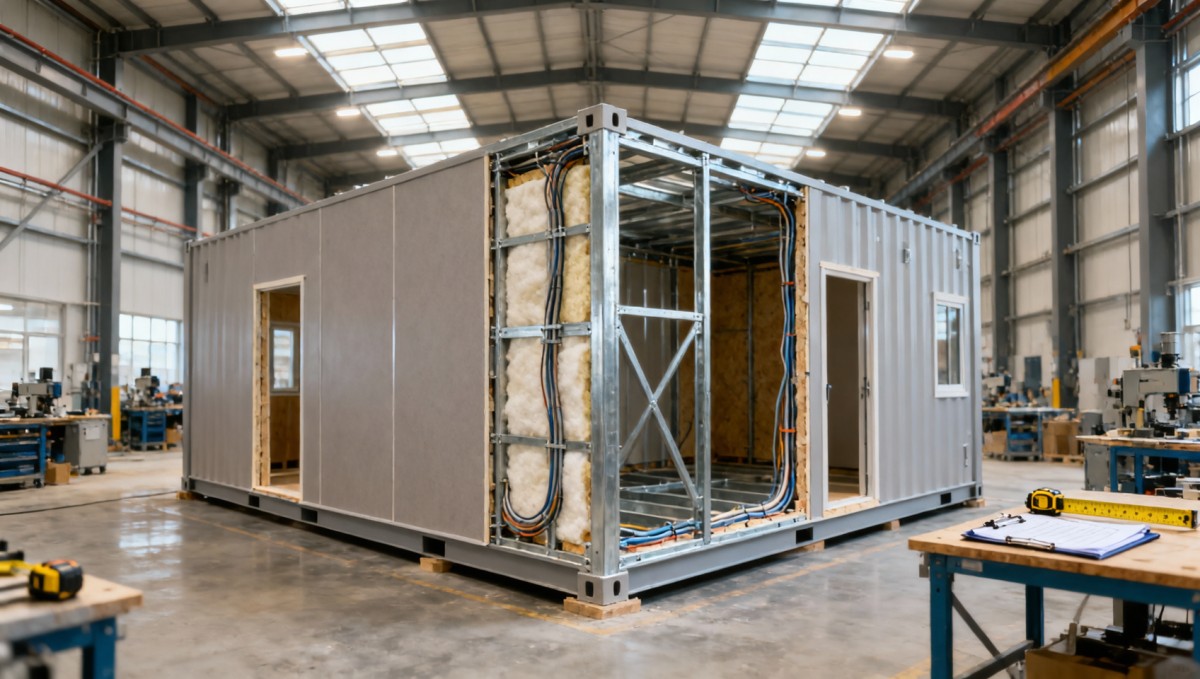
Capacity claims also need a project-specific test. Annual output says little about the production slot available for a particular order. Ask for a schedule linking design release, material purchasing, fabrication, inspections, packing, and dispatch. Identify shared bottlenecks, including specialist subcontractors and components with long replacement lead times.
A supplier willing to produce an agreed first article or representative mock-up can offer a useful way to validate workmanship and interfaces. Define its acceptance criteria and how corrections will carry into subsequent units; otherwise, the exercise risks becoming another showroom inspection.
Read specifications at the assembly and interface level
Material lists alone do not explain how a home will perform. Two suppliers can specify similar steel thicknesses or insulation depths while delivering different structural, thermal, acoustic, or moisture outcomes because their connections and assembly details differ.
Require controlled drawings and specifications that identify material grades, protective coatings, insulation properties, window performance, membranes, finishes, and permitted substitutions. Terms such as “premium,” “marine grade,” or “equivalent” need measurable definitions where they affect performance.
Then examine the interfaces: module-to-module joints, roof transitions, foundation connections, service crossings, and openings. These are places where factory responsibilities and site responsibilities meet. A weather-resistant wall panel does not establish that its field-installed joint will resist water penetration. Similarly, laboratory acoustic evidence for one assembly does not automatically describe sound transmission through a completed building with different junctions.
Transport and lifting deserve separate engineering attention. The completed building’s service condition is not the only loading condition it will encounter. Ask how temporary bracing, lifting points, packing supports, and transport restraints are designed, and who confirms that handling has not compromised the structure or finishes.
Convert factory prices into installed-cost comparisons
The useful financial comparison is the cost of achieving an approved, usable building at the site—not the invoice value at the factory gate. Build each offer into the same cost model, distinguishing firm prices, allowances, exclusions, and unresolved items.
Depending on the project, that model should include design adaptation, approval work, factory inspections, export packing, origin handling, freight, insurance, duties and taxes, destination handling, customs services, inland transport, storage, foundations, cranes, installation, utility connections, testing, and completion work. Show recoverable taxes separately where applicable rather than treating all taxes as permanent costs.
For volumetric modules, physical transport feasibility can outweigh freight rates. Confirm the actual packed dimensions and weights, shipping method, route restrictions, permits, lifting equipment, and site access. A quotation based on a standard container is not comparable with an offer requiring oversized cargo handling.
State the agreed Incoterms® rule, named place, and version precisely. These terms allocate specified delivery obligations, costs, and risks; they do not resolve building compliance, ownership transfer, installation scope, or warranty obligations. Those matters require separate contractual provisions.
Keep uncertainty visible. If one supplier excludes connection engineering and another includes it, obtain a comparable price or carry an explicit allowance rather than treating the exclusion as zero. Separate foreseeable project costs from contingency, and test the effect of freight changes, exchange-rate movements, storage, and delayed site readiness without presenting those scenarios as forecasts.
Examine whether financial and contractual promises are usable
A favorable technical assessment can still be undermined by payment exposure or weak contractual recourse. Verify the legal entity, ownership information where available, bank-account beneficiary, and authority of the signatory. Review financial information proportionate to the contract value and seek independent verification where the exposure warrants it.
Payment milestones should correspond to verifiable progress rather than dates alone. Design acceptance, identifiable material procurement, completed inspections, and shipment readiness can provide clearer evidence than an unsupported request for the next installment. Specify what happens if goods fail inspection or the schedule slips.
Advance-payment guarantees, documentary credits, escrow arrangements, and retention can address different risks, but none is a universal solution. Their value depends on wording, issuer quality, documentary requirements, governing law, and practical enforceability. A documentary credit does not establish physical quality unless the required documents provide meaningful inspection evidence.
The contract should also identify ownership of paid-for work in progress, insurance responsibilities, rights following termination, and access to drawings needed to complete or repair the building. Obtain jurisdiction-specific legal advice where cross-border enforcement or recovery of unfinished goods is material.
Warranty length should not dominate the comparison. More consequential questions are when coverage begins, what it excludes, who diagnoses defects, and who pays for labor, travel, freight, access, and reinstatement. A replacement component supplied overseas may leave most of the repair cost unresolved. Confirm local service arrangements, response obligations, and availability of compatible replacement parts.
Make the final comparison evidence-led
Use mandatory acceptance conditions before applying a weighted score. An unresolved approval pathway, refusal to allow necessary inspections, or inability to establish the contracting entity should not be balanced against attractive finishes or a lower price.
For suppliers that pass those conditions, score demonstrated capability separately from unresolved risk. Technical fit, quality controls, delivery feasibility, comparable installed cost, and after-delivery support can carry different weights according to the project. Record the evidence behind each score and reduce confidence where claims remain unsupported.
A supplier with a higher factory price may offer the stronger proposition if its documentation is accepted, its interfaces are engineered, and its delivery scope removes expensive uncertainty. A lower-priced supplier can remain competitive when the excluded work is clearly defined, locally deliverable, and fully costed.
The award decision should leave few unanswered questions about who designs, approves, inspects, transports, installs, and repairs each part of the building. Where a critical assumption remains open, make its resolution a condition of contract effectiveness or production release—not a problem to solve after shipment.
Recommended News
- Prefab Houses for Temporary Housing: Choosing a Solution for Your SiteNov 11, 2026Prefab houses for temporary housing: compare formats, site requirements, costs, and approvals to choose a practical solution for your project.
- How Do You Evaluate Modular Home Suppliers Internationally?Oct 27, 2026Learn how to evaluate modular home suppliers internationally: compare compliance, factory quality, installed costs, and warranties to avoid costly risks and choose with confidence.
- How to Compare Prefab Green Building Systems for Thermal PerformanceOct 21, 2026Compare prefab green systems beyond R-values. Learn how thermal bridges, airtightness, and moisture control affect performance—and choose your next building system with confidence.
- What Is the Typical Lead Time for Custom Modular Home Orders?Oct 12, 2026What is the typical lead time for custom modular home orders? Explore key timelines, permit delays, and delivery milestones to compare suppliers and plan your move with confidence.
- Which Prefabricated Housing System Fits Your Site, Climate, and Build Schedule?Oct 09, 2026Prefabricated housing building systems compared: choose modular, panelized, or hybrid solutions for site access, climate resilience, cost control, and faster delivery.
All Categories
Hot Articles
- Audience Targeting for Regional Cultural Promotion: A Practical GuideNov 16, 2026Master regional cultural promotion audience targeting with practical tips to reach the right people, craft compelling messages, and drive participation.
- Oman Awards Two Duqm Green Hydrogen Projects and Opens Fourth Auction at COP31Nov 15, 2026Oman green hydrogen projects in Duqm target 121,000 tonnes annually by 2032. Explore the awards and a new auction linking hydrogen with green-powered data centers.
- Supplier Capability Metrics: How to Assess Capacity, Quality and DeliveryNov 15, 2026Use supplier capability metrics to assess capacity, quality and delivery. Learn how to verify claims, compare suppliers and reduce sourcing risks.