
What makes a cultural destination strategy relevant to local communities?
TIME
Click count
A cultural destination strategy is relevant to local communities when it improves daily life before it promotes visitor appeal. That means local people can still move through the area easily, run viable businesses, use public spaces, recognise their own stories, and influence decisions that affect them. A restored historic district, museum quarter, waterfront, arts trail, or rural heritage route may attract attention, but it becomes a durable destination only when residents see practical value rather than disruption.
This distinction matters early. A project can have striking architecture, ambitious programming, and strong tourism marketing yet still lose local support if rents rise without local benefit, public space becomes inaccessible, traffic overwhelms neighbourhood streets, or culture is presented as a product disconnected from the people who sustain it. A useful cultural destination strategy treats heritage, infrastructure, business activity, environmental capacity, and community participation as one operating system.
Start with the local value proposition, not the visitor campaign
The first planning question should not be, “What will attract visitors?” It should be, “What problem or opportunity does this destination address for the place?” The answer may involve protecting a threatened craft tradition, bringing vacant buildings back into use, creating year-round employment, improving public access to a waterfront, supporting independent businesses, or making a local history more visible to younger residents.
These goals are not interchangeable. A town centre seeking to reactivate empty retail units needs a different approach from a heritage area trying to reduce crowding, or a rural community seeking modest income without turning everyday life into a visitor spectacle. When the local objective is vague, the delivery team tends to default to visible outputs: renovated facades, event calendars, signage, and promotional content. Those may be useful components, but they are not proof of relevance.
A stronger brief identifies the intended local benefit in terms people can test over time. For example:
- Can locally owned businesses participate in the visitor economy without being priced out?
- Will public spaces remain usable for residents during peak periods and events?
- Are cultural activities accessible beyond one-off festival dates?
- Does the plan create practical routes into work, training, supply contracts, or creative production?
- Will the destination protect the character that made the place meaningful in the first place?
These questions make community relevance operational. They also expose conflicts while changes are still affordable to make.
Community participation must affect decisions
Public consultation alone does not make a destination locally grounded. Communities can usually tell when engagement happens after the major choices have already been made. A strategy gains credibility when residents, local businesses, cultural groups, property owners, and service providers can influence matters that change the lived experience of the area.
That does not mean every participant must agree with every decision. Cultural projects often involve real trade-offs: more visitors may support local commerce but increase pressure on transport; conservation rules may preserve heritage but add cost for small operators; evening programming may activate a district but affect nearby homes. The purpose of participation is to identify these trade-offs clearly, set priorities, and explain how decisions will be made.
Engagement works best when it is tied to specific choices. Ask residents to respond to proposed access arrangements, event timing, public-space rules, business support criteria, storytelling priorities, and management responsibilities. Invite local cultural practitioners early enough to shape interpretation, not merely validate a finished narrative. Include people who use the place at different times: workers, students, older residents, families, vendors, transport users, and people with mobility needs.
There is also a practical reason to do this. Local knowledge often identifies constraints that desktop studies miss: a market street that cannot absorb coach drop-offs, a seasonal event that already limits parking, a pathway that floods, a community hall that could support programming, or a locally sensitive site that should not be commercialised. Such information is not an obstacle to delivery. It improves scope, phasing, and operating assumptions.
Design the destination around ordinary use
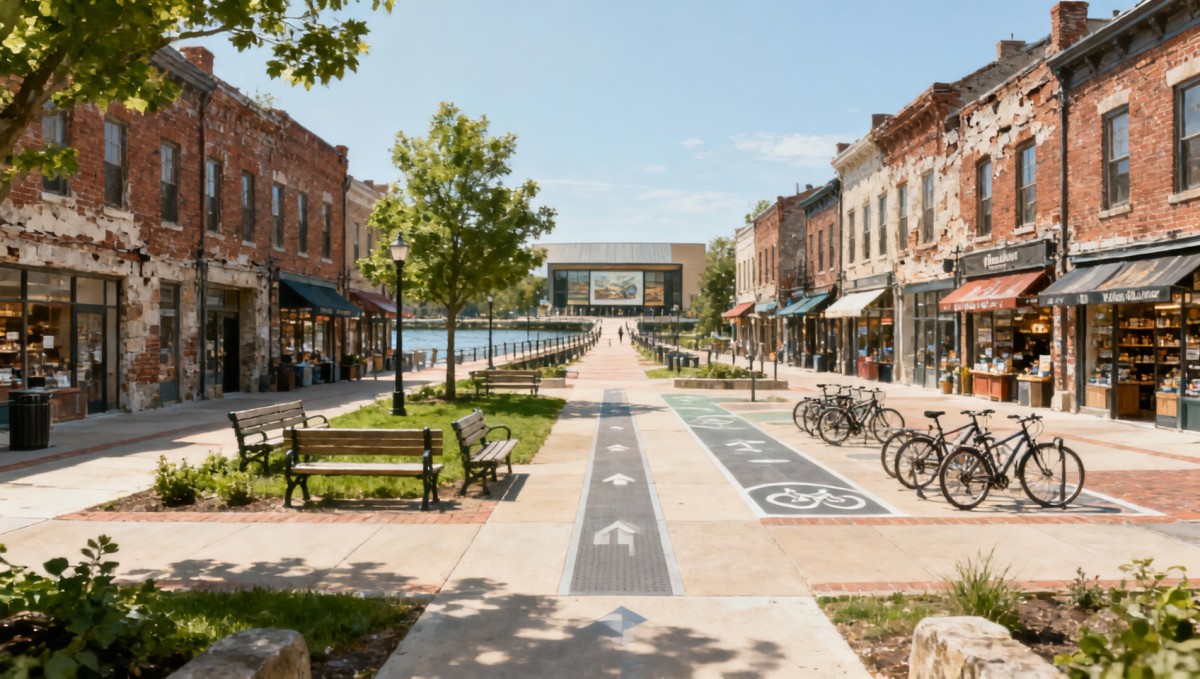
Places that work only during programmed events rarely feel relevant to the people who live nearby. The more resilient model is a destination that offers value on an ordinary weekday, in a quieter season, and outside the main visitor route.
This changes design priorities. Wayfinding should help residents as well as tourists. Seating, shade, lighting, toilets, crossings, cycle access, and step-free routes may have greater long-term importance than a landmark installation. Flexible spaces can host exhibitions or performances, but they should also support markets, workshops, community gatherings, and informal use. Maintenance plans need to cover the unglamorous elements that determine whether the area remains welcoming after launch.
Accessibility deserves particular attention. A cultural destination can unintentionally exclude local users through physical barriers, ticket prices, complex booking processes, language choices, or programming that assumes visitors have time and disposable income. Inclusion is not achieved by adding one accessible entrance or a discounted event. It is built into circulation, interpretation, operating hours, pricing logic, and the variety of ways people can participate.
Transport planning belongs in the cultural strategy as well. Increased footfall changes loading patterns, parking demand, pedestrian safety, public transport capacity, waste collection, and emergency access. If these effects are treated as issues for later technical design, the finished destination may function poorly despite a successful launch. The community experiences the operational consequences every day, so they should be considered alongside the visitor experience.
Keep economic benefit within the local system
A destination does not need to exclude outside investment or national brands to benefit its community. It does need a deliberate approach to local economic participation. Without one, the highest-value opportunities can flow to external operators while local people receive only seasonal, low-control work and higher living costs.
Relevant strategies examine who can supply goods, services, experiences, maintenance, food, interpretation, transport, and cultural programming. Small firms and independent practitioners often need opportunities that match their scale. A large procurement package may be efficient for administration but inaccessible to local suppliers. Splitting work into appropriate lots, publishing requirements early, using transparent selection criteria, and providing realistic lead times can widen participation without weakening delivery standards.
Commercial planning should also avoid treating every local business as a tourism business. A neighbourhood grocer, repair shop, school, workshop, or healthcare service may be essential to the area even if it does not sell directly to visitors. Rising rents, altered loading access, and event restrictions can damage these businesses. A destination strategy should map both visitor-facing enterprises and everyday services, then assess how construction and operation will affect each group.
The same principle applies to cultural labour. If local artists, historians, makers, and performers are used only as decorative contributors to a visitor offer, the project may extract cultural value without strengthening the cultural economy. Fair commissioning, repeat opportunities, skills development, and room for local-led programming create a more balanced relationship.
Protect meaning, not just buildings
Heritage can be physical, social, industrial, spiritual, artistic, or ecological. A plan focused only on preserving fabric may overlook the practices and relationships that give a place meaning. A former industrial site, for instance, may be valued not only for its machinery or architecture but also for the workers’ stories, local skills, and community memory connected to it.
Interpretation should therefore be developed with care. Simplified storytelling can make a destination easier to market, but it can also flatten contested histories or turn living culture into a fixed display. Local relevance improves when interpretation allows complexity, acknowledges different perspectives, and gives residents an ongoing role in how stories are presented.
This is especially important where cultural assets have religious, indigenous, memorial, or politically sensitive significance. Not every meaningful place should be positioned for high-volume visitation. Some sites need limited access, quiet-use rules, local stewardship, or a lower-profile visitor model. The appropriate strategy is the one that protects the asset’s social meaning, even when that limits commercial potential.
Set measures that reveal whether the place is still working for residents
Visitor numbers, media coverage, and ticket revenue can show demand, but they do not show whether a destination remains relevant to its host community. A better monitoring framework combines economic, social, cultural, environmental, and operational indicators.
The monitoring method matters as much as the measure. Feedback should be collected regularly, not only at launch or after controversy. Combine operational data with conversations involving local users and frontline staff. A complaint log may reveal recurring problems, but it will not explain whether an issue is caused by poor event scheduling, unclear signage, lack of seating, pricing, or a deeper loss of trust.
Common project mistakes that weaken community relevance
Starting with a landmark before agreeing the operating model. A signature building or public-realm intervention can attract investment, but the ongoing questions are harder: Who manages it? Who programmes it? How is it maintained? Who has access when commercial demand is high? If these answers are unclear, the project may open strongly and then drift away from local needs.
Equating consultation with consent. A meeting, survey, or exhibition does not resolve concerns unless feedback changes decisions or receives a clear response. Silence after consultation is often interpreted as dismissal.
Measuring success only through growth. More visitors are not always better. Capacity constraints, heritage sensitivity, residential conditions, and local service demand should set the acceptable scale of activity.
Assuming cultural programming automatically benefits the local economy. A popular event can still rely on external suppliers, temporary staff, and short-term spending patterns. Local benefit needs to be designed into commissioning, trading opportunities, and follow-on activity.
Leaving community governance until after construction. By that stage, key decisions about layout, access, tenancy, and commercial terms may be difficult to reverse. Governance should be considered while scope, funding, and procurement routes are still flexible.
Build relevance into the delivery sequence
A practical delivery sequence begins with a place-based baseline. Map cultural assets, current users, local businesses, access patterns, service pressures, and sensitive areas. Then define the local outcomes the project must protect or improve. Only after that should the team develop the visitor offer, spatial interventions, and commercial model.
At concept stage, test several scenarios rather than one preferred vision. A high-footfall model, a dispersed-route model, and a community-first model may all produce different infrastructure, staffing, and revenue requirements. Comparing them makes assumptions visible and helps stakeholders decide what level of tourism intensity fits the place.
Before procurement, translate local commitments into delivery requirements. Include expectations for access, local supplier engagement, interpretation, public-space management, maintenance, and reporting. Broad statements about “community benefit” are hard to administer. Clear responsibilities, review points, and escalation routes are more useful.
During construction and opening, keep communication focused on practical impacts: disruption, access changes, trading arrangements, event controls, and routes for raising issues. This is often more valuable to residents than promotional updates. Once operational, revisit the original local outcomes and adjust programming, management, or infrastructure where the evidence shows that the place is not working as intended.
Information should support local judgement
Destination planning benefits from external market intelligence, travel trends, and examples from other regions, but imported models should not replace local judgement. A strategy that performs well in a dense city, resort area, or heritage corridor may fail in a smaller community with different transport, housing, labour, or cultural conditions.
Platforms such as the Global Industry Synergy Network can help delivery teams connect travel and culture analysis with related considerations in green building materials, digital visitor tools, infrastructure, and cross-border market activity. The useful role of this information is to sharpen questions: what demand is realistic, what operating capabilities are needed, and where could external growth create local pressure? It should inform decisions made with the community, not decide them on the community’s behalf.
A relevant destination is not one that asks residents to tolerate tourism for an assumed future payoff. It is one where cultural investment makes the place more functional, more legible, and more economically connected for the people already invested in it. When that standard guides design, procurement, management, and measurement, visitor appeal becomes a result of local strength rather than a substitute for it.
Recommended News
- What makes a cultural destination strategy relevant to local communities?Sep 21, 2026Cultural destination strategy: discover how community-led planning protects heritage, supports local businesses, improves daily life, and creates sustainable visitor appeal.
- How Can Tourism Marketers Assess Cultural Sensitivity in Destination Campaigns?Sep 16, 2026How to assess cultural sensitivity in tourism destination marketing: discover practical review steps that protect local voices, build trust, and improve campaigns.
- How Cultural Brand Promotion Helps Regional Destinations Attract More Qualified VisitorsJul 24, 2026Cultural brand promotion helps regional destinations attract qualified visitors by turning local identity into memorable experiences, stronger positioning, and sustainable economic value.
- Regional Cultural Promotion for International Buyers: Practical Strategies for Trade EventsJul 11, 2026Regional cultural promotion for international buyers: discover practical trade event strategies that build trust, highlight regional strengths, and turn buyer interest into real business opportunities.
- How to Build English Regional Cultural Promotion Content for Tourism and Trade AudiencesJul 07, 2026English regional cultural promotion for tourism and trade: learn how to turn local identity into credible, search-friendly content that attracts visitors, buyers, and global interest.
- How to Define Technical Buying Criteria for Reliable Category ResearchSep 28, 2026Technical buying criteria for category research: build measurable requirements, assess risk, compliance, and lifecycle value for smarter supplier decisions.
- B2B Market Analysis Compliance Guide: How to Validate Data, Claims, and SourcesSep 25, 2026B2B market analysis compliance guide: learn to validate data, supplier claims, methodologies, and cross-border sources for credible, decision-ready market intelligence.
- When R&D in manufacturing is ready to move beyond the pilot stageSep 22, 2026R&D in manufacturing: discover the five signs your pilot is ready to scale, from process control and quality to integration, ownership, and real-world economics.
- How R&D in the manufacturing industry reduces scale-up riskSep 22, 2026r&d in manufacturing industry reduces scale-up risk with pilot builds, process validation, supplier alignment, and workforce readiness for more reliable launches.
- The most common supplier compliance requirements before onboardingSep 21, 2026Explore the most common supplier compliance requirements before onboarding, from legal checks and quality to ESG, cybersecurity, and supply continuity.
- Technology Advancements Dashboards: What Metrics Reveal Emerging Industry Shifts?Oct 02, 2026Technology advancements dashboard insights reveal investment, adoption, supply-chain, and policy signals—helping leaders spot real industry shifts before competitors.
- How to Compare Global Sourcing Information Before Shortlisting Overseas SuppliersSep 30, 2026Global sourcing information comparison made practical: verify suppliers, assess compliance, capacity, landed cost, and delivery risk before building a confident overseas shortlist.
- Battery Cage Price in Nigeria: Cost Drivers for Farm Project BudgetsSep 22, 2026Battery cage price in Nigeria explained: compare installed costs, steel quality, logistics, water systems and project budget risks before choosing poultry housing.
- How to Build a Poultry Equipment Price List for a New Farm SetupSep 22, 2026Poultry equipment price list guide for new farm setups: compare systems, uncover hidden costs, assess quality, and plan installation with confidence.
- Which digital export channels fit products with longer sales cycles?Sep 21, 2026Digital export channels for long sales cycles: learn how websites, industry platforms, marketplaces, and targeted outreach build trust, qualify buyers, and drive complex B2B export deals.
All Categories
Hot Articles
- Inbound Tourism Planning: How Destinations Can Build Visitor-Ready ExperiencesOct 04, 2026Inbound tourism planning helps destinations create reliable, visitor-ready journeys through seamless arrivals, mobility, access, safety, and service operations. Explore practical strategies.
- How to Choose Translation Services for Technical Documents and Global ProjectsOct 03, 2026Translationservices guide for technical documents and global projects: evaluate expertise, terminology control, quality assurance, security, and delivery for reliable results.
- Technology Advancements Dashboards: What Metrics Reveal Emerging Industry Shifts?Oct 02, 2026Technology advancements dashboard insights reveal investment, adoption, supply-chain, and policy signals—helping leaders spot real industry shifts before competitors.