
The Thermodynamics of Avian Liveability: Engineering Closed-Loop Poultry Ventilation And Temperature Control Systems
TIME
Click count
1. Introduction: The Extreme Weather Threat to Precision Farming
Modern poultry farming operates under a strict paradox: while genetic advancements have maximized layer egg output and growth velocities, they have simultaneously rendered modern commercial bird breeds hyper-sensitive to atmospheric fluctuations. Heat stress stands as the single most devastating environmental variable in intensive poultry production, capable of causing catastrophic mortality events and wiping out a farm’s productivity within a matter of hours. Achieving predictable biological outcomes now requires the complete abandonment of natural or open-sided housing philosophies. Survival and optimization are now entirely dependent upon the deployment of an engineered Poultry Ventilation And Temperature Control System. This mechanical complex acts as the artificial life-support network of the modern poultry house, manipulating microclimatic physics to maintain an unyielding thermal homeostasis regardless of external meteorological volatility.
2. Tunnel Ventilation Physics and Aerodynamic Design

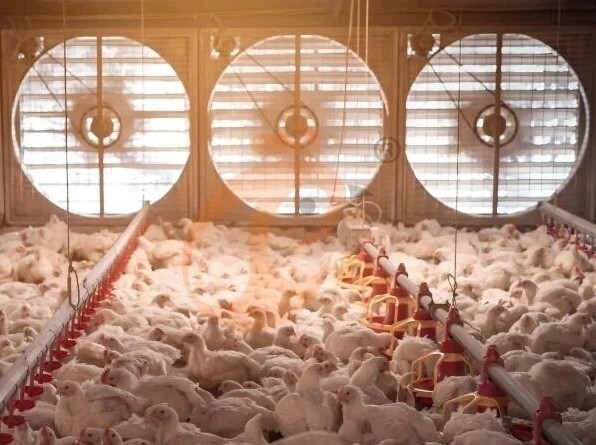
The core mechanical principle behind managing extreme thermal loads in high-density poultry houses is negative-pressure tunnel ventilation. This engineering discipline relies on the meticulous creation of a high-velocity air stream moving longitudinally through the length of the building.
Negative-Pressure Dynamics: High-efficiency exhaust fans (typically 50-inch or 57-inch fiber-reinforced plastic configurations) are bank-installed at the exhaust end of the house. By forcefully pulling stale air out of the building, a low-pressure zone is created internally. This negative pressure draws fresh air uniformly through targeted intake inlets or evaporative cooling pad matrices located at the opposite end of the building.
Wind Chill Effect Management: The primary cooling vector is not merely the replacement of hot air, but the convective heat loss generated by air velocity passing directly over the birds' bodies—known as the wind chill effect. A properly calibrated
Poultry Ventilation And Temperature Control System is designed to maintain an air speed of 2.5 to 3.0 meters per second at the bird level, effectively lowering the layer's perceived temperature by up to 5 to 7 degrees Celsius.
3. Evaporative Cooling and Humidity Equilibrium
During peak diurnal temperature spikes, air movement alone is insufficient to prevent heat exhaustion. Evaporative cooling systems must be integrated directly into the intake airflow stream.
Cooling Pad Engineering: Cross-fluted cellulose pad matrices are positioned over the air intake walls. Water is distributed evenly along the top of the pads via specialized overhead pipe headers, creating a continuous thin sheet of water within the corrugated pad channels. As hot, dry ambient air is drawn through these wet matrices, water molecules evaporate into the air stream, absorbing latent heat energy and instantly dropping the intake air temperature.
Closed-Loop Smart Regulation: The introduction of evaporative moisture introduces a secondary complication: relative humidity (RH). High temperature paired with high humidity halts the bird's natural cooling mechanism (panting). Therefore, the modern system utilizes intelligent climatic controllers linked to multi-point temperature and humidity sensors. When internal humidity crosses a dangerous 75% threshold, the controller automatically scales back the water pumps while shifting the exhaust fans to maximum velocity to clear the moisture load.
4. Automated Smart Environmental Controllers: The Brain of the House
The modern poultry climate system is entirely automated via central environmental control computers running specialized microcode. These processors collect real-time data inputs from static pressure meters, ammonia gas detectors, and internal/external thermal probes. The software continuously calculates the house's total heat load and steps the ventilation configuration through precise stages—transitioning smoothly from minimum ventilation cycles (for fresh oxygen supply during cooler hours) to transitional and full tunnel ventilation states. This automated loop ensures that human operational error is removed from the biosecurity equation, protecting millions of dollars of livestock assets 24 hours a day.
💡GISN Key Takeaways
Regional Trade Dynamics: Import auditing boards in the Middle East and African tropical trade corridors are mandating the integration of fail-safe backup power systems paired with automated ventilation controllers to eliminate the risk of flock suffocation during regional grid failures.
Author: Global Trade Strategist
Technical Specifications: Professional cooling pads require a minimum thickness of 150mm with a $45/45$ geometry to guarantee maximum evaporative efficiency. Exhaust fan motors must possess an IP55 ingress protection rating and class F insulation to endure continuous operation in high-dust agricultural settings.
Author: Chief Technology Fellow
Strategic Deployment: Farm engineering contractors and commercial poultry farm operators can leverage the system integration standards and hardware selector tools available on the
Poultry Ventilation And Temperature Control System Hub to engineer optimal climatic control networks.Author: Industrial Operation Consultant
Recommended News
- Where Semi-Automatic Poultry Farms Fit Between Manual and Smart SystemsOct 09, 2026Semi automatic poultry farm solutions bridge manual labor and smart systems, improving feeding, watering, waste handling, and control. Explore the right upgrade path for your farm.
- Layer Battery Cage System Selection: Capacity, Access, and Welfare FactorsSep 22, 2026Poultry cage system selection guide: compare capacity, access, automation, and welfare factors to build a reliable, efficient layer operation.
- How to Specify Energy-Efficient Poultry Ventilation for Broiler HousesSep 20, 2026Energy efficient poultry ventilation systems: learn how to specify fans, inlets, controls, and cooling for lower energy use, healthier broilers, and reliable airflow.
- Which Broiler Chicken Farming Equipment Manufacturer Fits Your Farm Scale?Sep 16, 2026Recommend a broiler chicken farming equipment manufacturer by matching automation, reliability, engineering support, and service to your farm scale.
- Layer Cage Selection Criteria for Small-Scale Poultry Farms in NigeriaSep 12, 2026poultry cages for sale in Nigeria — discover durable, climate-tested layer cages optimized for small-scale farms: corrosion resistance, space efficiency & real-world TCO savings.
- CE Prefab Houses: Which Components Require CE Marking Before Project Approval?Oct 10, 2026CE prefab houses: learn which components need CE marking before approval, from structural steel and windows to fire protection and MEP systems.
- How to Evaluate Technology Options Against Inspection Standards for Project ApprovalOct 07, 2026Technology option analysis inspection standards: compare evidence, testing, compliance, and lifecycle risk to make faster, approval-ready project decisions.
- How to Specify Manufacturing Equipment Systems for Throughput, Uptime, and SafetyOct 05, 2026Manufacturing equipment systems: learn how to specify sustained throughput, uptime, safety, controls, and acceptance tests for dependable production.
- How to Define Technical Buying Criteria for Reliable Category ResearchSep 28, 2026Technical buying criteria for category research: build measurable requirements, assess risk, compliance, and lifecycle value for smarter supplier decisions.
- B2B Market Analysis Compliance Guide: How to Validate Data, Claims, and SourcesSep 25, 2026B2B market analysis compliance guide: learn to validate data, supplier claims, methodologies, and cross-border sources for credible, decision-ready market intelligence.
- Vietnam Precast Concrete Market: Demand Drivers, Capacity, and Buyer RisksOct 09, 2026Vietnam precast concrete market insights: assess demand drivers, production capacity, logistics, quality compliance, and buyer risks for smarter sourcing and investment decisions.
- Technology Advancements Dashboards: What Metrics Reveal Emerging Industry Shifts?Oct 02, 2026Technology advancements dashboard insights reveal investment, adoption, supply-chain, and policy signals—helping leaders spot real industry shifts before competitors.
- How to Compare Global Sourcing Information Before Shortlisting Overseas SuppliersSep 30, 2026Global sourcing information comparison made practical: verify suppliers, assess compliance, capacity, landed cost, and delivery risk before building a confident overseas shortlist.
- Battery Cage Price in Nigeria: Cost Drivers for Farm Project BudgetsSep 22, 2026Battery cage price in Nigeria explained: compare installed costs, steel quality, logistics, water systems and project budget risks before choosing poultry housing.
- How to Build a Poultry Equipment Price List for a New Farm SetupSep 22, 2026Poultry equipment price list guide for new farm setups: compare systems, uncover hidden costs, assess quality, and plan installation with confidence.
All Categories
Hot Articles
- Grid Modernization for Utilities: A Practical Roadmap for Integrating DERsOct 12, 2026Grid modernization for utilities: explore a practical roadmap to integrate DERs, improve feeder visibility, manage voltage and protection risks, and prioritize high-value grid upgrades.
- Eco-Friendly Construction: How Project Teams Cut Carbon Without Compromising PerformanceOct 11, 2026Eco-friendly Construction strategies that help project teams cut lifecycle carbon, control costs and risk, improve procurement, and deliver high-performing assets.
- CE Prefab Houses: Which Components Require CE Marking Before Project Approval?Oct 10, 2026CE prefab houses: learn which components need CE marking before approval, from structural steel and windows to fire protection and MEP systems.