
China Customs Adds 'Restriction ID' to Export Declarations
TIME
Click count
On April 16, 2026, China’s General Administration of Customs (GACC) issued a notice mandating the inclusion of a new ‘Restriction Identification Code’ on all export customs declarations, effective immediately. The measure targets sensitive technology exports—including AI-based solutions and smart grid equipment—and introduces mandatory pre-export technical export filing with provincial commerce authorities. This policy shift reflects intensified regulatory oversight over dual-use technologies and signals a structural tightening in cross-border tech trade compliance.
Event Overview
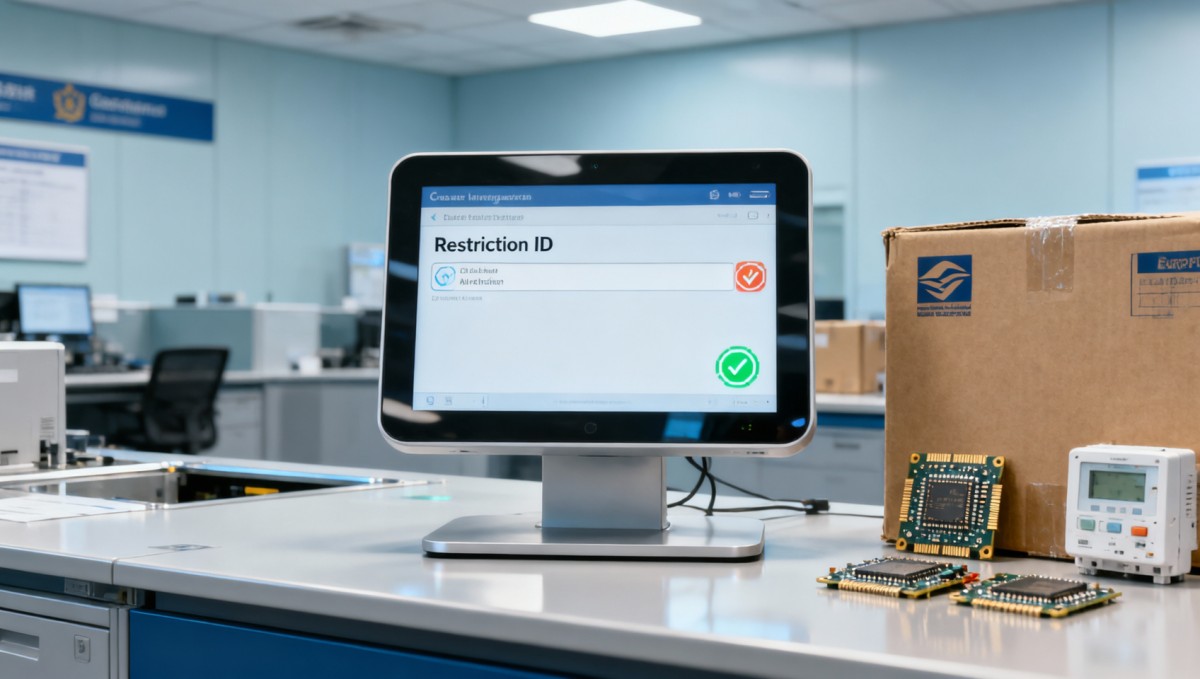
Effective April 16, 2026, GACC requires all export declarations to include a newly defined ‘Restriction Identification Code’ and associated declaration elements. Exporters of artificial intelligence algorithm services, edge intelligent terminals, and microgrid control systems must complete screening against the China Catalogue of Technologies Prohibited or Restricted from Export and obtain technical export filing approval from provincial-level commerce departments prior to shipment. Failure to comply results in automatic return of the entire customs declaration or elevated port inspection scrutiny.
Industries Affected
Direct trading enterprises face immediate operational impact: they now bear full responsibility for identifying whether their exported goods fall under restricted categories—regardless of whether they manufacture the items themselves. This shifts upstream compliance risk downstream, requiring enhanced internal classification capacity, updated ERP/customs declaration system integration, and tighter contractual alignment with suppliers on technology origin and control status.
Raw material procurement enterprises are affected indirectly but significantly. Where imported components (e.g., AI-accelerated chips, real-time OS modules, or certified communication stacks) embed controlled algorithms or architecture, procurement teams must now verify not only end-product compliance but also embedded technology lineage—especially when sourcing from non-domestic OEMs or contract manufacturers. Supplier documentation requirements (e.g., technology origin statements, export control self-declarations) become critical due diligence items.
Contract manufacturing and OEM enterprises encounter heightened liability exposure. Even if acting solely as production service providers, they may be required to retain and submit technical documentation—such as software bill-of-materials (SBOM), firmware architecture diagrams, or inference logic flowcharts—to support the exporter’s restriction code assignment. Their role transitions from ‘non-responsible party’ to ‘compliance-enabling partner’, necessitating internal export control awareness training and document retention protocols.
Supply chain service enterprises—including freight forwarders, customs brokers, and logistics platforms—must upgrade system capabilities to validate the presence and format validity of the Restriction Identification Code during pre-declaration checks. Brokers can no longer rely solely on HS code–based screening; they now need access to technical specifications or product classification guidance to flag potential mismatches. Service-level agreements (SLAs) may require revision to allocate responsibility for code misassignment or filing delays.
Key Focus Areas and Recommended Actions
Conduct technology classification audits by Q3 2026
Enterprises exporting AI or smart grid–related products should initiate internal reviews of current product portfolios against the latest Prohibited/Restricted Export Catalogue, focusing on algorithmic functionality, data processing autonomy, and real-time decision-making capability—not just hardware specs. Classification outcomes directly determine whether a filing is triggered.
Establish dual-track filing workflows with provincial commerce departments
Given variability in provincial interpretation and processing timelines, exporters should engage early with local commerce bureaus to clarify documentation expectations (e.g., whether source code submission is required, how model weights or training data parameters are assessed). Parallel preparation of filing dossiers—while maintaining version-controlled technical descriptions—is strongly advised.
Update digital declaration systems to support dynamic code assignment
Legacy customs declaration tools often treat export controls as static HS-code rules. New systems must allow manual or AI-assisted assignment of the Restriction Identification Code based on configurable technical attributes (e.g., inference latency < 50ms, on-device training enabled, federated learning architecture). Integration with product lifecycle management (PLM) databases is increasingly essential.
Editorial Perspective / Industry Observation
Observably, this policy is less about blocking exports than about building traceability infrastructure for emerging technologies. The Restriction Identification Code functions as a ‘compliance passport’—not a barrier, but a prerequisite for transparency. Analysis shows that the emphasis on microgrid controllers and edge AI terminals suggests regulators are prioritizing systemic resilience risks over discrete component controls. From an industry perspective, the timing aligns with China’s broader push to standardize technical sovereignty metrics across energy and digital infrastructure sectors. Current implementation appears calibrated to avoid disrupting high-volume low-risk shipments—filing exemptions for legacy firmware versions or open-source inference engines remain plausible, though unconfirmed.
Conclusion
This requirement marks a maturation point in China’s export control framework: moving from broad sectoral bans toward granular, product-specific, and technically grounded oversight. It does not signal isolation—but rather institutionalization of responsible innovation governance. For global supply chains, the implication is clear: technology provenance, not just geography or ownership, now defines regulatory treatment.
Source Attribution
Official source: General Administration of Customs of the People’s Republic of China, Announcement No. [2026]XX, issued April 16, 2026. Also referenced: Ministry of Commerce’s Administrative Measures for Technical Export Filing (2023 Revision). Note: Provincial implementation guidelines and filing templates remain pending; market participants are advised to monitor provincial commerce department portals for updates through Q2 2026.
Recommended News
- Do AI Manufacturing Inspection Tools Actually Reduce Inspection Time?Sep 16, 2026Do AI tools for manufacturing actually reduce inspection time? Discover where AI vision saves time, what affects ROI, and how to pilot smarter quality control.
- How Intelligent Data Analysis Dashboards Turn Operational Data Into Actionable DecisionsAug 30, 2026Intelligent data analysis dashboard: turn project data into clear, timely actions. Spot risks, control costs, protect schedules, and improve operational decisions.
- EU AI Act Article 50 Takes Effect, Requiring Clear Labels on AI-Generated ContentAug 15, 2026EU AI Act Article 50 now requires clear labels on AI-generated content in EU markets—learn what this means for listings, customer service, and compliance risks.
- How to Choose AI Business Solutions: Key Features, Integration Risks, and ROIJul 17, 2026AI business solutions: learn how to compare key features, avoid integration risks, and calculate real ROI so you can choose the right platform with confidence.
- AI Automation Tools for Procurement: Key Features to Compare Before You BuyJul 14, 2026AI automation tools for procurement compared clearly: discover the key features to evaluate before you buy, from integration and accuracy to scalability, governance, and ROI.
- How to Specify Manufacturing Equipment Systems for Throughput, Uptime, and SafetyOct 05, 2026Manufacturing equipment systems: learn how to specify sustained throughput, uptime, safety, controls, and acceptance tests for dependable production.
- How to Define Technical Buying Criteria for Reliable Category ResearchSep 28, 2026Technical buying criteria for category research: build measurable requirements, assess risk, compliance, and lifecycle value for smarter supplier decisions.
- B2B Market Analysis Compliance Guide: How to Validate Data, Claims, and SourcesSep 25, 2026B2B market analysis compliance guide: learn to validate data, supplier claims, methodologies, and cross-border sources for credible, decision-ready market intelligence.
- When R&D in manufacturing is ready to move beyond the pilot stageSep 22, 2026R&D in manufacturing: discover the five signs your pilot is ready to scale, from process control and quality to integration, ownership, and real-world economics.
- How R&D in the manufacturing industry reduces scale-up riskSep 22, 2026r&d in manufacturing industry reduces scale-up risk with pilot builds, process validation, supplier alignment, and workforce readiness for more reliable launches.
- Technology Advancements Dashboards: What Metrics Reveal Emerging Industry Shifts?Oct 02, 2026Technology advancements dashboard insights reveal investment, adoption, supply-chain, and policy signals—helping leaders spot real industry shifts before competitors.
- How to Compare Global Sourcing Information Before Shortlisting Overseas SuppliersSep 30, 2026Global sourcing information comparison made practical: verify suppliers, assess compliance, capacity, landed cost, and delivery risk before building a confident overseas shortlist.
- Battery Cage Price in Nigeria: Cost Drivers for Farm Project BudgetsSep 22, 2026Battery cage price in Nigeria explained: compare installed costs, steel quality, logistics, water systems and project budget risks before choosing poultry housing.
- How to Build a Poultry Equipment Price List for a New Farm SetupSep 22, 2026Poultry equipment price list guide for new farm setups: compare systems, uncover hidden costs, assess quality, and plan installation with confidence.
- Which digital export channels fit products with longer sales cycles?Sep 21, 2026Digital export channels for long sales cycles: learn how websites, industry platforms, marketplaces, and targeted outreach build trust, qualify buyers, and drive complex B2B export deals.
All Categories
Hot Articles
- Heavy Equipment Sourcing: A Due-Diligence Checklist for Reliable SuppliersOct 06, 2026Heavy equipment sourcing information: use this due-diligence checklist to verify suppliers, compare true costs, control delivery risks, and secure reliable equipment support.
- How to Specify Manufacturing Equipment Systems for Throughput, Uptime, and SafetyOct 05, 2026Manufacturing equipment systems: learn how to specify sustained throughput, uptime, safety, controls, and acceptance tests for dependable production.
- Inbound Tourism Planning: How Destinations Can Build Visitor-Ready ExperiencesOct 04, 2026Inbound tourism planning helps destinations create reliable, visitor-ready journeys through seamless arrivals, mobility, access, safety, and service operations. Explore practical strategies.