
China Delivers Desalinated Water System for Green Ammonia Project
TIME
Click count
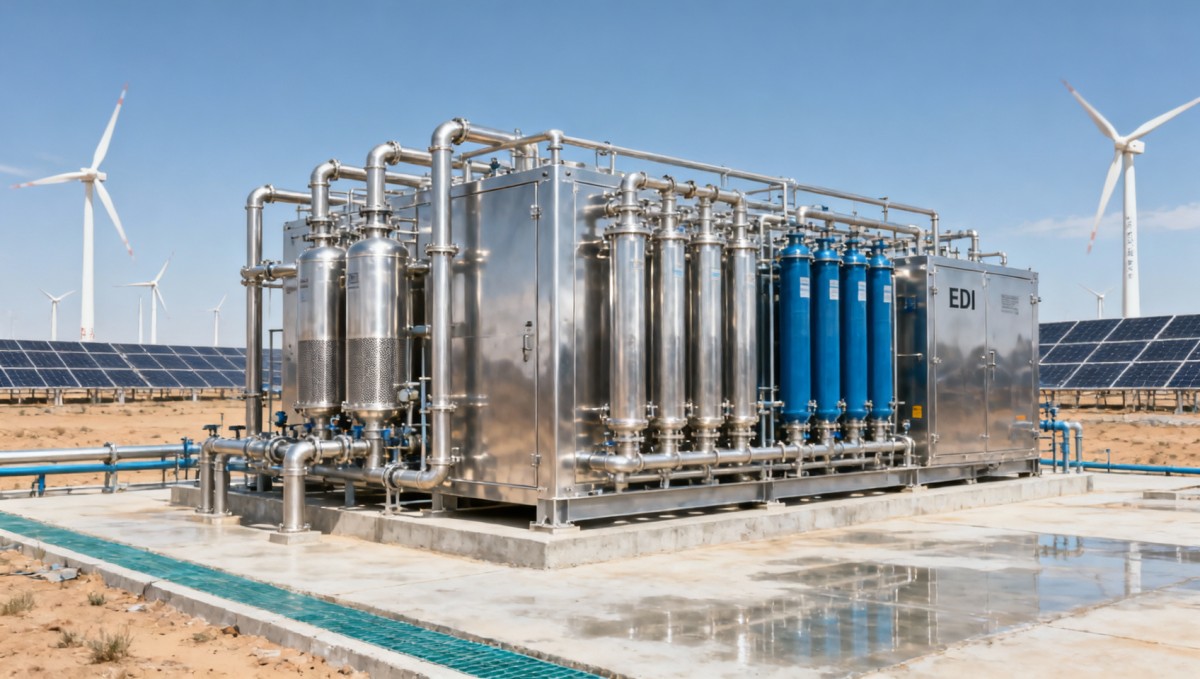
On April 28, 2026, the desalted water station for the Shenzhen Energy Etoke Banner Wind-Solar Hydrogen-to-Green-Ammonia Integrated Project—EPC-contracted by China Chemical Engineering Donghua Company—successfully produced qualified water. This development signals growing capability in modular, high-specification water treatment system export, with implications for green hydrogen and green ammonia equipment supply chains serving EU and Middle Eastern markets undergoing accelerated green ammonia import certification.
Event Overview
On April 28, 2026, the desalinated water station of the Shenzhen Energy Etoke Banner Wind-Solar Hydrogen-to-Green-Ammonia Integrated Project, under EPC contract by China Chemical Engineering Donghua Company, commenced stable water production. The system employs ultrafiltration + dual-stage reverse osmosis + electrodeionization (EDI) technology, producing water meeting both circulating water and hydrogen production feedwater standards. This milestone supports full-chain commissioning of green hydrogen and green ammonia equipment and enables reliable delivery schedules.
Impact on Specific Industry Segments
Green Hydrogen Equipment Exporters
These firms rely on certified, integrated utility systems—including high-purity water—to meet overseas regulatory requirements for electrolyzer operation. The successful delivery confirms that Chinese EPC contractors can now supply compliant, pre-integrated desalination modules—not just standalone components—reducing commissioning risk and timeline uncertainty for end customers in regulated markets.
Green Ammonia Import-Ready Project Developers (EU, Middle East)
Developers pursuing import certification (e.g., under EU’s RFNBO criteria or Gulf Cooperation Council sustainability frameworks) require demonstrable local infrastructure readiness. A certified, operational desalinated water system is a prerequisite for hydrogen production validation. This delivery provides a reference case for how modular water treatment can be rapidly deployed to satisfy jurisdiction-specific technical compliance benchmarks.
Water Treatment System Integrators & Component Suppliers
Suppliers of UF membranes, RO elements, and EDI stacks may see increased demand for pre-qualified, application-specific configurations—particularly those validated for hydrogen-grade water under intermittent renewable power input. The project’s use of dual-stage RO + EDI reflects tightening purity expectations beyond standard industrial water specs, signaling a shift toward hydrogen-critical performance parameters.
International Engineering Procurement Contractors (EPCs)
Global EPCs bidding on green hydrogen/ammonia projects in arid or coastal regions must now assess whether localized water treatment integration—especially using standardized, export-certified modules—is becoming a de facto scope requirement. This delivery sets a precedent for bundled utility system delivery rather than purely process-focused engineering packages.
What Relevant Enterprises or Practitioners Should Focus On Now
Monitor certification pathway alignment for key export markets
Track official updates from EU Commission (e.g., delegated acts under RED III), UAE’s ADQ Green Hydrogen Standards, or Saudi NEOM’s green ammonia import protocols—specifically whether integrated desalination system documentation (e.g., material traceability, conductivity logs, microbial testing reports) is formally recognized as part of RFNBO or equivalent verification.
Assess technical specifications against hydrogen-grade water benchmarks—not generic industrial standards
Verify whether procurement or tender documents reference ISO 4001:2023 (hydrogen fuel quality) or IEC 62282-8-101 (electrolyzer feedwater), not just ASTM D1193 Type II/IV. Dual-stage RO + EDI reflects a response to sub-0.1 µS/cm conductivity requirements; deviations may trigger requalification.
Distinguish between policy signal and operational readiness
Note that this delivery confirms feasibility—not automatic scalability. Exporters should not assume all Chinese water treatment suppliers possess equivalent integration capability. Due diligence remains essential on system validation history, third-party test reports (e.g., TÜV SÜD or SGS), and commissioning support capacity—not just equipment supply.
Prepare for upstream coordination on power-water coupling
Since wind-solar generation is intermittent, water system design must accommodate variable feed flow and pressure. Procurement teams should align early with balance-of-plant (BOP) engineers on storage sizing, pump control logic, and EDI regeneration scheduling—critical for maintaining continuous hydrogen output during grid-independent operation.
Editorial Perspective / Industry Observation
Observably, this delivery is less about a single project milestone and more about the emergence of a replicable, export-ready utility module—one that bridges a critical gap between renewable power and electrochemical hydrogen synthesis. Analysis shows it functions primarily as a capability signal: it confirms domestic integration maturity for a subsystem previously sourced piecemeal or adapted from power/water sectors. From an industry perspective, it does not yet represent broad-based market availability—but rather a benchmark for what compliant, bankable water infrastructure looks like in green hydrogen export contexts. Continued observation is warranted on whether similar modules appear in tenders across Morocco, Chile, or Australia over the next 12–18 months.
Concluding, this event underscores a quiet but consequential shift: water treatment is no longer a background utility consideration but a front-line compliance enabler for green hydrogen and ammonia trade. It is best understood not as a finished market solution, but as an early indicator of evolving infrastructure standardization—and a prompt for stakeholders to revisit assumptions about scope boundaries, certification pathways, and cross-system interoperability in clean energy export projects.
Source: Public announcement by China Chemical Engineering Donghua Company, April 28, 2026. Note: Certification recognition status in EU/Middle East jurisdictions remains under active review and is subject to ongoing regulatory consultation.
Recommended News
- How Smart Green Building Technology Cuts Energy Costs in Commercial ProjectsAug 07, 2026Smart green building technology helps commercial projects cut energy costs through HVAC optimization, lighting controls, and real-time monitoring. Discover ROI, risks, and practical savings.
- How to Choose Energy-Efficient Building Systems for Measurable Energy SavingsJul 15, 2026Energy-efficient building systems for energy savings: learn how to compare HVAC, lighting, controls, and envelopes to achieve measurable savings, lower costs, and smarter long-term building performance.
- New Energy Systems for Industrial Sites: When Solar, Storage, and Grid Control Work TogetherJul 12, 2026New energy systems help industrial sites cut costs, improve resilience, and optimize solar, storage, and grid control in one strategy. Learn what drives better ROI and stability.
- Low Carbon Carbon Footprint Metrics: How to Measure Emissions Across Materials and OperationsJul 10, 2026Low carbon carbon footprint metrics made practical: learn how to measure emissions across materials and operations with clear boundaries, better data, and decision-ready insights.
- Renewable Energy for Commercial Buildings: Solar, Storage, or Hybrid Systems?Jul 08, 2026Renewable Energy for commercial buildings explained: compare solar, storage, and hybrid systems to cut costs, improve resilience, and choose the best-fit strategy for long-term performance.
- Can Bulldozers Be Adapted for Precision Agriculture Applications?Sep 16, 2026Can bulldozers be converted for precision agriculture applications? Discover how guided grading, soil protection, and data-driven planning improve farm infrastructure.
- REACH Compliance in B2B Market Analysis: Assessing Supplier Risk and Market AccessSep 12, 2026B2B market analysis REACH compliance: assess supplier risk, strengthen evidence controls, and protect EEA market access with practical sourcing insights.
- Analyzing Pressure Ratings in Technical Specifications for Safe Equipment SelectionSep 10, 2026Technical specifications analysis for pressure rating selection: learn how to assess temperature, materials, transients, and connections for safer equipment choices.
- How Often Should Heavy Excavators Be Serviced in Mining Operations?Sep 03, 2026What are the maintenance intervals for heavy excavators in mining? Discover practical service schedules, severe-duty adjustments, oil analysis, and uptime-focused maintenance tips.
- Which mining equipment performance standards matter most on site?Sep 03, 2026Mining equipment performance industry standards: assess availability, payload, fuel efficiency, durability, and safety to improve on-site productivity.
- Prefab Building Cost Factors: How to Budget for Design, Transport, and Site WorkSep 17, 2026Explore prefab building cost factors and learn how to budget smarter for design, transport, foundations, utilities, installation, and approvals.
- Which Emerging Destinations Offer the Best Manufacturing Tax Incentives in 2026?Sep 03, 2026What emerging destinations offer the best manufacturing tax incentives 2026? Compare Vietnam, India, Morocco, Egypt, and Gulf zones for tax, duty, and export advantages.
- Can Data Analysis Tools Detect Supplier Fraud in Procurement Data?Sep 03, 2026Can data analysis tools detect supplier fraud in procurement data? Discover key red flags, analytics methods, and practical controls to investigate risks sooner.
- What are the current pricing structures for industrial automation solutions?Sep 03, 2026What are the current pricing structures for industrial automation solutions? Compare upfront, subscription, usage-based, RaaS, and lifecycle costs to make smarter investment decisions.
- How German bulk pricing changes the cost of industrial machinerySep 03, 2026Industrial machinery and supplies price list and bulk purchase costs in Germany: uncover real savings across equipment, logistics, service, and compliance.
All Categories
Hot Articles
- How Distributors Can Select Digital Marketing Software That Integrates With Their Sales ProcessSep 21, 2026Digital marketing software for distributors: learn how to select an integrated platform that improves lead routing, sales follow-up, account data, and measurable commercial results.
- How to Specify Energy-Efficient Poultry Ventilation for Broiler HousesSep 20, 2026Energy efficient poultry ventilation systems: learn how to specify fans, inlets, controls, and cooling for lower energy use, healthier broilers, and reliable airflow.
- How to Choose Business Travel Services in Europe for Multi-Country TeamsSep 19, 2026Business travel services Europe: learn how to select the right provider for multi-country teams, with policy control, rail access, duty of care, payment visibility, and 24/7 support.