
When is a bentonite membrane suitable for below-grade waterproofing?
TIME
Click count
A below-grade waterproofing decision is rarely made in a calm, uncomplicated moment. It often comes after a geotechnical report raises questions about groundwater, a basement layout becomes more complex, or a project team realizes that a leak behind a finished retaining wall will be expensive to investigate and even harder to repair. In these situations, a bentonite membrane can be a strong candidate—but only when the site conditions and construction sequence allow it to perform as intended.
Bentonite-based waterproofing is not simply “another sheet membrane.” Its performance depends on confinement, contact with the concrete structure, and the behavior of the surrounding soil and water. For project managers and engineering leads, the practical question is not whether bentonite is generally effective. It is: Will this system remain confined, hydrated appropriately, and continuous at the exact locations where this project is most vulnerable?
What makes a bentonite membrane different below grade?
A bentonite membrane typically combines sodium bentonite clay with geotextile layers, a carrier sheet, or another supporting structure. When exposed to water, sodium bentonite swells and forms a dense, low-permeability barrier. This swelling action is the feature that makes the system attractive for foundations, basements, tunnels, elevator pits, underground parking structures, and other cast-in-place concrete work.
Unlike waterproofing systems that rely entirely on an intact synthetic film, bentonite membranes are often valued for their ability to seal around small punctures, minor overlaps, and limited movement-related imperfections. The clay’s expansion can help close small pathways that would otherwise allow water migration. That does not mean the membrane is forgiving of poor installation. It means its waterproofing mechanism is different: the system works best when the bentonite is held in place and pressed firmly between the concrete and the surrounding ground.
For a project team, this distinction matters. A bentonite membrane is usually a confined waterproofing system, not an exposed coating intended to span open voids or remain freely exposed to flowing water.
The strongest fit: cast-in-place concrete with reliable confinement
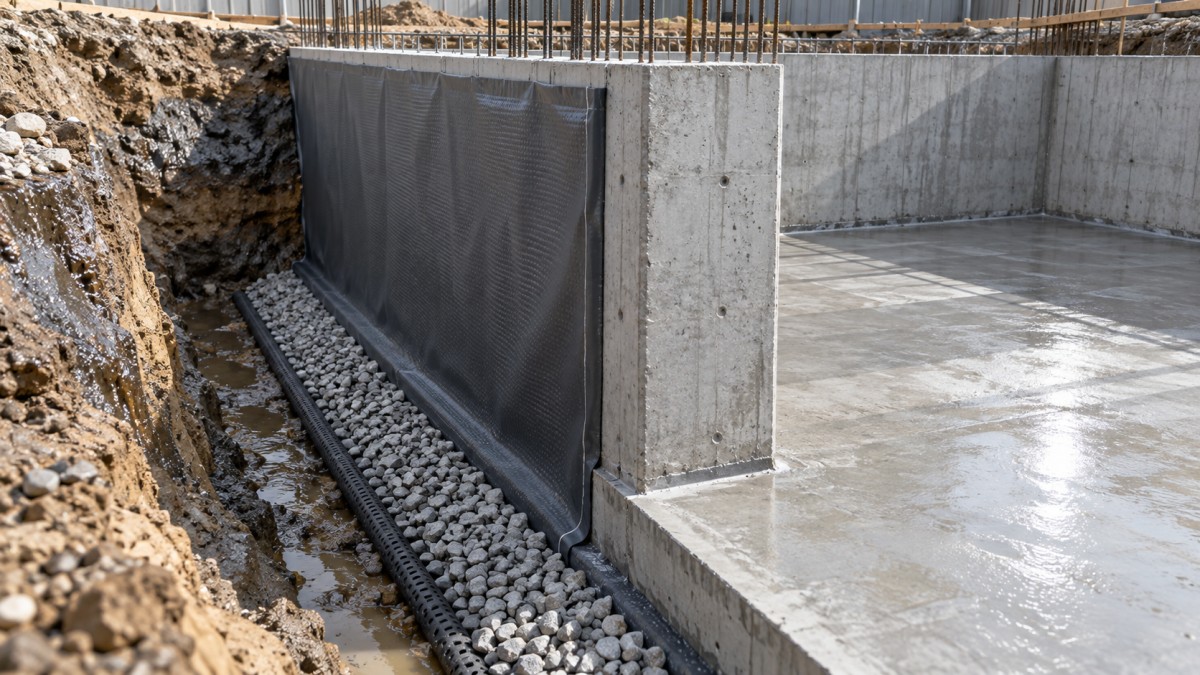
A bentonite membrane is particularly suitable where a new concrete foundation or wall will be poured directly against the waterproofing layer. The weight and stiffness of the structure, together with the backfill or soil pressure on the opposite side, create the confinement needed to control bentonite swelling. Once hydrated, the clay remains compressed in the assembly and can form a durable barrier against groundwater.
This makes the system especially relevant for:
- Basement foundation walls constructed against excavation support or retained soil;
- Underslab waterproofing beneath cast-in-place concrete slabs;
- Blind-side applications, where the exterior face of the wall cannot be accessed after construction;
- Retaining walls and below-grade podium structures;
- Elevator pits, utility rooms, and other localized below-grade elements;
- Infrastructure work where access for future external repairs will be limited.
Blind-side construction deserves special attention. On dense urban sites, a foundation wall may be poured against lagging, shotcrete, secant piles, soil retention systems, or an adjacent structure. Once the concrete is in place, there may be no workable exterior face for a conventional liquid-applied repair. In that scenario, a bentonite membrane can be an appealing option because it is installed before the wall is cast and is designed to bond through intimate contact with the concrete.
The appeal is not merely technical. It is a risk-management decision. Where future access is impossible or disruptive, a system that can accommodate minor localized defects through swelling may reduce the project’s exposure to difficult post-construction remediation.
Groundwater and hydrostatic pressure: suitable, but not a shortcut around design
Many below-grade projects consider bentonite membranes because groundwater is present or expected seasonally. The system can be suitable under hydrostatic conditions when it is properly specified, continuously installed, and confined by the completed assembly. However, groundwater pressure should never be evaluated in isolation.
The design team should understand the anticipated water table, the possibility of perched water, rainfall-driven fluctuations, drainage pathways, and the consequences of a drainage system becoming blocked or inoperative. A waterproofing membrane is one layer of protection; site drainage, foundation drainage, concrete detailing, joints, and waterstop strategy all affect the final outcome.
A common mistake is to assume that a membrane selection eliminates the need for drainage planning. It does not. Drainage can reduce the water load imposed on the structure, while waterproofing manages water that reaches the building envelope. On some projects, the membrane may be expected to resist full hydrostatic pressure. On others, it is part of a drained system. The specification should state which condition governs, rather than leaving the issue to assumption during construction.
Where water chemistry is unusual, the discussion becomes more specific. Sodium bentonite can be affected by water or soil containing elevated concentrations of certain dissolved salts, especially calcium and magnesium ions. These conditions can reduce the clay’s swelling behavior. A geotechnical report that mentions saline groundwater, contaminated fill, brackish conditions, industrial land history, or aggressive soil chemistry should trigger an early compatibility review with the membrane manufacturer and waterproofing designer. This is not a reason to rule out bentonite automatically; it is a reason to verify the formulation and system suitability before procurement.
Soil conditions that support—or complicate—the choice
Soil is not just the setting around below-grade waterproofing. For a bentonite membrane, it is part of the working environment. Fine-grained soils and well-compacted backfill generally provide the contact and confinement the system needs. In many conventional foundation excavations, this is a natural fit.
Challenges arise when the membrane is placed against coarse, open-graded, highly irregular, or void-forming materials. Large aggregate, uncompacted rock fill, drainage boards with pronounced void spaces, or rough shotcrete can create channels in which water may travel before the bentonite has sufficient confinement to seal. The membrane may need a compatible protection layer, smoothing course, detailing method, or a different waterproofing approach altogether.
Project managers should ask a simple field-oriented question: What will physically press against both sides of this membrane after the work is complete? If the answer is “cast concrete on one side and stable soil or a designed support surface on the other,” the application may be promising. If the answer involves open cavities, unstable backfill, loose rock, or drainage composites that leave extensive unconfined spaces, the team should pause and review the assembly.
Where a bentonite membrane is often the practical answer
The following conditions commonly point toward bentonite waterproofing as a viable solution:
- Limited exterior access: The wall will be blind-sided, adjacent to a property line, or inaccessible after concrete placement.
- Complex below-grade geometry: The project includes pile caps, grade beams, penetrations, corners, and transitions where a self-sealing layer can complement careful detailing.
- Cast-in-place concrete construction: Fresh concrete will form close, continuous contact with the membrane.
- Moist or wet ground conditions: The site needs a membrane system that is not dependent on a perfectly dry concrete substrate during installation.
- Repair access is costly: The building program, surrounding development, or infrastructure layout makes external excavation after completion highly undesirable.
- Coordinated joint design: Waterstops, termination details, penetrations, and construction joints can be integrated into a complete below-grade water-management strategy.
The reference to damp conditions is important. Some waterproofing products require a clean, dry, well-cured substrate to achieve adhesion. Bentonite membranes are often selected where installation conditions are less accommodating, particularly before concrete placement. Still, “tolerant of site moisture” should not be confused with “unaffected by poor housekeeping.” Standing water, muddy surfaces, torn material, and uncontrolled early hydration can compromise work quality.
Do not specify it by membrane alone
Below-grade failures frequently occur at transitions rather than across open wall areas. The main field of a bentonite membrane may look excellent, while a poorly treated corner, tie-back location, pipe penetration, cold joint, or termination becomes the route for water entry.
For that reason, the specification should define the whole assembly: laps, fastening method, protection requirements, corner treatment, waterstop interface, penetration detailing, repair procedures, and inspection hold points. It should also clarify responsibility. If the structural contractor installs the membrane while another contractor installs waterstops and a third team handles drainage, unassigned interfaces can become a serious project risk.
Construction sequencing deserves equal attention. Bentonite products must be protected from displacement before the concrete pour and from damage caused by reinforcement work, foot traffic, equipment, or backfilling. In underslab work, the membrane needs a stable substrate and disciplined coordination with rebar placement. On walls, installers need a plan for maintaining continuity around reinforcing steel congestion, formwork operations, and changing excavation conditions.
A useful pre-installation meeting should include the waterproofing installer, concrete contractor, structural representative, site superintendent, and quality-control personnel. The discussion should be practical: Where are the first pours? How will penetrations be recorded? Who inspects damaged areas? What happens if rain occurs before concrete placement? Which details require manufacturer review? These questions are far more valuable before the pour than after the basement is occupied.
Situations where another system may be better
A bentonite membrane is not automatically the best choice for every below-grade wall. It may be less suitable where the membrane cannot be adequately confined, where persistent voids are expected, or where the supporting surface is too irregular to permit continuity. Highly contaminated or chemically aggressive environments may also demand a product-specific assessment or an alternative barrier.
It can be a poor fit when the design requires a membrane to remain exposed for an extended period, when backfill cannot be controlled, or when the wall system is not cast-in-place concrete and cannot create the intended contact. Precast assemblies, masonry walls, certain insulated foundation systems, and walls subject to substantial differential movement may require a different strategy or specialized detailing.
Likewise, a project with severe structural movement expectations should not rely on self-sealing behavior as a substitute for movement-joint design. Expansion joints, seismic joints, and major construction joints need purpose-designed waterstops and compatible joint systems. Bentonite can play a role nearby, but it should not be asked to solve a movement condition beyond its intended application.
A decision screen for project managers
Before approving a bentonite membrane for below-grade waterproofing, bring the design and construction teams through a short but disciplined review:
- Confirm the structural assembly. Is the membrane confined between cast-in-place concrete and soil, shoring, or another stable support?
- Review groundwater assumptions. Is the system intended for damp-proofing, intermittent water, or sustained hydrostatic pressure?
- Check soil and water chemistry. Has the geotechnical information identified salinity, contamination, or other conditions requiring compatibility confirmation?
- Map discontinuities. Identify joints, penetrations, pile heads, corners, transitions, and terminations before material reaches the site.
- Assess the substrate. Will the membrane sit against a surface that is smooth enough and stable enough to avoid unconfined voids?
- Plan the installation sequence. Can the work be protected from rain, displacement, damage, and premature hydration until it is enclosed?
- Set inspection points. Establish who signs off on membrane continuity and detail repairs before concrete placement or backfill.
If these answers are clear, a bentonite membrane can be a highly sensible below-grade waterproofing choice—particularly for confined, cast-in-place, and hard-to-access conditions. If several answers remain uncertain, the better decision may be to resolve those uncertainties before selecting a system, rather than treating waterproofing as a line item to be finalized in the field.
The specification decision is really a constructability decision
For project leaders, the most useful way to evaluate a bentonite membrane is to look beyond product literature and visualize the finished assembly. Water will find the smallest unprotected route. Concrete will shrink and joints will be tested. Trades will work over the membrane before it is buried forever. The right system is the one that matches those realities, not simply the one with the most familiar name or the lowest initial installed cost.
When confinement is dependable, cast-in-place concrete is part of the design, groundwater exposure has been properly assessed, and details are controlled from drawing to pour, bentonite waterproofing offers a credible and practical defense for below-grade construction. Its value is strongest where the project team respects the conditions that make the material work—and coordinates the entire envelope accordingly.
Recommended News
- How to Compare Eco-Friendly Flooring Materials for High-Traffic Commercial SpacesOct 01, 2026Compare eco-friendly flooring materials for high-traffic commercial spaces with practical insights on durability, maintenance, lifecycle impact, and smarter specification choices.
- How to Specify Eco-Friendly Construction Materials for European Building ProjectsSep 29, 2026Eco-friendly construction materials Europe: learn how to specify durable, compliant, low-impact products with whole-life evidence, practical procurement checks, and buildable performance criteria.
- When is a bentonite membrane suitable for below-grade waterproofing?Sep 22, 2026Bentonite membrane suitability for below-grade waterproofing: assess confinement, groundwater pressure, soil chemistry, and installation details.
- Eco Construction for Warehouses: How to Cut Energy Use Without Disrupting OperationsSep 22, 2026Eco construction for warehouses: cut energy use with phased upgrades, smarter controls, and resilient materials—without disrupting logistics or daily operations.
- Energy-Efficient Construction Materials Manufacturing: Controlling Thermal PerformanceSep 16, 2026Energy-efficient construction materials manufacturing: control thermal performance through moisture management, process precision, and assembly-level verification.
- How to Define Technical Buying Criteria for Reliable Category ResearchSep 28, 2026Technical buying criteria for category research: build measurable requirements, assess risk, compliance, and lifecycle value for smarter supplier decisions.
- B2B Market Analysis Compliance Guide: How to Validate Data, Claims, and SourcesSep 25, 2026B2B market analysis compliance guide: learn to validate data, supplier claims, methodologies, and cross-border sources for credible, decision-ready market intelligence.
- When R&D in manufacturing is ready to move beyond the pilot stageSep 22, 2026R&D in manufacturing: discover the five signs your pilot is ready to scale, from process control and quality to integration, ownership, and real-world economics.
- How R&D in the manufacturing industry reduces scale-up riskSep 22, 2026r&d in manufacturing industry reduces scale-up risk with pilot builds, process validation, supplier alignment, and workforce readiness for more reliable launches.
- The most common supplier compliance requirements before onboardingSep 21, 2026Explore the most common supplier compliance requirements before onboarding, from legal checks and quality to ESG, cybersecurity, and supply continuity.
- Technology Advancements Dashboards: What Metrics Reveal Emerging Industry Shifts?Oct 02, 2026Technology advancements dashboard insights reveal investment, adoption, supply-chain, and policy signals—helping leaders spot real industry shifts before competitors.
- How to Compare Global Sourcing Information Before Shortlisting Overseas SuppliersSep 30, 2026Global sourcing information comparison made practical: verify suppliers, assess compliance, capacity, landed cost, and delivery risk before building a confident overseas shortlist.
- Battery Cage Price in Nigeria: Cost Drivers for Farm Project BudgetsSep 22, 2026Battery cage price in Nigeria explained: compare installed costs, steel quality, logistics, water systems and project budget risks before choosing poultry housing.
- How to Build a Poultry Equipment Price List for a New Farm SetupSep 22, 2026Poultry equipment price list guide for new farm setups: compare systems, uncover hidden costs, assess quality, and plan installation with confidence.
- Which digital export channels fit products with longer sales cycles?Sep 21, 2026Digital export channels for long sales cycles: learn how websites, industry platforms, marketplaces, and targeted outreach build trust, qualify buyers, and drive complex B2B export deals.
All Categories
Hot Articles
- Technology Advancements Dashboards: What Metrics Reveal Emerging Industry Shifts?Oct 02, 2026Technology advancements dashboard insights reveal investment, adoption, supply-chain, and policy signals—helping leaders spot real industry shifts before competitors.
- How to Compare Eco-Friendly Flooring Materials for High-Traffic Commercial SpacesOct 01, 2026Compare eco-friendly flooring materials for high-traffic commercial spaces with practical insights on durability, maintenance, lifecycle impact, and smarter specification choices.
- How to Compare Global Sourcing Information Before Shortlisting Overseas SuppliersSep 30, 2026Global sourcing information comparison made practical: verify suppliers, assess compliance, capacity, landed cost, and delivery risk before building a confident overseas shortlist.