
Energy-Efficient Construction Materials Manufacturing: Controlling Thermal Performance
TIME
Click count
A wall panel can leave the factory with an acceptable declared thermal value and still create a problem once it reaches a building envelope. A slight increase in insulation density, a wetter-than-expected core, an adhesive line that bridges two facing layers, or inconsistent glass coating application can change the heat-flow behavior that designers expected. The consequences are not limited to energy modeling: condensation risk, surface temperature, HVAC sizing, comfort complaints, and compliance documentation may all be affected.
The central rule in energy-efficient construction materials manufacturing is that thermal performance must be controlled as a system property, not treated as a single laboratory number. Manufacturers need to manage material composition, geometry, moisture, interfaces, curing, and quality verification together. Evaluators should therefore compare declared values with the conditions under which those values were measured, then determine whether routine production can reliably reproduce them.
Start with the heat-transfer mechanism, not the product label
Materials marketed as insulating, low-carbon, reflective, or high-performance do not reduce heat flow in the same way. A meaningful technical assessment begins by identifying the dominant mechanism:
- Conduction governs dense materials such as concrete, masonry, metals, glass, and many composite skins. Thermal conductivity, usually expressed as lambda (λ), is the principal property.
- Convection becomes important in cavities, porous structures, and glazing units. Air movement within voids can reduce the expected resistance of an otherwise low-conductivity assembly.
- Radiation matters across air gaps, through glazing, and at reflective surfaces. Surface emissivity, coating quality, and cavity design affect this component.
- Moisture transport can alter all three. Water usually conducts heat more readily than air, and wet materials may perform very differently from dry test specimens.
This distinction prevents a frequent evaluation error: selecting a material solely by its nominal conductivity while ignoring the assembly in which it will operate. A highly insulating core can lose much of its advantage when interrupted by conductive fasteners, framing members, panel joints, mortar beds, or poorly designed edge details. Likewise, a reflective layer cannot be judged by reflectance alone when it is installed in direct contact with another material and lacks the air space needed for radiative control.
Declared, design, and in-service values are not interchangeable
Thermal data is useful only when its basis is clear. A declared value is generally tied to controlled product testing and defined reference conditions. A design value may incorporate allowances for moisture, aging, density variation, installation orientation, or other service conditions. The in-service result depends on the actual assembly, workmanship, local climate, and degradation exposure.
When reviewing a technical data package, ask four direct questions:
- Was the reported conductivity measured on a dry specimen, at a reference moisture state, or after conditioning?
- What specimen thickness, density, orientation, and temperature range were used?
- Does the reported resistance apply to the material itself, a finished panel, or a complete wall or roof assembly?
- Which production variables are controlled to keep routine output within the tested range?
A low λ value does not automatically produce a high R-value in use. Thickness remains a direct part of the calculation, and nonuniform thickness can create weak zones across large boards or panels. For insulated products, the relationship is often expressed as R = d/λ, where d is thickness. That equation is useful for preliminary comparison, but it does not account for thermal bridges, joints, moisture, or air leakage. It should not be used as a substitute for assembly-level analysis.
Where manufacturing variation changes thermal performance
The production line is where many thermal properties are gained or lost. The most relevant control points differ by material family, but several patterns recur.
Porous insulation and lightweight boards
Mineral-based insulation, cellular polymers, fiber boards, aerated products, and other porous materials rely on controlled internal structure. Small shifts in pore size, cell openness, fiber orientation, binder distribution, or compaction can change heat flow. Density deserves careful interpretation. Higher density can improve mechanical integrity in some products, yet it may also raise conductivity when more solid material replaces still air. Lower density is not automatically better either; it can lead to collapse, air movement, poor dimensional stability, or insufficient strength.
Control plans should link raw-material consistency to the finished microstructure. Incoming fiber, resin, blowing agents, fillers, recycled content, and moisture-bearing ingredients all require defined acceptance limits. During forming and curing, manufacturers should monitor basis weight, thickness, oven profile, pressure, line speed, and post-cure conditioning. Sampling only at the end of a shift can miss drift that occurred during startup, material changeover, or temperature adjustment.
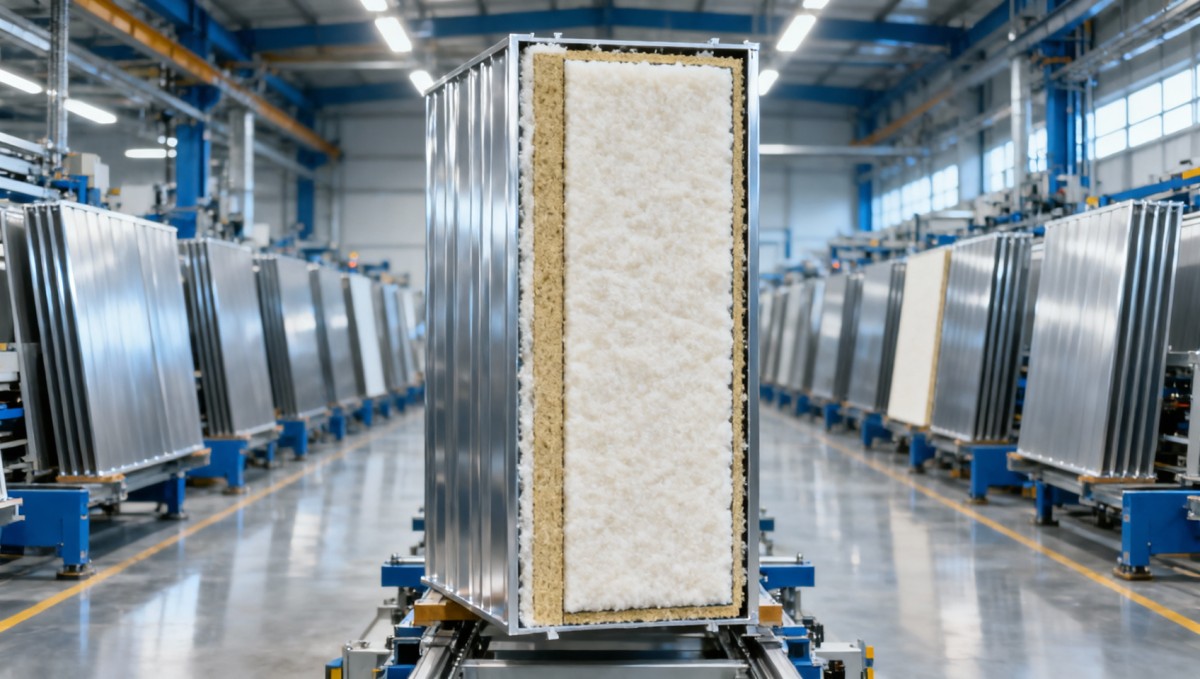
Insulated composite panels
Composite panels introduce an interface problem. The core may have a favorable conductivity, while the facings, adhesives, rails, fasteners, and edge treatments establish alternate paths for heat transfer. A continuous metal facing is particularly sensitive because it can carry heat laterally to a joint or fixing point. The relevant question is not merely “What is the core insulation value?” but “How does the full panel behave at seams, edges, penetrations, and supports?”
Bond-line thickness and adhesive placement must be repeatable. Excess adhesive or a locally compressed core can form a thermal bridge. Gaps, voids, or weak adhesion may introduce air movement and moisture pathways. Dimensional control also matters: uneven panel geometry can produce joint gaps that are later masked during installation but remain significant to thermal and airtightness performance.
Low-carbon concrete, masonry, and cement-based materials
Concrete and masonry are generally not insulation materials, but their thermal mass, conductivity, and interaction with insulation can materially influence envelope performance. Lower-carbon binders, supplementary cementitious materials, lightweight aggregates, and recycled constituents may change pore structure, moisture behavior, and density. A mix designed primarily around compressive strength or embodied-carbon targets should not be assumed to have unchanged thermal properties.
Batch water is a major variable. It affects workability and curing, but it also influences capillary pore formation and the moisture condition of the finished unit. In precast or block manufacturing, curing temperature and duration can alter hydration, shrinkage, and internal moisture. Products tested shortly after curing may not represent the state at delivery or equilibrium in a completed building. Thermal evaluation should therefore be paired with water absorption, drying behavior, and dimensional stability data where those characteristics affect the intended use.
High-performance glazing
Glazing performance is controlled by more than glass thickness. Coating emissivity, coating orientation, cavity width, gas fill, spacer construction, seal integrity, and frame interaction all influence center-of-glass and whole-window behavior. A coating applied outside its target thickness range may change solar and infrared properties. Contamination, handling damage, or incorrect assembly orientation can undermine an otherwise suitable glass specification.
Insulating glass units require particular discipline around cavity control and edge sealing. A unit can have good initial performance while carrying a higher long-term risk if sealant application, desiccant handling, spacer geometry, or gas-fill verification is inconsistent. Evaluators should distinguish center-of-glass values from whole-product values, since edge zones and frames often contribute disproportionately to heat loss.
Moisture is often the hidden reason values do not match
When field performance appears weaker than the thermal schedule, moisture should be considered early rather than treated as a secondary issue. Hygroscopic materials may absorb moisture during storage or transport. Cementitious products may leave production with elevated internal water. Open-cell insulation may be exposed to rain before enclosure. Even a product with a vapor-resistant facing can be affected through unsealed cuts, joints, or fastener penetrations.
The practical response is not simply to request a dry-state conductivity report. Review the moisture assumptions used in thermal calculations, then compare them with production, packaging, storage, and installation conditions. Materials intended for humid, below-grade, ventilated-cavity, roof, or intermittently wet environments need appropriate assembly design as well as material data. Vapor control, drainage, ventilation, and drying potential are construction details, but manufacturing can support them through stable facings, reliable edge treatment, controlled water absorption, and clear handling limits.
A production control plan should connect process data to thermal risk
Testing finished products is essential, but thermal testing can be too slow or too costly to serve as the only production control. A stronger approach identifies process measurements that correlate with thermal behavior and establishes action limits before final-product failure occurs.
Each control needs a defined response. For example, a thickness deviation may trigger additional sampling, a line-speed review, and segregation of affected production lots. A change in raw material should not be handled as a purely purchasing issue when it can alter density, moisture uptake, pore structure, or coating adhesion. Traceability is especially useful when thermal verification is performed on periodic samples rather than every unit. It allows the tested specimen to be tied back to batch records, equipment settings, and curing conditions.
Test the right level of the construction system
Material tests answer one question: how readily does a specimen transmit heat under defined conditions? They do not fully answer how a wall, roof, floor, or façade behaves. The appropriate verification level depends on the risk being evaluated.
- Material-level testing is suitable for confirming conductivity, density-related behavior, and lot-to-lot consistency.
- Component-level testing is appropriate for boards, blocks, insulated panels, or glazing units where product geometry and interfaces are part of the performance claim.
- Assembly-level calculation or testing becomes necessary when framing, fasteners, joints, cavities, air barriers, and repeating bridges have a meaningful effect.
Do not combine values from separate material data sheets as though all layers were continuous and perfectly installed. Steel rails, concrete slab edges, curtain-wall anchors, roof fasteners, and window perimeters can dominate localized heat loss. Two assemblies with the same nominal insulation thickness may therefore have substantially different effective thermal resistance. Thermal-bridge modeling or an equivalent validated assessment is warranted where repeating structural elements or complex penetrations are present.
Common evaluation mistakes that lead to weak specifications
One mistake is specifying only a maximum conductivity and minimum thickness. This leaves unresolved how the material will perform after aging, moisture exposure, compression, or fabrication into a larger product. Another is accepting a test report without confirming specimen identity, conditioning state, and applicability to the supplied configuration.
It is also risky to treat production tolerances as purely visual or dimensional matters. Thickness tolerance, squareness, flatness, core alignment, and coating placement can all influence thermal continuity at joints. A panel that is technically within nominal dimensions may still create uneven contact or oversized gaps when repeated across an elevation.
Finally, operational changes should be reviewed through a thermal lens. A new binder, recycled feedstock, curing schedule, coating supplier, adhesive, packaging method, or line speed can be commercially reasonable while still requiring revalidation. Change control should define which modifications need a document review, which require retained-sample comparison, and which require renewed thermal testing.
Making the final technical decision
A robust specification identifies the thermal property required, the condition under which it applies, the product geometry, the relevant tolerances, and the assembly features that can reduce effective performance. It also identifies the evidence needed from manufacturing: process controls, batch traceability, sampling frequency, and change-management records. This is more useful than requesting a single “high insulation” claim because it gives reviewers a way to determine whether thermal performance remains stable beyond the original test specimen.
For products used in moisture-sensitive or bridge-prone assemblies, the final review should include the installation detail, not just the factory data. A material may be technically suitable but require continuous insulation, protected edges, compatible vapor control, or revised fastening geometry to achieve the intended result. Controlling thermal performance is therefore a shared task between product manufacturing and envelope design, with the manufacturing evidence establishing the reliability of the material portion of that system.
Recommended News
- Eco Construction for Warehouses: How to Cut Energy Use Without Disrupting OperationsSep 22, 2026Eco construction for warehouses: cut energy use with phased upgrades, smarter controls, and resilient materials—without disrupting logistics or daily operations.
- Energy-Efficient Construction Materials Manufacturing: Controlling Thermal PerformanceSep 16, 2026Energy-efficient construction materials manufacturing: control thermal performance through moisture management, process precision, and assembly-level verification.
- Sustainable Home Decor: How to Choose Materials That Are Safer and Built to LastSep 15, 2026Sustainable home decor made simple: discover safer, durable materials, low-emission finishes, and practical tips for creating a beautiful home built to last.
- Technical Buying Criteria for Green Materials in High-Performance Building ProjectsSep 09, 2026Technical buying criteria for green materials: evaluate carbon data, durability, fire safety, lifecycle cost, circularity, and supply risk for high-performance building projects.
- How to Select Green Building Products for Low-Carbon Commercial ProjectsSep 08, 2026Green building products guide for low-carbon commercial projects: compare EPDs, lifecycle carbon, performance, procurement risk, and durable system fit.
- How R&D in the manufacturing industry reduces scale-up riskSep 22, 2026r&d in manufacturing industry reduces scale-up risk with pilot builds, process validation, supplier alignment, and workforce readiness for more reliable launches.
- Can Bulldozers Be Adapted for Precision Agriculture Applications?Sep 16, 2026Can bulldozers be converted for precision agriculture applications? Discover how guided grading, soil protection, and data-driven planning improve farm infrastructure.
- REACH Compliance in B2B Market Analysis: Assessing Supplier Risk and Market AccessSep 12, 2026B2B market analysis REACH compliance: assess supplier risk, strengthen evidence controls, and protect EEA market access with practical sourcing insights.
- Analyzing Pressure Ratings in Technical Specifications for Safe Equipment SelectionSep 10, 2026Technical specifications analysis for pressure rating selection: learn how to assess temperature, materials, transients, and connections for safer equipment choices.
- How Often Should Heavy Excavators Be Serviced in Mining Operations?Sep 03, 2026What are the maintenance intervals for heavy excavators in mining? Discover practical service schedules, severe-duty adjustments, oil analysis, and uptime-focused maintenance tips.
- Prefab Building Cost Factors: How to Budget for Design, Transport, and Site WorkSep 17, 2026Explore prefab building cost factors and learn how to budget smarter for design, transport, foundations, utilities, installation, and approvals.
- Which Emerging Destinations Offer the Best Manufacturing Tax Incentives in 2026?Sep 03, 2026What emerging destinations offer the best manufacturing tax incentives 2026? Compare Vietnam, India, Morocco, Egypt, and Gulf zones for tax, duty, and export advantages.
- Can Data Analysis Tools Detect Supplier Fraud in Procurement Data?Sep 03, 2026Can data analysis tools detect supplier fraud in procurement data? Discover key red flags, analytics methods, and practical controls to investigate risks sooner.
- What are the current pricing structures for industrial automation solutions?Sep 03, 2026What are the current pricing structures for industrial automation solutions? Compare upfront, subscription, usage-based, RaaS, and lifecycle costs to make smarter investment decisions.
- How German bulk pricing changes the cost of industrial machinerySep 03, 2026Industrial machinery and supplies price list and bulk purchase costs in Germany: uncover real savings across equipment, logistics, service, and compliance.
All Categories
Hot Articles
- How to Evaluate a Digital Transformation Platform for Enterprise-Wide IntegrationSep 23, 2026Digital transformation platform evaluation guide for enterprise-wide integration—compare security, scalability, data governance, costs, and proof-of-value criteria.
- How R&D in the manufacturing industry reduces scale-up riskSep 22, 2026r&d in manufacturing industry reduces scale-up risk with pilot builds, process validation, supplier alignment, and workforce readiness for more reliable launches.
- Eco Construction for Warehouses: How to Cut Energy Use Without Disrupting OperationsSep 22, 2026Eco construction for warehouses: cut energy use with phased upgrades, smarter controls, and resilient materials—without disrupting logistics or daily operations.