
East China's First China-Vietnam 'Railway Express' Launches
TIME
Click count
On May 20, 2026, the first China–Vietnam 'Railway Express' service under the 'railway fast clearance' framework departed from Ningbo in East China, marking a structural shift in cross-border logistics for green building materials and prefabricated housing exports to Vietnam and the broader ASEAN region. The initiative—enabled by a bilateral customs facilitation mechanism between China’s General Administration of Customs and Vietnam’s Ministry of Industry and Trade—directly addresses long-standing bottlenecks in transit time, carbon reporting consistency, and documentation redundancy.
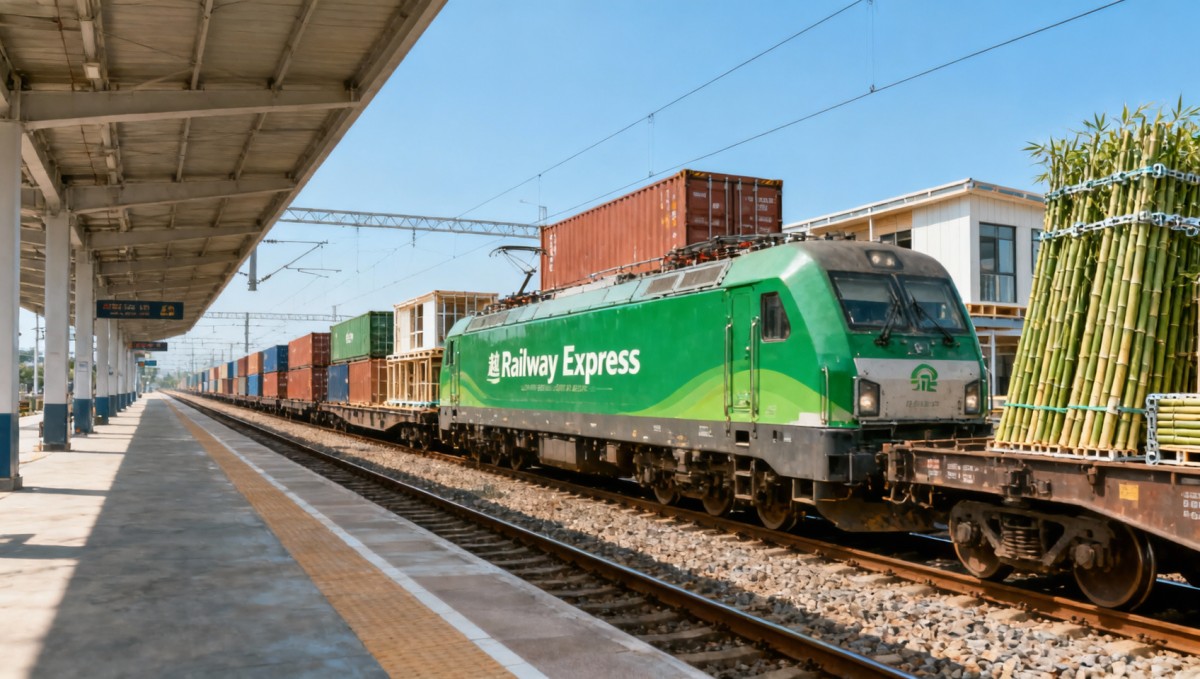
Event Overview
On May 20, 2026, the inaugural China–Vietnam 'Railway Express' train departed Ningbo carrying bamboo-based green building materials, modular prefabricated housing units, and low-carbon connection components. It arrived at Gia Lam Station in Hanoi without intermediate transshipment or repeated customs inspections. Under the joint mechanism, end-to-end clearance is completed within 24 hours.
Industries Affected
Direct Export Enterprises: Companies exporting green building systems or off-site construction solutions to Vietnam now benefit from predictable delivery windows (reduced by up to 60% versus prior rail–road hybrid routes) and verifiable Scope 3 emissions data—critical for ESG disclosures and tender compliance in ASEAN public infrastructure projects.
Raw Material Sourcing Firms: Suppliers of certified bamboo, recycled steel, and bio-based insulation face heightened demand for traceable, export-grade certification (e.g., FSC, EPD, ISO 14040-compliant LCA reports), as buyers increasingly require upstream environmental credentials to support downstream carbon claims.
Manufacturing & Assembly Plants: Producers of modular housing units must adapt production scheduling to align with fixed weekly train departures—not just port-based vessel slots—and integrate standardized packaging and unitized loading protocols compatible with China–Vietnam rail gauge and customs pre-arrival data submission requirements.
Logistics & Compliance Service Providers: Freight forwarders and customs brokers specializing in green construction exports must now offer integrated 'one declaration, full journey' support—including pre-filing of Vietnamese import declarations, real-time rail tracking linked to Vietnamese Single Window, and bilingual technical documentation validation—beyond traditional paper-based coordination.
Key Considerations and Recommended Actions
Validate Product Classification Under the New Fast Clearance Regime
Not all green building components automatically qualify; exporters must confirm Harmonized System (HS) codes against the jointly published 'Eligible Goods List' issued by both customs authorities. Bamboo-derived panels and structural connectors have been explicitly included—but composite cladding with >15% synthetic resin may require case-by-case review.
Align Carbon Accounting Protocols with Vietnamese Importer Requirements
Vietnamese procurement agencies are beginning to request embedded carbon data per unit (kg CO₂e/m²), calculated using Vietnam’s national LCA guidelines. Exporters should proactively adopt interoperable digital product passports—not just PDF EPDs—to ensure seamless data exchange across the rail corridor.
Secure Slot Allocation Early in the Monthly Cycle
The Ningbo–Hanoi 'Railway Express' operates on a fixed weekly schedule with limited capacity. First-come, first-served slot booking opens on the 1st of each month via the Zhejiang International Trade 'Single Window' portal; delays beyond the 5th often result in wait times exceeding two weeks.
Editorial Perspective / Industry Observation
Observably, this is not merely a logistics upgrade—it reflects an emerging regulatory alignment between China and ASEAN on sustainable infrastructure trade standards. Analysis shows that the 24-hour clearance window was achieved not only through procedural streamlining but also via synchronized digital infrastructure: both sides now accept identical XML schemas for cargo manifests and environmental declarations. That interoperability layer—rather than speed alone—is what makes replication to Laos or Cambodia more feasible than previous bilateral rail pacts. From an industry perspective, this signals a pivot from 'cost-driven sourcing' toward 'compliance-coordinated supply chains', where regulatory harmonization becomes a competitive differentiator.
Conclusion
This launch represents a calibrated step toward institutionalizing low-carbon trade corridors—not just for green building goods, but as a testbed for broader ASEAN–China environmental trade governance. It does not eliminate non-tariff barriers overnight, but it establishes a replicable model where speed, transparency, and sustainability are co-designed—not traded off.
Source Attribution
Official announcements issued by China’s General Administration of Customs (GACC Notice No. 2026-41) and Vietnam’s Ministry of Industry and Trade (Decision 788/QĐ-BCT, dated May 15, 2026). Data on transit time and eligibility criteria confirmed via the Zhejiang Provincial Government’s Cross-Border Trade Facilitation Dashboard (updated May 19, 2026). Note: Implementation details for secondary ASEAN destinations (e.g., Thailand, Indonesia) remain under inter-ministerial consultation and are subject to change.
Recommended News
- How to Compare Eco-Friendly Flooring Materials for High-Traffic Commercial SpacesOct 01, 2026Compare eco-friendly flooring materials for high-traffic commercial spaces with practical insights on durability, maintenance, lifecycle impact, and smarter specification choices.
- How to Specify Eco-Friendly Construction Materials for European Building ProjectsSep 29, 2026Eco-friendly construction materials Europe: learn how to specify durable, compliant, low-impact products with whole-life evidence, practical procurement checks, and buildable performance criteria.
- When is a bentonite membrane suitable for below-grade waterproofing?Sep 22, 2026Bentonite membrane suitability for below-grade waterproofing: assess confinement, groundwater pressure, soil chemistry, and installation details.
- Eco Construction for Warehouses: How to Cut Energy Use Without Disrupting OperationsSep 22, 2026Eco construction for warehouses: cut energy use with phased upgrades, smarter controls, and resilient materials—without disrupting logistics or daily operations.
- Energy-Efficient Construction Materials Manufacturing: Controlling Thermal PerformanceSep 16, 2026Energy-efficient construction materials manufacturing: control thermal performance through moisture management, process precision, and assembly-level verification.
- How to Specify Manufacturing Equipment Systems for Throughput, Uptime, and SafetyOct 05, 2026Manufacturing equipment systems: learn how to specify sustained throughput, uptime, safety, controls, and acceptance tests for dependable production.
- How to Define Technical Buying Criteria for Reliable Category ResearchSep 28, 2026Technical buying criteria for category research: build measurable requirements, assess risk, compliance, and lifecycle value for smarter supplier decisions.
- B2B Market Analysis Compliance Guide: How to Validate Data, Claims, and SourcesSep 25, 2026B2B market analysis compliance guide: learn to validate data, supplier claims, methodologies, and cross-border sources for credible, decision-ready market intelligence.
- When R&D in manufacturing is ready to move beyond the pilot stageSep 22, 2026R&D in manufacturing: discover the five signs your pilot is ready to scale, from process control and quality to integration, ownership, and real-world economics.
- How R&D in the manufacturing industry reduces scale-up riskSep 22, 2026r&d in manufacturing industry reduces scale-up risk with pilot builds, process validation, supplier alignment, and workforce readiness for more reliable launches.
- Technology Advancements Dashboards: What Metrics Reveal Emerging Industry Shifts?Oct 02, 2026Technology advancements dashboard insights reveal investment, adoption, supply-chain, and policy signals—helping leaders spot real industry shifts before competitors.
- How to Compare Global Sourcing Information Before Shortlisting Overseas SuppliersSep 30, 2026Global sourcing information comparison made practical: verify suppliers, assess compliance, capacity, landed cost, and delivery risk before building a confident overseas shortlist.
- Battery Cage Price in Nigeria: Cost Drivers for Farm Project BudgetsSep 22, 2026Battery cage price in Nigeria explained: compare installed costs, steel quality, logistics, water systems and project budget risks before choosing poultry housing.
- How to Build a Poultry Equipment Price List for a New Farm SetupSep 22, 2026Poultry equipment price list guide for new farm setups: compare systems, uncover hidden costs, assess quality, and plan installation with confidence.
- Which digital export channels fit products with longer sales cycles?Sep 21, 2026Digital export channels for long sales cycles: learn how websites, industry platforms, marketplaces, and targeted outreach build trust, qualify buyers, and drive complex B2B export deals.
All Categories
Hot Articles
- How to Specify Manufacturing Equipment Systems for Throughput, Uptime, and SafetyOct 05, 2026Manufacturing equipment systems: learn how to specify sustained throughput, uptime, safety, controls, and acceptance tests for dependable production.
- Inbound Tourism Planning: How Destinations Can Build Visitor-Ready ExperiencesOct 04, 2026Inbound tourism planning helps destinations create reliable, visitor-ready journeys through seamless arrivals, mobility, access, safety, and service operations. Explore practical strategies.
- How to Choose Translation Services for Technical Documents and Global ProjectsOct 03, 2026Translationservices guide for technical documents and global projects: evaluate expertise, terminology control, quality assurance, security, and delivery for reliable results.