
2026 World Intelligent Industry Expo Highlights AI+Green Materials in Tianjin
TIME
Click count
The 2026 World Intelligent Industry Expo opened in Tianjin on May 28–31, 2026, with ‘AI+Green Materials’ emerging as a new focal point for cross-border procurement. The event marks the first dedicated joint exhibition zone for ‘Green Building Materials × AI Empowerment’, drawing attention from international construction developers, EPC contractors, and green certification bodies—particularly those evaluating suppliers against EPD, Declare Label, and LEED v5 requirements.
Event Overview
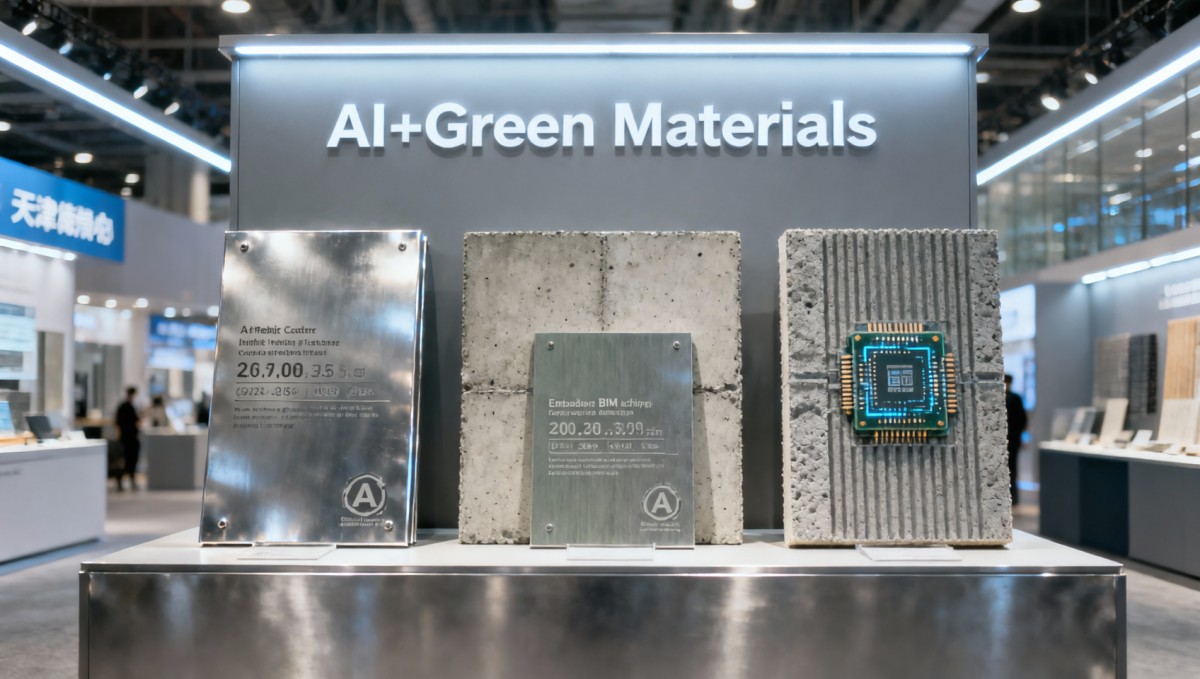
Held from May 28 to 31, 2026, in Tianjin, the 2026 World Intelligent Industry Expo featured a newly introduced ‘Green Building Materials × AI Empowerment’ joint exhibition zone. This zone showcased prefabricated building materials equipped with carbon footprint tracking capabilities, self-healing coatings, and digital twin BIM interfaces. Multiple international architectural developers, engineering-procurement-construction (EPC) contractors, and green building certification institutions conducted on-site targeted procurement matchmaking, with explicit emphasis on Chinese suppliers compliant with Environmental Product Declaration (EPD), Declare Label, and LEED v5 standards.
Impact on Specific Industry Segments
Direct Exporters and Cross-Border Trading Firms
These firms are directly affected due to heightened demand for certified green building products integrated with AI-enabled functionalities. Impact manifests in increased inquiry volume for EPD-verified, BIM-compatible, and carbon-tracked materials—and tighter alignment requirements with overseas green rating systems.
Raw Material Sourcing and Input Suppliers
Suppliers of base materials (e.g., low-carbon cement additives, bio-based resins, smart pigments) face upstream pressure to support downstream traceability and performance validation. Impact includes growing requests for material-level environmental data and compatibility documentation for AI-integrated construction workflows.
Prefabricated Component Manufacturers
Manufacturers of structural and cladding elements are impacted by the convergence of digital twin readiness, self-repair functionality, and third-party green labeling. Impact centers on product development timelines, testing protocols, and certification coordination—especially where digital interface specifications (e.g., IFC/BIM interoperability) intersect with sustainability claims.
Supply Chain and Certification Support Providers
Logistics integrators, verification bodies, and digital platform operators serving the construction supply chain face demand for end-to-end transparency tools—such as blockchain-backed carbon tracking or automated EPD generation modules. Impact appears in service scope expansion and integration requirements with both manufacturing ERP and green rating platforms.
What Relevant Companies or Practitioners Should Focus On — and How to Respond Now
Monitor official updates on export-related green compliance guidance
China’s Ministry of Housing and Urban-Rural Development and the China Green Building Council have not yet issued formal implementation guidelines for LEED v5-aligned domestic certification pathways. Current procurement interest at the Expo signals early market pull—not regulatory mandate. Companies should track upcoming technical circulars and pilot program announcements before committing to full-scale certification investments.
Prioritize verification-ready product lines with dual AI and green attributes
Among existing offerings, focus on products already supporting carbon footprint calculation (e.g., via LCA software integration), possessing standardized BIM object libraries, or demonstrating measurable self-healing performance under ASTM/EN test methods. These represent lowest-friction entry points for near-term cross-border qualification.
Distinguish between buyer-led specification requests and standardized procurement criteria
Several attending EPC firms issued bespoke RFP language referencing ‘real-time carbon dashboard integration’ or ‘Declare Label–compliant ingredient disclosure’. These remain project-specific asks—not industry-wide requirements. Firms should document such requests separately and assess scalability only after observing repetition across ≥3 independent buyers.
Prepare internal alignment between sustainability, digital, and export teams
Product data required for EPD and BIM interoperability often reside in separate departments (e.g., environmental affairs vs. IT vs. international sales). Cross-functional working groups should convene now to map data ownership, define shared terminology (e.g., ‘carbon intensity per m³’ vs. ‘embodied carbon per functional unit’), and align on minimum viable documentation packages for initial buyer outreach.
Editorial Perspective / Industry Observation
Observably, this Expo does not signal immediate regulatory change—but rather reflects accelerating convergence between two parallel trends: global green building standard evolution (notably LEED v5’s enhanced operational and embodied carbon requirements) and industrial AI deployment in construction supply chains. Analysis shows that ‘AI+Green Materials’ is currently functioning as a procurement filter, not a certification threshold. From an industry perspective, its significance lies less in technical novelty and more in the co-location of demand signals: buyers are no longer evaluating AI capability and green compliance in isolation, but as interdependent system requirements. This suggests a shift from additive feature development toward integrated product architecture planning.
Current more appropriate interpretation is that this represents an early-stage market signal—not a mature commercial requirement. While vendor engagement was active at the Expo, no binding MOUs or volume commitments were publicly announced. Sustained attention is warranted, but premature scaling of AI-green integration infrastructure carries execution risk absent further buyer validation beyond single-event interest.
Conclusion: The 2026 World Intelligent Industry Expo underscores a tangible, near-term shift in how international construction stakeholders evaluate Chinese building material suppliers—not solely on cost or compliance, but on demonstrable interoperability between sustainability verification and digital construction workflows. For industry participants, this is best understood not as an urgent compliance deadline, but as a directional cue toward integrated product data management and cross-disciplinary collaboration. Responsive action now centers on structured observation, selective capability alignment, and internal process harmonization—not wholesale technology or certification overhauls.
Source: Official announcements from the 2026 World Intelligent Industry Expo Organizing Committee; publicly reported exhibition zone details and participant statements released May 28–31, 2026. Note: LEED v5 implementation timelines outside the U.S., EPD adoption rates among Chinese exporters, and Declare Label acceptance by non-U.S. certifiers remain under observation and are not confirmed by current sources.
Recommended News
- Grid Modernization for Utilities: A Practical Roadmap for Integrating DERsOct 12, 2026Grid modernization for utilities: explore a practical roadmap to integrate DERs, improve feeder visibility, manage voltage and protection risks, and prioritize high-value grid upgrades.
- Eco-Friendly Construction: How Project Teams Cut Carbon Without Compromising PerformanceOct 11, 2026Eco-friendly Construction strategies that help project teams cut lifecycle carbon, control costs and risk, improve procurement, and deliver high-performing assets.
- CE Prefab Houses: Which Components Require CE Marking Before Project Approval?Oct 10, 2026CE prefab houses: learn which components need CE marking before approval, from structural steel and windows to fire protection and MEP systems.
- Which Prefabricated Housing System Fits Your Site, Climate, and Build Schedule?Oct 09, 2026Prefabricated housing building systems compared: choose modular, panelized, or hybrid solutions for site access, climate resilience, cost control, and faster delivery.
- Vietnam Precast Concrete Market: Demand Drivers, Capacity, and Buyer RisksOct 09, 2026Vietnam precast concrete market insights: assess demand drivers, production capacity, logistics, quality compliance, and buyer risks for smarter sourcing and investment decisions.
- CE Prefab Houses: Which Components Require CE Marking Before Project Approval?Oct 10, 2026CE prefab houses: learn which components need CE marking before approval, from structural steel and windows to fire protection and MEP systems.
- How to Evaluate Technology Options Against Inspection Standards for Project ApprovalOct 07, 2026Technology option analysis inspection standards: compare evidence, testing, compliance, and lifecycle risk to make faster, approval-ready project decisions.
- How to Specify Manufacturing Equipment Systems for Throughput, Uptime, and SafetyOct 05, 2026Manufacturing equipment systems: learn how to specify sustained throughput, uptime, safety, controls, and acceptance tests for dependable production.
- How to Define Technical Buying Criteria for Reliable Category ResearchSep 28, 2026Technical buying criteria for category research: build measurable requirements, assess risk, compliance, and lifecycle value for smarter supplier decisions.
- B2B Market Analysis Compliance Guide: How to Validate Data, Claims, and SourcesSep 25, 2026B2B market analysis compliance guide: learn to validate data, supplier claims, methodologies, and cross-border sources for credible, decision-ready market intelligence.
- Vietnam Precast Concrete Market: Demand Drivers, Capacity, and Buyer RisksOct 09, 2026Vietnam precast concrete market insights: assess demand drivers, production capacity, logistics, quality compliance, and buyer risks for smarter sourcing and investment decisions.
- Technology Advancements Dashboards: What Metrics Reveal Emerging Industry Shifts?Oct 02, 2026Technology advancements dashboard insights reveal investment, adoption, supply-chain, and policy signals—helping leaders spot real industry shifts before competitors.
- How to Compare Global Sourcing Information Before Shortlisting Overseas SuppliersSep 30, 2026Global sourcing information comparison made practical: verify suppliers, assess compliance, capacity, landed cost, and delivery risk before building a confident overseas shortlist.
- Battery Cage Price in Nigeria: Cost Drivers for Farm Project BudgetsSep 22, 2026Battery cage price in Nigeria explained: compare installed costs, steel quality, logistics, water systems and project budget risks before choosing poultry housing.
- How to Build a Poultry Equipment Price List for a New Farm SetupSep 22, 2026Poultry equipment price list guide for new farm setups: compare systems, uncover hidden costs, assess quality, and plan installation with confidence.
All Categories
Hot Articles
- Grid Modernization for Utilities: A Practical Roadmap for Integrating DERsOct 12, 2026Grid modernization for utilities: explore a practical roadmap to integrate DERs, improve feeder visibility, manage voltage and protection risks, and prioritize high-value grid upgrades.
- Eco-Friendly Construction: How Project Teams Cut Carbon Without Compromising PerformanceOct 11, 2026Eco-friendly Construction strategies that help project teams cut lifecycle carbon, control costs and risk, improve procurement, and deliver high-performing assets.
- CE Prefab Houses: Which Components Require CE Marking Before Project Approval?Oct 10, 2026CE prefab houses: learn which components need CE marking before approval, from structural steel and windows to fire protection and MEP systems.